The Senate on Tuesday evening passed an immigration bill that would make certain areas off-limits for immigration officers to detain people, create a process for residents to sue federal agents for violating their constitutional rights and limit the use and sharing of data from automatic license plate readers.
The bill is a combination of several pieces of legislation aimed at holding federal agents accountable for actions taken against residents.
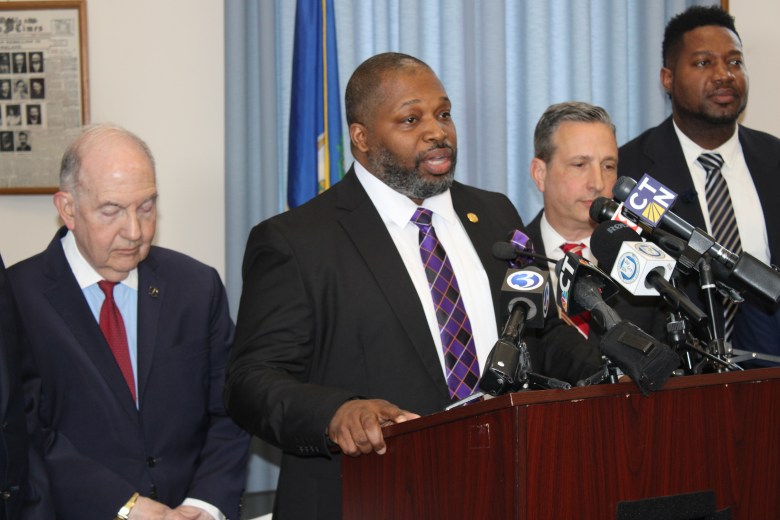
In a press conference earlier Tuesday, Democrats said the new law was necessary to protect Connecticut residents.
“We should not have a bill that we have to run in state government to protect us from the federal government,” said Senate Majority Leader Bob Duff, D-Norwalk. “ We are in authoritarian times right now through the federal government, but thankfully, because of federalism, because of state’s rights, we are able to respond to the excesses and the power grab from the federal government.”
But Republicans said the bill would have no legal jurisdiction over federal immigration officers.
“ Everything in the bill related to ICE is absolutely superfluous. We do not have the authority in the state of Connecticut to tell ICE where they can and can’t go and what the procedures are,” said Sen. Minority Leader Stephen Harding, R-Brookfield. “ You cannot override the federal government. It’s that simple.”
In a special session in November, the legislature passed a bill, largely on party lines, limiting the actions federal authorities can take at courthouses and prohibiting state agencies from widely sharing state residents’ personal information.
The current bill expands some of those protections.
The bill includes a section that allows state residents to sue federal law enforcement agents for violations of their constitutional rights, a proposal created in response to the shooting of Alex Pretti by a U.S. Border Patrol officer in Minneapolis in January. It gives the state Inspector General the right to investigate the use of deadly force by federal agents, or the death of someone who was in the custody of federal agents, and it removes immunity from officers who arrest or assault someone taking photos or videotaping their actions.
The bill also establishes “protected areas” — including schools, hospitals, social service agencies and houses of worship — where people cannot be arrested solely on the basis of a civil offense, such as an immigration violation. It prohibits law enforcement officers from wearing masks while on duty. It bans former federal law enforcement officers who were found to be guilty of misconduct or retired during an investigation from being hired by Connecticut state or local police, and it requires police officers to complete 480 hours of training before they can be hired by state agencies.
The proposal for establishing protected areas drew a lot of support in a public hearing in March, where members of immigrant advocacy groups, teachers and faith leaders told stories of immigrants and their children living in fear. They said immigrants should be able to worship, go to school and get medical care freely.
Republican lawmakers objected, saying that federal immigration authorities needed to be able to do their job and questioning where the lines should be drawn around immigration enforcement.
On Tuesday, Harding argued during a press conference that the bill violated the Supremacy Clause of the U.S. Constitution, which says that when state and federal laws conflict, the federal law will override the state law. Absent enforcement over federal agents, Harding said, the bill simply became an “anti-cop bill” that would put additional burdens on state and local police officers.
“ I don’t think ICE should do whatever they want whenever they want. But this bill does nothing about this,” said Harding. “There is nothing in this bill that is going to be upheld legally.”
Senate President Pro Tem Martin Looney, D-New Haven, said at a press conference earlier Tuesday that he expected the federal government to challenge the bill under the Supremacy Clause. On Monday, the Department of Justice sued the state of Connecticut over the state’s Trust Act, a law that dictates how state and local law enforcement can interact with federal immigration authorities.
But Looney said the state had the right to pass the provisions in the bill under the 10th Amendment to the Constitution, which says that any authority that has not been granted to the federal government naturally falls to the states.
“We believe that we are on strong grounds here to defeat the Supremacy Clause argument by the federal government on this issue,” Looney said.
Harding disagreed.
“The 10th Amendment is an amendment that gives states rights,” Harding said. “It gives states the right to dictate policy within its own state. It doesn’t allow the state to tell the federal government what they can and can’t do.”
During debate in the Senate, Sen. John Kissel, R-Enfield, said that there were “a slew of [legal] cases” that found that federal officers could not be held liable for violating a state law.
“When it comes to the behavior of federal agencies, it’s outside of our bailiwick, it’s outside of our wheelhouse, it’s outside of our authority,” said Kissel.
Kissel said he was concerned about how the bill would affect federal agencies like the Federal Bureau of Investigation, the Department of Justice, the Drug Enforcement Administration and the Bureau of Alcohol, Tobacco and Firearms. He called the bill “extremely broad” and said it would “dramatically limit individuals performing their jobs.”
Sen. Rob Sampson, R-Wolcott, said that the bill was little more than a political maneuver by the Democrats, since it would have no teeth at the federal level.
“Since the beginning of our country, it’s been understood that immigration policy falls under the realm of the federal government,” Sampson said.
He argued that the bill failed to represent the needs of victims of immigrants who came without legal status and then committed crimes.
“We’re talking about the actual lives of real people. Innocent people. Taken too early. Because of terrible policy enacted for political purposes.” Sampson said.
He also objected to the portion of the bill prohibiting ICE agents from wearing masks.
“The fact is, those folks are wearing masks because their very lives are in danger because of the political climate in this country,” Sampson said.
Sen. Gary Winfield, D-New Haven, said the bill’s intention was to protect people’s constitutional rights — which federal law enforcement should not be violating in the first place — and that this did not violate the federal supremacy clause.
“The point of this is to protect people … and to make sure that when something goes awry, they have the ability to get into a court and deal with that,” Winfield said.
Winfield also noted that the characterization of immigrants without legal status as criminals was misleading.
According to an analysis by the CT Data Collaborative, in the first seven months of 2025, a quarter of the people detained by ICE in Connecticut were convicted of a crime. About half had pending criminal charges, and another quarter had not been charged with any crime.
Sen. Sujata Gadkar-Wilcox, D-Bridgeport, said the bill was not directed at making immigration policy but at “the health, safety and welfare” of people in Connecticut, which she said the state has power to oversee.
“To have families routinely being disrupted and to have people being detained in the way they are being detained … that’s unconstitutional. Not only is it unconstitutional, it’s not who we are,” said Gadkar-Wilcox.
In addition to the other provisions, the bill also establishes new regulations around the use of data from automatic license plate readers.
Concern about the use of license plate readers arose after reports surfaced that federal Border Patrol agents had been using data from the devices to conduct immigration enforcement throughout the interior of the U.S. The Connecticut chapter of the ACLU called for a temporary ban on the use of license plate readers throughout the state, raising particular concerns about police departments that contracted with the company Flock safety.
In February, CT Insider published an investigation that found that license plate readers in at least six police departments in Connecticut that use Flock had been searched by out-of-state agencies for reasons related to immigration enforcement.
The bill restricts the amount of time that data is retained to 21 days, and it bans the use of data for immigration enforcement, investigating people who have sought or received abortions or transgender care, or finding the identity of someone “engaged in an activity protected under the First Amendment to the United States Constitution.”