



Families place a loved one in a nursing home because they need help. Because they cannot do it alone. Because they trust that professionals will provide care with dignity, patience, and humanity.
What they do not consent to —what no one would ever consent to – is turning their loved one into a problem to be managed with drugs.
And yet, that is exactly what federal investigators say is happening.
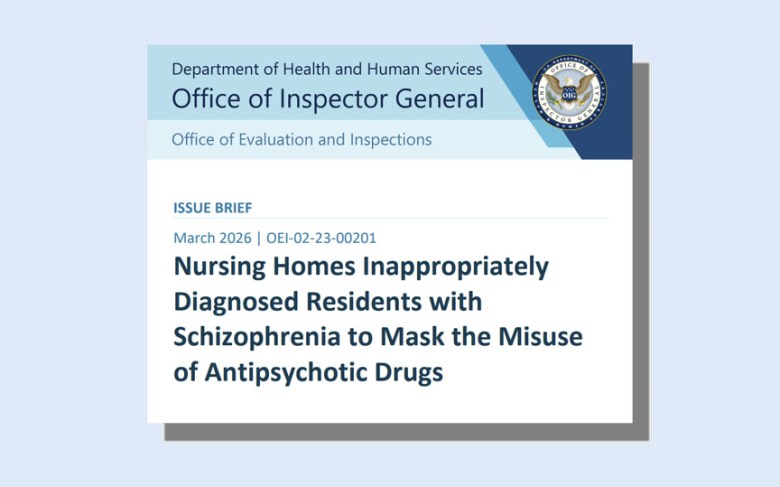
In March, the U.S. Department of Health and Human Services Office of Inspector General (OIG) released findings that should alarm every family and every policymaker in this country. Investigators found that some nursing homes inappropriately diagnosed residents with schizophrenia – not because it was medically accurate, but to justify the use of powerful antipsychotic drugs and to artificially improve the facility’s public ratings.
Let that sink in.
A false diagnosis. A powerful drug. A vulnerable person. All to make a facility look better on paper.
In a companion report, OIG described “alarming instances” where residents with dementia were given antipsychotic medications not because they needed them – but because it made them easier to handle. Easier for staff. Quieter. More compliant.
These drugs carry FDA warnings. For people with dementia, they can increase the risk of death. This is not care – this is chemical restraint. And it is inhuman.
We have spent nearly 40 years fighting this exact kind of abuse – the quiet, systemic mistreatment of vulnerable people by those entrusted with their care. It does not always leave visible bruises, but the harm is real. The loss of dignity is real. And too often, the consequences are irreversible.
This is not an abstract policy problem. It is a moral failure.
Why this matters in Connecticut
Connecticut law is clear. Nursing home residents have the right to dignity. They have the right to be free from improper restraint. Chemical restraints – like antipsychotic drugs – can only be used for legitimate medical purposes, with a physician’s order, within a defined plan of care, and with ongoing review.
In other words, the conduct described by OIG is not just troubling – it directly contradicts the legal and ethical framework that is supposed to protect residents. But laws only matter if they are followed and enforced.
The quiet danger families miss
This abuse rarely announces itself. Families don’t get a call saying, “We’ve started sedating your loved one for convenience.” Instead, they notice changes. A once-engaged parent becomes withdrawn. A loved one is suddenly drowsy, confused, or falling. Conversations fade. Personality disappears. They are told it is “progression.” Sometimes, it isn’t.
OIG’s findings – and reporting by The Washington Post – show that some residents were medicated for behaviors that were not dangerous, like repeated requests for help. Or restlessness. Or confusion.
In other words: simple human behavior.
When those behaviors are treated with sedation instead of care, we are no longer treating a patient; we are suppressing a person. And when diagnoses are manipulated to justify that sedation, the system itself becomes complicit.
Accountability must go beyond the bedside
This is not about one bad nurse or one bad shift. It is about systems. OIG identified failures across the chain: medical directors who did not intervene, pharmacists who did not flag misuse, policies that failed to protect residents, and incentives that rewarded the wrong behavior.
That is how abuse becomes normalized. Real reform requires confronting all of it – how facilities are staffed, how decisions are reviewed, how families are informed, and how regulators enforce the law.
What Connecticut should do now
If we are serious about protecting the elderly and vulnerable, Connecticut must act decisively:
- Require clear, plain-language disclosure to families when antipsychotic drugs are started or increased – including risks, alternatives, and purpose.
- Audit late-added schizophrenia diagnoses, especially in residents with dementia receiving these drugs.
- Enforce existing laws on chemical restraints with real consequences.
- Invest in staffing, training, and non-drug approaches to dementia care so medication is not used as a substitute for time and compassion.
- Make reporting easier – and outcomes more transparent – for families.
What families can do
Trust your instincts. If something feels off, it probably is. Ask questions. Demand answers. Request records. If your loved one suddenly seems sedated, withdrawn, or declining, treat it as a serious warning sign. Because it is.
And if you suspect abuse or improper medication, report it. There are systems in place – but they only work if people use them.
Why this is also a legal issue
When families come to us, they are not looking for a lawsuit, they are looking for answers: How did this happen? Who allowed it? Why weren’t we told?
For nearly four decades, we have stood with Connecticut families asking those questions. We have seen what happens when convenience replaces care, when oversight fails, and when vulnerable people are treated as burdens instead of human beings.
We will continue to fight it. Because this should never be acceptable. Not in Connecticut. Not anywhere. This is not about medicine; it is about dignity. Dementia does not erase personhood. A diagnosis is not a loophole.
And no one – no one – should ever be drugged into silence for the sake of convenience.
Connecticut families deserve real care. Not chemical control.
Michael A. D’Amico is a Connecticut trial attorney and partner at D’Amico Pettinicchi Injury Lawyers, where he represents individuals and families in nursing home abuse.