Will parents be forced to opt out of upcoming state Smarter Balanced Assessment testing this May to get the Ridgefield Board of Education to act?
Superintendent Susie DaSilva and the Ridgefield Public Schools (RPS) Board of Education were tasked with the unenviable challenge of cutting over $1.5 million from the school district’s budget at the request of a few elected leaders who are not educators. What to cut was the subject of the April 13 BOE meeting which ended without a decision due to debate over difficult issues and the very real human impact reductions may have.
Fortunately, there is an easy and obvious solution to immediately save costs, academics, and teachers — cut out the Chromebooks.
What are Chromebooks?
Chromebooks are consumer-grade laptops built for web browsing by adults. They were not developed for use by children in school. They were repurposed due to lack of demand and rebranded by Big Tech (aka “Ed Tech”) with a new target market — schools. Big Tech is guided by profits, not student outcomes. Taxpayers in public school districts foot the bill for this trillion-dollar “Ed Tech” industry, and students pay the ultimate price.
Google Chromebooks promised to improve an educational system that was not broken, and there is absolutely no evidence that is what they do. National and international studies reveal that using Chromebooks does not result in better academic outcomes as compared with traditional teaching methods — using pencil, paper, and textbooks — and also reveal that Chromebooks do cause social-emotional harm. Since their introduction in 2010, K-12 student reading, writing, and mathematics have declined. According to neuroscientist Jared Horvath, daily in-class Chromebook use corresponds to a one to two letter grade reduction and the first generation of children in history that will be less cognitively capable than their parents.
In practice, Chromebooks reward speed over depth, clicking over thinking, and passive consumption over active creation. They are culpable in building a generation defined by manufactured inattention, reward-driven integrity, and applauded mediocrity. The technology these children are supposedly being trained on will not exist when they reach high school and beyond. The current pedagogy incorporating Chromebooks is not based on data, and it costs money.
Who uses Chromebooks in school?
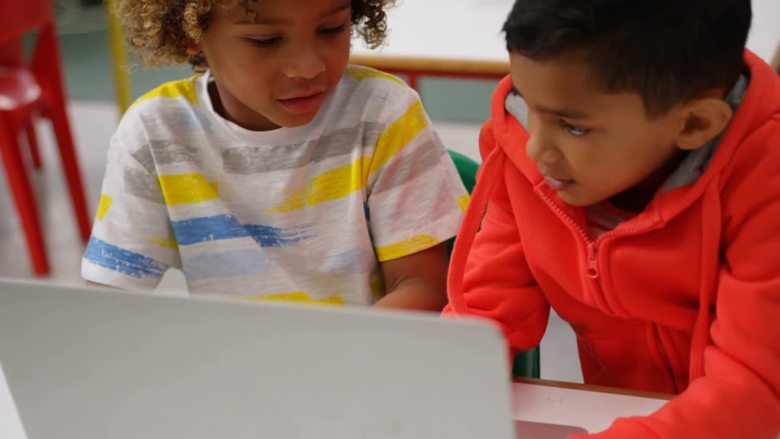
In Ridgefield public schools, Chromebooks are introduced in first and second grade. Students use them with regularity in third grade. All fourth through 12th grade students are issued 1:1 Chromebooks per district policy — one Chromebook to every single student as of fourth grade. Usage is teacher dependent, at least at the elementary level.
A growing majority of Ridgefield parents do not want their children using Chromebooks in school. They want actual teachers and pedagogy proven to be effective — pencil, paper, and physical textbooks.
What do Chromebooks cost?
How much do these devices most parents do not want their child using actually cost taxpayers? Based on publicly available RPS information: greater than $3.2 million per 4-year life cycle, or $800,000 annualized.
Those numbers underestimate the actual total direct and consequential costs that likely exceed $2 million per year per student. The consequential or intangible costs of Chromebooks — their deleterious impacts on learning and behavior, the overall dilution and gamification of the academic experience, and privacy violations — are immeasurable, although a jury will no doubt ascribe a seven figure number to those costs eventually.
In light of the impending budgetary decisions, however, this section will focus on publicly available, explicitly traceable direct or hard costs of providing 1:1 Chromebooks, which still underestimates actual direct costs.
No current or prior school budget provides a specific line item for Chromebook hardware, operational software, or any other direct costs relative to Chromebooks such as: licensing, renewals, cybersecurity, cloud storage, IT staff to manage devices and security, troubleshooting, repairs, replacements, coordinating repairs and replacements, bidding, researching options, attorneys’ fees, insurance premiums, the need for additional mental health providers and behaviorists, and litigation costs. Absent access to the ever-elusive RPS raw data on those other costs — which must be maintained somewhere in this district — what follows is analysis reliant upon on perfunctory, publicly available hard data only.
As of October 2025, approximately 4,300 kids are enrolled in RPS, of which approximately 3,400 are in fourth through 12th grade. Starting in fourth grade children are issued 1:1 Chromebooks. Published hardware and operational costs are $235 per Chromebook per year. That figure does not include any of the other direct costs noted above. Assuming 3,400 students are issued 1:1 Chromebooks each year and the devices have a four-year life cycle as articulated by Dr. DaSilva, this district commits $3.2 million over a four-year life cycle or $800,000 annualized. The analysis assumes every Chromebook purchased in year one survives to year four with an active operating system all four years (more on that below).
If RPS had 33% fewer Chromebooks in fourth through 12th grade, total annualized savings would be approximately $96,000 per year exclusive of the previously mentioned other costs, or $384,000 over four years.
If RPS had 50% fewer Chromebooks, estimated savings would be approximately $145,000 per year exclusive of other direct costs, or $580,000 over four years.
Serendipitous as it were, cutting Chromebooks by 33% to 50% in fourth through 12th grade would yield annualized hardware and operational cost savings commensurate with an RPS teacher’s annual salary: $96,000 to $145,000. Again, that conservative estimation excludes the very real “other” costs which have not been disclosed publicly.
Why do we have Chromebooks?
Before the April 13, school board meeting, the justification for purchasing thousands of Chromebooks was that the devices will prepare children for a future of technology. Yet, according to neurologist Jared Horvath, all reliable data says the opposite — students have never been less prepared since the introduction of technology in school.
The current RPS Elementary Technology Policy reflects that Chromebooks “teach” kids how to use Google Docs and play with music and video apps during library:
- “Publishing” on Google Docs — Children peck at a keyboard (typing is not taught) and click “file” then “share.” Google says it takes three hours to learn Google Docs. Our district has decided it takes 10 years. A worksheet and a pencil accomplish the same task — without the screen time, the ophthalmological damage, the behavioral consequences, or the hard cost.
- “Research” — Students are handed a device capable of accessing every dark corner of the web. Most firewalls can be circumvented in two to three minutes, and it has happened in this very district. A library curates age-appropriate books, while a Chromebook gives kids access to literally anything and hopes they will not find it. That is not a policy; that is gambling.
- “Individualized practice” and “enrichment” — Children run through algorithmically generated problems on a screen while the teacher works with a small group. That is virtual babysitting, not differentiated instruction, and many “enrichment” programs are video games.
- SoundTrap and WeVideo — These are apps for playing music and making videos – skills for curating proficient YouTubers rather than developing creative, analytical children who read and learn in a traditional library class.
Clicking through digital worksheets and tests built by software techs, not educators, dragging answers into boxes, playing mandatory video games, earning badges and stars for answering questions, and scrolling through screens instead of thinking are not skills for the future. What Chromebooks provide are uninsurable, un-auditable, risk-laden operations and access to platforms of busy-work designed to optimize engagement and entertainment. They are not for education.
All of this to say, it turns out none of the above is really why Chromebooks persist in our post-pandemic classrooms. We learned the real reason at the April 13 BOE meeting when our superintendent bravely disclosed to the community that 1:1 Chromebooks are purchased in order for students to take the Smarter Balanced Assessment (SBA) test — a state-sanctioned test the schools must offer but which students are not required to take if parents opt out. (See BOE meeting at 2 hours, 30 minutes; https://www.youtube.com/watch?v=RCjBZcOC0tU .)
Her admission that the primary purpose of Chromebooks is for testing is refreshing and praiseworthy. But, it necessarily means the primary purpose of Chromebooks is not for teaching anything. As a parent, this reality is profoundly disappointing, albeit not surprising given all the data.
What can be done?
There are four things that can be done to reduce the negative impact of Chromebooks, save money, and save education and jobs. These coincide with my recommendation that one third of all elementary and middle school classes be completely tech-free, as well as my posit that those will be the most sought-after and highest-achieving classes.
- Purchase fewer Chromebooks and share devices. There is no need for every student to have a 1:1 device. SBA and other state testing can be accomplished with shared devices in a computer lab. That would require purposeful scheduling. It was possible pre-pandemic, and it is possible now. Any claim scheduling would be too difficult is disingenuous, at best. Jared Horvath’s research offers guidance on how to do this. He explains test preparation requires only two to three practice sessions of 20 to 30 minutes each on a Chromebook, culminating with a test at a staggered time.
- Negotiate 10-year life cycle contracts — Google’s Auto Update Expiration (AUE) currently dictates when a Chromebook becomes obsolete, forcing schools to rebuy devices at specific intervals like every 4 years even where the device itself is in good working order. A device purchased one year ago can be rendered unusable for state testing the very next year depending on the operating system and contract. It is quite the racket. However, since 2024, Google has offered up to 10 years of support for newer platforms on devices available since 2021. The RPS district should contractually lock in a 10 year cycle for all new device purchases. Districts hold real bargaining power now: Chromebook adoption is declining, and lawsuits are increasing (i.e. against Google, i-Ready, and PowerSchool). This district has already experienced a PowerSchool breach and multiple firewall failures — second graders accessing images of violent car crashes and women in underwear, 6th graders accessing shooting games, etc. It is only a matter of time before RPS, and perhaps its teachers and officers under Connecticut General Statutes, join the list of defendants. Reducing the number of Chromebooks, reduces the number of student interactions with Chromebooks, which reduces the potential for litigation.
- Request Paper Tests. The district should request that the state provide physical paper tests, eliminating the need to waste resources on Chromebooks.
- Parents may Opt Out of SBA Testing this May 2026 — If the BOE does not act to save teachers’ jobs and reduce student exposure to proven harms, parents may have no choice but to opt out of state testing this May. If Chromebooks exist primarily for testing and students are not taking the test, the district does not need them — or at least not as many. Don’t make us exercise this option.
Analysis
Conservative assessment reveals Chromebooks cost taxpayers in the RPS district more than $800,000 per year per student on devices parents do not want. That figure excludes many other direct and intangible costs as underlying data necessary to ascertain those actual numbers (likely in the seveb figures annually) is not made publicly available in this district. Cutting the fleet of devices by 33% to 50% saves at least $96,000 to $145,000 annually — roughly one teacher’s salary.
That should reframe the budget debate: cut a teacher or cut some Chromebooks. This will attract people to Ridgefield schools as parents relocate based upon whether schools offer no tech or low tech options. Keep our teachers, improve our reputation, save our kids.