



A bill backed by Gov. Ned Lamont that aims to expand Connecticut’s authority over immunizations passed the House on Tuesday evening with a 89-60 vote, largely along party lines. But not before a lengthy debate.
The proposal, which drew vocal opposition during a March public hearing, would expand the power of the state’s Public Health Commissioner to establish vaccine recommendations, guarantee insurance coverage of recommended shots and allow the agency to purchase doses from sources other than the U.S. Centers for Disease Control and Prevention.
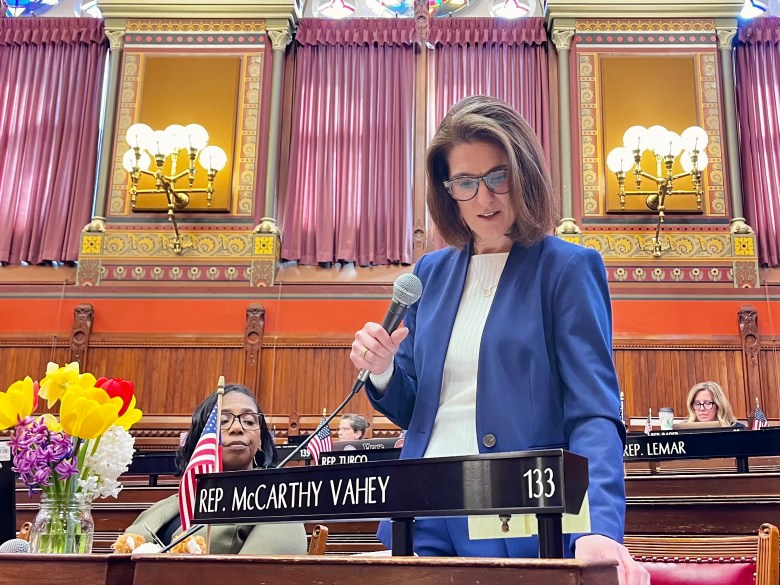
During a press briefing ahead of Tuesday’s floor debate, Public Health Committee co-Chair Cristin McCarthy Vahey said the goal of the legislation, House Bill 5044, was to maintain access to vaccines for those who want them — not to impose mandates.
“There are no new vaccines being mandated in this bill, contrary to what some people are saying,” McCarthy Vahey said. “We are taking a step to assure that we have access to vaccines, that we are using those rigorous scientific standards, that we are affordably providing those vaccines.”
Before the vote, House Speaker Matt Ritter, D-Hartford, said he expected “99% of our caucus” would vote yes on the bill.
During the debate, House Republicans primarily took issue with a measure in the bill addressing the state’s Religious Freedom Restoration Act, or RFRA, and the potential effect the provision would have on a pending lawsuit before the Connecticut Supreme Court.
In 2021, the legislature voted to eliminate religious exemptions from vaccines in schools. But RFRA could pose a potential conflict to that move. One of the measures included in H.B. 5044 seeks to clarify that RFRA, which protects religious liberties, does not apply to school vaccine requirements.
In response to a question from Public Health Committee Ranking Member Nicole Klarides-Ditria, McCarthy Vahey confirmed that this would be the first time the legislature would vote to create such a clarification to RFRA.
“For the first time in Connecticut history, the legislature is carving out an exception into our Religious Freedom Restoration Act. If we can suspend religious liberty protections for vaccines here today, what rights are we going to carve out for tomorrow?” Klarides-Ditria said.
Several Republicans also raised concerns that Democrats were using the measure to protect the state from losing a pending lawsuit.
In 2022, two Connecticut families brought a lawsuit against members of the Lamont administration, challenging the Connecticut law that repealed religious exemptions for vaccines. Two years later, the Connecticut Supreme Court dismissed five of six of the issues raised in the lawsuit but said it would further review the plaintiffs’ claims made pursuant to RFRA.
“Is this legislature rewriting the law because the state is worried it might lose ongoing litigation over vaccine mandates?” Klarides-Ditria said during the floor debate.
Earlier in the day, Ritter said the attorney general’s office had told him there was a chance the state could lose the case based on RFRA as it’s currently written.
Ritter said the measure in H.B. 5044 addressing RFRA is an attempt to clarify “for the court, that in 2021 we meant what we said, which is there’s no religious exemption available for vaccines.”