


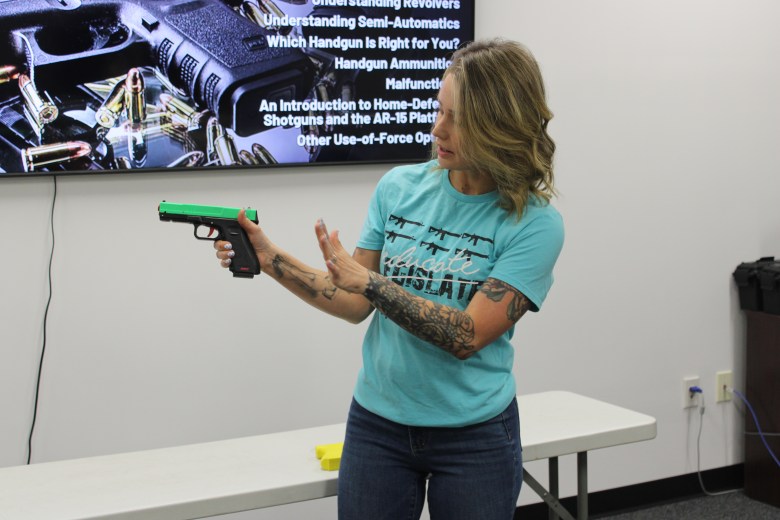
On a bustling March day at the Capitol, Elizabeth Miller sat in front of a microphone to testify against the “Glock switch” bill, a bill banning the sale of certain types of pistols manufactured after October 2026.
The bill, which passed, was designed to incentivize the gun’s manufacturers to redesign their product to make it more difficult to convert into an automatic pistol.
For Miller, this bill was concerning. Although the bill won’t force people to give up guns they already own, the new ban will affect the availability of Glock pistols — Miller’s preferred choice of weapon.
“I have carried a Glock since I was 21 years old, so for over 17 years now. As a woman, I rely on Glocks to protect myself and my three kids,” she said.
Miller went on to say that, although a physically small person, she could conceal a smaller model with relative ease. They are reliable, affordable and user-friendly, she said.
“I can’t stress the fact enough, as a woman, that some guns can be intimidating,” she said.
Miller’s concerns were echoed multiple times in the hearing that day by members of a group that often doesn’t get the spotlight during discussions about firearms and the Second Amendment: women and mothers. Yet women make up a growing percentage of gun owners in the U.S.
According to a Gallup poll from 2024, the percentage of American women who own guns increased by 5% between the years 2007-2012 and 2019-2024. The rise was largely driven by women who identified as Republican. A 2023 Pew Center Survey found that one in four women own a gun.
Women who spoke with the Connecticut Mirror said having access to a firearm gave them a sense of confidence in their ability to defend themselves and their children from potential threats.
Holly Sullivan, the president of the Connecticut Citizens Defense League, and a single mom of a 10-year-old daughter, said she sees firearms as a means of female empowerment.
“ We don’t necessarily need to depend on a husband or whatever for a variety of different things — and self-defense is just another one of those things,” Sullivan said.
Silvana Apicella, a West Haven resident, said she purchased a firearm after the 2007 Cheshire home invasion, when two men entered the home of the Petit family, murdered Jennifer Hawke-Petit and her two daughters and severely injured her husband William Petit.
“I was a single mom, and that scared the bejesus out of me. That really scared me, someone being followed home from the grocery store at night,” Apicella said.
Living with Apicella is her 22-year-old son, a niece who recently left an abusive relationship, her niece’s two children — both under the age of 2 — and a second 17-year-old niece for whom Apicella has custody. She described herself as a “mama bear,” protecting everyone in her house.
“It makes me feel strong that I can do that. That I know that, at the end of the day, I can help my family. If anything ever happened, I’m right there,” she said.
Elizabeth Ruocco said that as a petite woman with a disability, she has worried about being a target. Before becoming pregnant with her now 3-month-old son, she obtained a permit and purchased a firearm.
“I practiced with it, unloaded for a while. It was just a paperweight that I carried on me because I wanted to learn how to safely carry it and feel comfortable with it before there was ammunition in it,” Ruocco said.
Ruocco said she specifically chose to purchase a Glock because she can fire it with one hand, and because she can clean it without help.
Part of the reason she chose to own a firearm, Ruocco said, was an experience of being sexually assaulted as a teenager. “I didn’t want that to ever happen again, whether it was with someone that I knew or a stranger,” Ruocco said.
Sullivan and Apicella both said they live in areas where police response times are slow. Sullivan, who lives in a rural area, said cell phone service isn’t reliable either.
“Having a firearm in the home, safely stored, has been a lifeline for me to know that I can take care of my daughter and I don’t need anybody else to be able to do it,” Sullivan said.
For Rebecca Dolly, the state director of Women for Gun Rights, having access to a firearm helped calm the fears she felt after giving birth to her daughter.
“She’s my first child, and I remember being postpartum with her, and I had this immense anxiety about leaving the house with her,” she said. “I don’t know where it came from, but I was just absolutely terrified, and the only thing that helped ease that anxiety … was having my firearm on me. It just gave me the sense of security and confidence, being able to protect her out in public.”
But the female gunowners who spoke with CT Mirror said they felt there were misunderstandings about guns and the danger they pose. They also felt that, as women, they were sometimes looked at askance for their position on firearms.
“We tend to be very quiet… As a gun owner, there’s a lot of stigmas,” Sullivan said. She added that she was once thrown out of a Mommy-and-Me group she and her daughter were part of, which she attributed to the group’s feelings about her views on guns.
Sullivan’s daughter was born a year after the 2012 mass shooting at Sandy Hook Elementary School, she said, and the tragedy escalated the gun debate. The problem, Sullivan said, was that people rarely had genuine conversations about it.
“I live in Southbury, the next town over to Sandy Hook, and it’s a very hot topic, but I think when we avoid talking about it, it only makes it worse,” Sullivan said. “ That’s exactly what’s happening with the gun debate here in Connecticut. We’re not having open and honest discussions.”
‘This could change things in an instant’
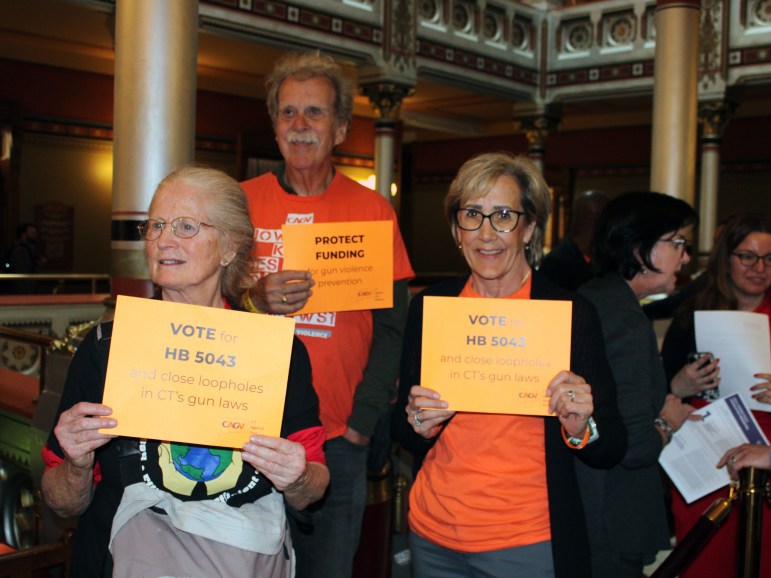
Perhaps no one event has influenced Connecticut’s view on firearms more than the shooting at Sandy Hook in Newtown. It has contributed to a paradox — that what some moms view as a means of protecting their children, other moms see as a threat to their children’s safety.
Carly Corrigan, a member of Moms Demand Action and a mom of two teenagers, said the shooting was what shaped her views on the topic. At the time, she said, she was pregnant with her second child.
“ Having a very young child and thinking about when they would be in school and putting myself in those parents’ shoes just was really, really, really tough,” Corrigan said.
Corrigan started paying more attention to gun laws. She said she knows that firearms are the leading cause of death for children and teens under 18 in the U.S.
In 2022, about 2,500 children died by firearm, the vast majority between ages 15 and 17. Two-thirds of those deaths were homicides, and about a quarter were suicides.
Corrigan said that when she thinks about threats to her children, her image goes to someone who has a gun in a public place — schools, shopping malls, theaters — and is intent on causing harm. “ It’s the things that you can’t control. Which, I mean, that’s life and that’s being a parent. And when they go out in the world, you just never know,” she said.
Corrigan said she’s not “anti-gun” and that she respects the constitutional rights of people who want to own them. She said she wants “sensible” laws that keep guns out of the hands of people who shouldn’t have them. She said if some moms feel safer owning a gun, that’s their choice, as long as the guns are stored safely when not in use.
“I am a single mom myself, so I can certainly put myself in their shoes,” she said. “We all are doing the best we can. We have to make the best decisions that we can for ourselves and our families.”
Mary Ann Jacobs, a member of the group Connecticut Against Gun Violence, and a former library clerk at Sandy Hook Elementary, remembers hiding in a closet with a group of 9-year-old children for several hours on the day the shooting took place in 2012.
“These guns that are able to shoot multiple rounds very quickly are responsible for the 26 deaths at Sandy Hook School, very specifically,” Jacobs said. “ I believe in the Second Amendment and having guns for sport and hunting, but you don’t need to shoot 152 rounds in three minutes to do those activities.”
Jacobs said her husband owns guns and that her children shoot skeet. She said her husband made sure their children were trained in gun safety.
For Joanna Whitney, also a member of Moms Demand Action, what drove her to advocating for gun safety was slightly different. A decade ago, when she was living in Texas, she briefly left her then 2-year-old children with a neighbor while she went to grab something from her house. On her way across the yard, she realized that the neighbor, a hunter, had guns, and she had no idea how they were stored. She ran back.
The guns were safely stored. But the experience stayed with her.
“ That was just sort of the thing that made me think, ‘Oh my gosh, this could change things in an instant,’” she said.
After moving to Connecticut in 2017, Whitney became involved in Moms Demand Action, particularly its campaign around gun storage. “It’s kind of one of the ways that everyone comes together and agrees on. We’ve yet to have conversations with folks and find someone who thinks that yes, 2-year-olds should have unfettered access to loaded firearms out on the kitchen table,” Whitney said.
Common ground
Women who opposed stricter gun legislation also emphasized the importance of safe storage.
“Responsible gun owners don’t mess around. We make sure everything is locked up. Nobody can get it unless you know it’s needed,” Apicella said.
Several women who spoke with CT Mirror said they felt the key to lowering the rate of gun violence was more education in schools around firearm safety and use. In 2019, Connecticut’s State Department of Education was tasked with creating a guide to develop firearm safety curricula.
But Sullivan said towns have to choose to adopt it. “With the correct training and exposure, you can raise responsible gun owners. The generations of Americans before us had firearms readily accessible and did not have the mass casualty incidents that we have today,” Sullivan said.
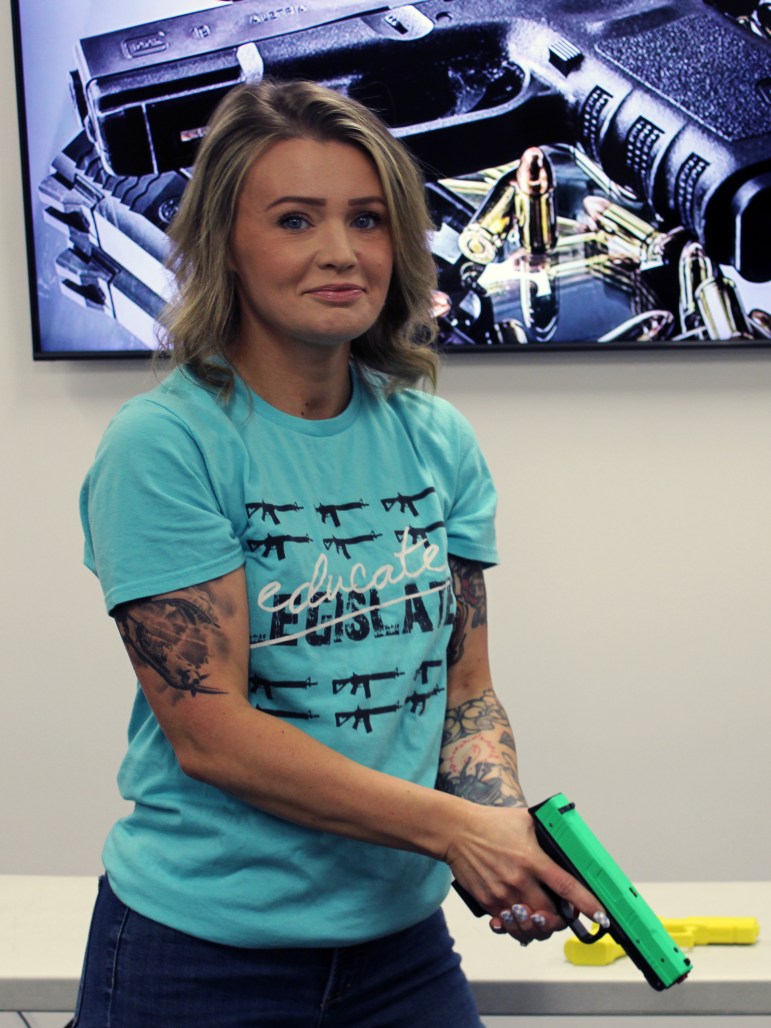
Dolly said she began to teach her daughter about gun safety when she was very small.
“Before she could talk, [she] would point to a trigger on a Nerf gun and say, ‘No, no, no.’” Dolly said. “Children are very, very smart, and if we teach them from a young age about firearms and what to do if we encounter one, we are going to see a massive decrease in incidents, accidents and violence, I believe.”
Jacobs, whose husband owns guns, said that he took her sons for gun safety education.
She said she thought having more universal gun laws, rather than each state making its own laws, would make it easier to stop people from trafficking guns illegally across state borders.
Whitney said she’d like to see people who come out in opposition to bills regulating firearms to bring forward their own proposals for addressing gun violence. She said she doesn’t know what modifications to current bills or entirely new legislation people who favor less regulation on guns would support.
“ I think we can agree that doing nothing isn’t the answer. I think that that is something that we would all agree — that there is too much gun violence. So what are the things that might be supported that aren’t just the status quo?” she said.
Whitney said there were many things that people who generally opposed laws limiting gun ownership and groups like hers could find agreement on — everything from background checks to keep guns out of the hands of people who might be a risk to public safety, to safe storage laws, to keeping automatic weapons off the streets.
“ I think we can agree that doing nothing isn’t the answer.”
Joanna Whitney, Moms Demand Action
Apicella said she doesn’t think the solution to gun violence is to make more laws restricting guns; Instead, states should boost efforts to pursue criminals, she said. Apicella said much of the crime she reads about involves extended capacity magazines, which are already illegal in Connecticut.
“Mental health also is a big issue in the state … Drugs are a big issue here in the state, and [state officials] always take funding away from those things, and that’s what the people need the most,” Apicella said. “We don’t need to be told what to do in our own homes or what we can’t carry as far as how we’re choosing to protect ourselves.”
Jacobs added that in a setting like the Capitol, where people tend to stick with their own groups, it’s difficult to look for agreement. But one-on-one conversations are different.
“I’ve spoken at events where all the gun guys show up and I’ve sat down at a table with them, and we talked about stuff and … they’re like, ‘Oh yeah, people with dangerous criminal backgrounds shouldn’t have guns.’ I’m like, ‘Look at that — we just found common ground.’”
Sullivan agreed that there were plenty of places of agreement that women with different opinions on gun legislation can reach. The key is to actually have the conversations.
“We are still women. We’re still moms. We are still members of the same communities,” she said. “This is so taboo in Connecticut. It exists in a vacuum where the two groups just don’t talk to each other. But yes, I think it’s entirely possible. I think that we all share a very common goal of wanting our families and our communities to be safe.”
