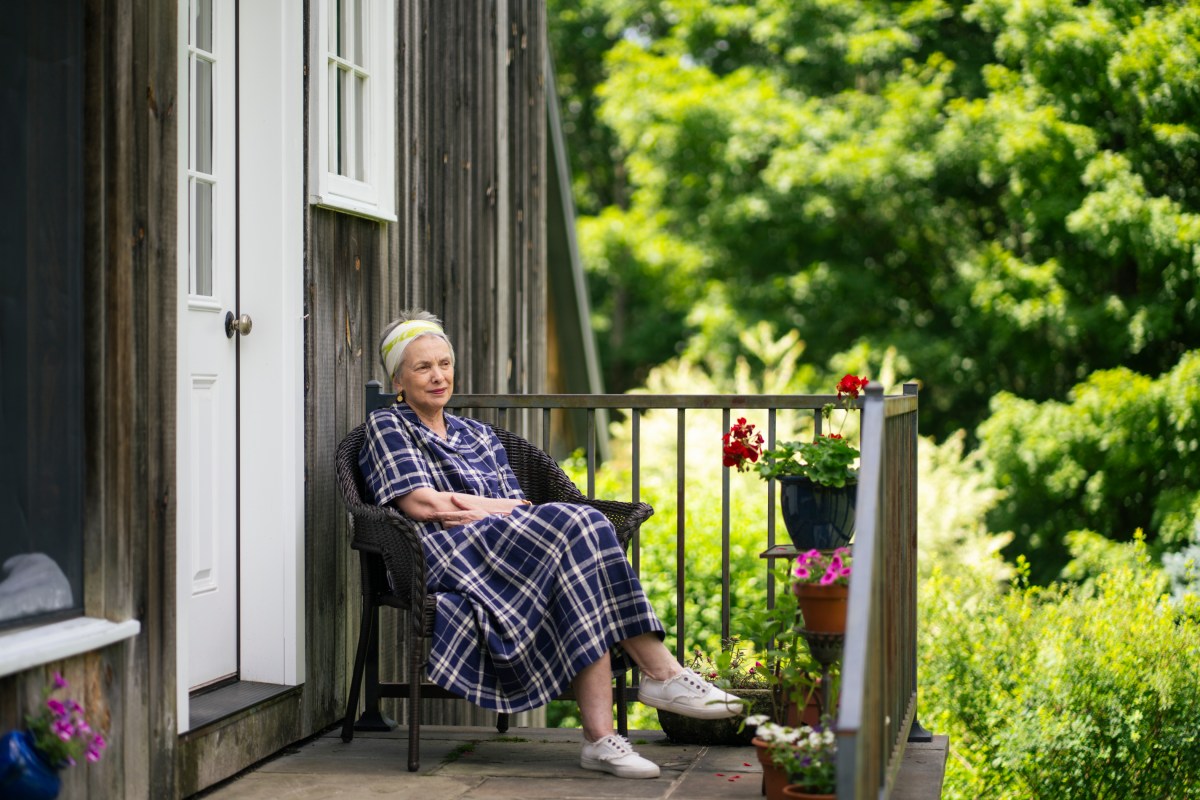


COVID was the turning point for Pamela Sztybel.
The sometimes Connecticut-based, sometimes New York City-based artist found herself — like many, many people all over the world — in lockdown.
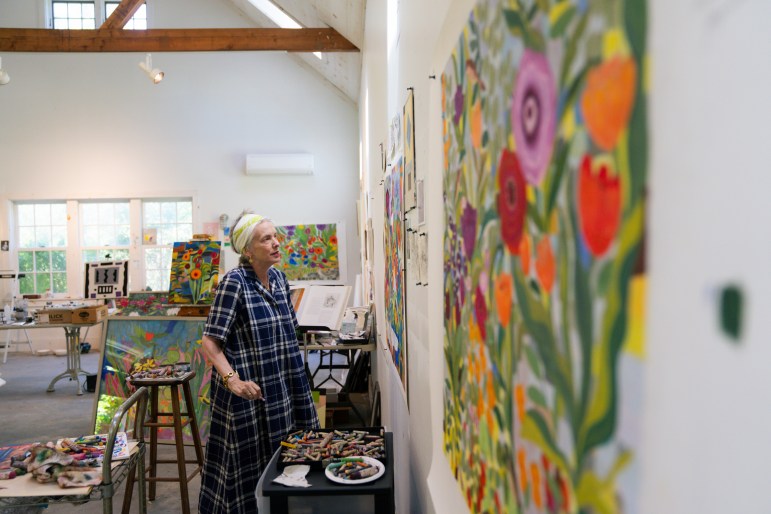
She couldn’t get to her New York studio. And it would be a while before she could travel to her big, bright country studio in Bridgewater, where her large, colorful flower paintings hung on the walls and where she had miles of paints, brushes, chalks and all manner of art supplies.
She was stuck at her comparatively pint-sized New York kitchen table.
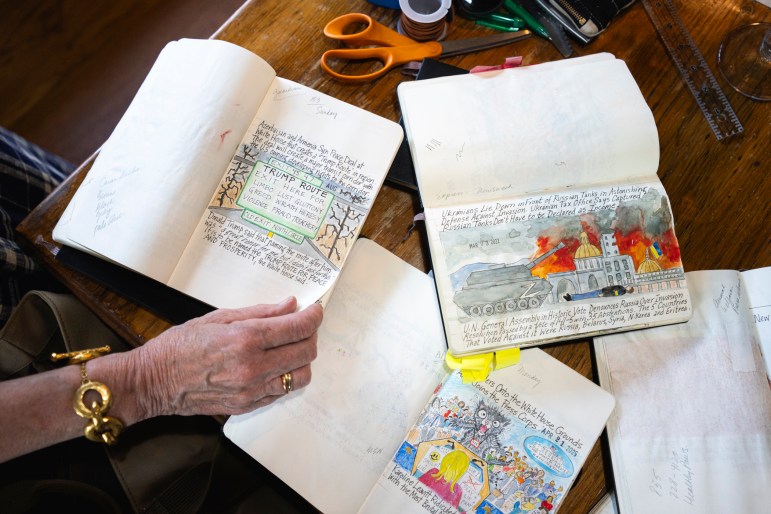
So she did what any artist with a ton of time on their hands would do — she drew. Given the conditions, she necessarily drew small.
And so the COVID Diary sketchbooks were born — a solid year of a daily news-inspired cartoon-style sketches that chronicled the times. Each was time-stamped and then photographed and posted on Instagram and Facebook.
Six years later, COVID may be gone — well, sort of — but Sztybel’s sketches are not. They are no longer regularly produced daily, but their ripped-from-the-headlines commentary approach remains, and it is more strident than ever.
“I started doing the COVID Diary just to amuse my friends, but it kind of became more than that,” said Sztybel, who uses what she calls the American English pronunciation of her Polish name: Stye-Bell.
“I got it into my head that I would do a little drawing. I would pull a headline from a news source — something I didn’t write, some other person wrote. And then I would do a little drawing to go with it.”
She bought an artist’s notebook and a date stamp to mark each sketch. The first sketch was Feb. 20, 2020.
“At first I was drawing them kind of straight,” she said. “But quickly I got bored doing it that way.”
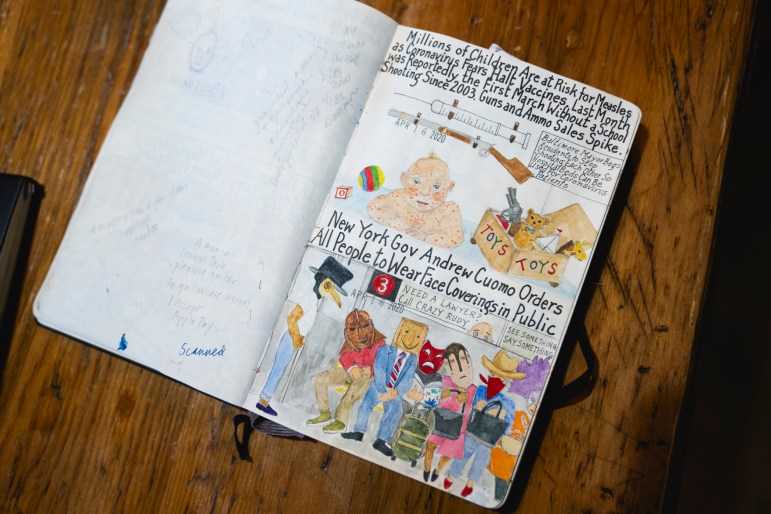
So she found an edge, at times a very sharp one. The truth — often a hard truth — laced with humor.
She hand-wrote the news headlines she found on each drawing, noting their source on the opposing blank page. She said that was in case people didn’t believe her or they thought the words were hers, which they were not.
The edge, as well as the humor, were in the sketches themselves — sometimes caricature, sometimes commentary, sometimes both.
“So I think the first one where I kind of got a chuckle myself was Angela Merkel,” Sztybel said.
“German Chancellor Angela Merkel goes into self-quarantine. Happy Hour goes online as coronavirus forces everyone inside,” was the headline. She showed Merkel viewed on a computer screen with a glass of wine, presumably German, and sausage on a fork. On the other side of the screen, a martini and chips.
She took on the postponed Japan Olympics with one of the rings looking virusy, Vice President Mike Pence’s new COVID role, and the surge in pet adoptions.
But when President Donald Trump partially reopened Mar-a-Lago in May of 2020, Sztybel’s rendition had a much harder edge. Scorpions, snakes and cockroaches were on the lounge chairs with the Grim Reaper serving a drink. She also mocked former New York Gov. Andrew Cuomo’s mask mandate.
Finding source material was easy, Sztybel said. “You know you can do that with a phone in bed in the middle of the night.”
But they also had to be drawable and amusing in some way, or such that she could add elements to make them more of both.
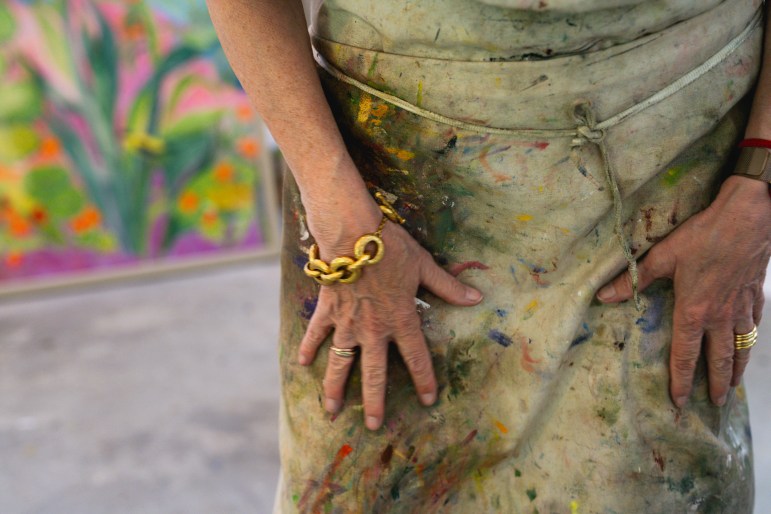
She turned the COVID relief checks, delayed because Trump insisted his signature be on them, into a dynamic Oval Office depiction with his big signature, a sharpie and Trump’s favorite, mostly fast foods, piled on the desk.
“They’re kind of fun to read through now,” she said. “At the time, it wasn’t very much fun.”
But she quickly learned they were playing a role beyond amusing herself and her friends because she was documenting the situation in a way that no one else was.
“I was getting messages from people around the world,” she said. “I got one from a lady. She said, ‘I look at your drawings every day with my grandson, and we go over them together, and we learn about what’s going on from your drawings.’ I guess he could take it in through my drawings in a way that was maybe more palatable, or maybe you could understand it better than the news, or it was less scary.”
She said reactions like that compelled her to keep going. And so she did — for 365 days straight. Days that included Joe Biden’s election in 2020.
“I remember being in my car when, when it became clear that Biden won, and people I didn’t know texting me, saying, ‘Where’s the drawing?’ And I wrote back, ‘I’m driving.’ And they said, ‘Pull over.’”
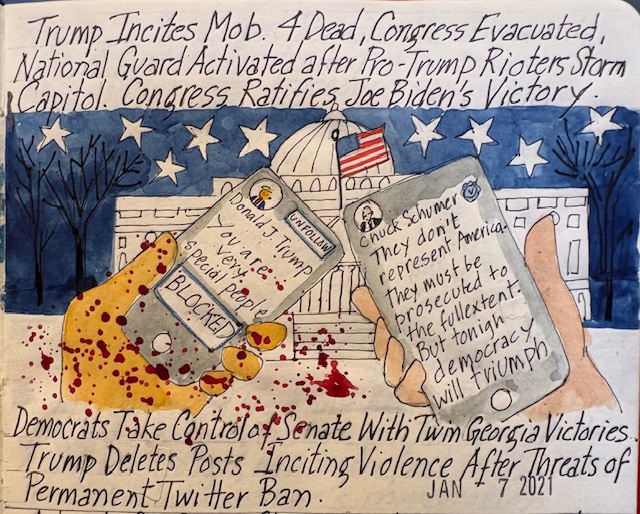
The 365 days also included January 6.
“Trump incites mob. Four dead. Congress evacuated. National Guard activated after pro Trump rioters storm capital. Congress ratifies Joe Biden’s victory,” were the headlines she used. To accompany them she drew Trump’s hand — orange-hued and blood-spattered — holding a cellphone with the phrase, “You are very special people” typed on the screen.
On Feb 20, 2021, the COVID diary was done. From an artistic standpoint, Sztybel said, she had learned new skills, such as working very small and very quickly. She also drew objects she’d never drawn before, like snakes, insects and the Grim Reaper.
But the emotional toll of delving into these subjects every day made her realize that she needed to get away from it for a while.
The long history of caricature
The marriage of art and politics goes back several hundred years.
“The history, if you want to link it to caricature or cartooning, is really 18th century Italy. But the kind of political edge that it takes really happens in the 19th century in France, and that’s called the golden age of caricature,” said Katherine Kuenzli, chair of the Department of Art and Art History at Wesleyan University.
That growth of caricature coincided with sustained political and governmental turbulence set in motion by the French Revolution, not unlike the discord and upheaval in the U.S. and much of the world today. The artists “were really mocking the kind of weakness and pomp of the officials,” Kuenzli said.
Some of the techniques from that time remain today. King Louis-Philippe’s depiction as a pear, derived from his jowly look, may equate to some of the traits artists, including Sztybel, use for Trump today: orange skin, strange hair, long red ties among them.
The notion of caricature was pushed along by the poet Charles Baudelaire’s 1863 essay “The Painter of Modern Life,” which advocated for everyday life as a component of art. And it paved the way for caricature to move into the 20th century and modern art, supercharged by authoritarian movements such as the Russian Revolution and the rise of European fascism.
“You have this idea that art is not just for the elite. It’s a really revolutionary idea,” Kuenzli said. “It gives a voice to and it gives agency to everyday people.”
Arguably, the throughline with today is authoritarianism, which, beyond specific caricature, has yielded many art forms that are often responses to the abuses of a regime and the propaganda for which it uses art, Kuenzli said.
Ukraine prompts the return of sketches
One year almost to the day after the COVID Diary ended, Russia invaded Ukraine.
Sztybel picked up her drawing tools and notebooks again almost instantly. This time it was personal.
Her grandmother — her father’s mother — was born in Kyiv and as a teenager escaped to Poland during the Russian Revolution. On Sept. 4, 1939, that same grandmother escaped again, this time from Hitler, along with her husband and young son — Sztybel’s father.
“She had to leave her home twice, and her family she never saw again,” Sztybel said.
So began the Ukraine Sketchbook.
“I was horrified about Putin invading a sovereign nation. I missed doing the drawings. People were asking me to do the drawings,” she said. “That part of the world is part of my history. But with the Ukraine drawings, there was nothing funny about any of it.”
Her drawings depicted truths in the upside-down world of war and the ordinary people who were stepping up in ordinary and extraordinary ways: Tiny shoes lined up with candles in Helsinki to mark the children being killed. A relentless count of the fates of children — deaths, injuries and kidnappings. Rape reported to be “happening systematically” in Russian occupied areas. Russian looting of Ukrainian artworks. Libraries being used as bomb shelters. A teenage girl set to graduate who returned to her bombed school in her prom dress. Pets and other animals being rescued. The heroic stand by Ukrainians at a steel plant in Mariupol. The ripple effect of food insecurity around the world from Ukraine’s inability to ship its normally massive grain crops.
And the heartbreaking letter written by a Ukrainian boy to his dead mother: “Mama. Thank you for the best 9 years of my life. Many thanks for my childhood. You are the best mama in the world. I will never forget you.”
“Not funny at all, no,” Sztybel said. “But interesting to draw. To try to make an image out of such serious headlines was challenging.”
“Order out of chaos is pretty much what artists do. And in this very miniature way, maybe that is what I was trying to do,” she said.
On her Facebook posts, she also added a donation link for World Central Kitchen, chef Jose Andres’ operation that provides meals in trouble spots, such the war in Ukraine and Hurricane Maria in Puerto Rico.
“That little engine was doing some good for somebody,” Sztybel said.
A lighter touch
Sztybel made it six months on Ukraine before lightening up her offerings with animal news drawings — 150 of them.
Nuns who adopted a stray dog they named Sister Jennifer, depicted by Sztybel in full nun’s garb, and who attended six chapel services a day. A U.S. library that is accepting cat pictures instead of late fees. Bring your pet to work day in the EU, noting that people who are scared or allergic should “consider teleworking.”
She has also continued to paint — large and small florals, fruits and other components of the natural world. And she drew a group of dog illustrations for a book of poetry by the former U.S. Poet Laureate Billy Collins.
But in March 2025, in the wake of the infamous Feb. 28 Oval Office meeting in which President Trump and Vice President Vance excoriated Ukrainian President Volodymyr Zelensky, Sztybel roared back.
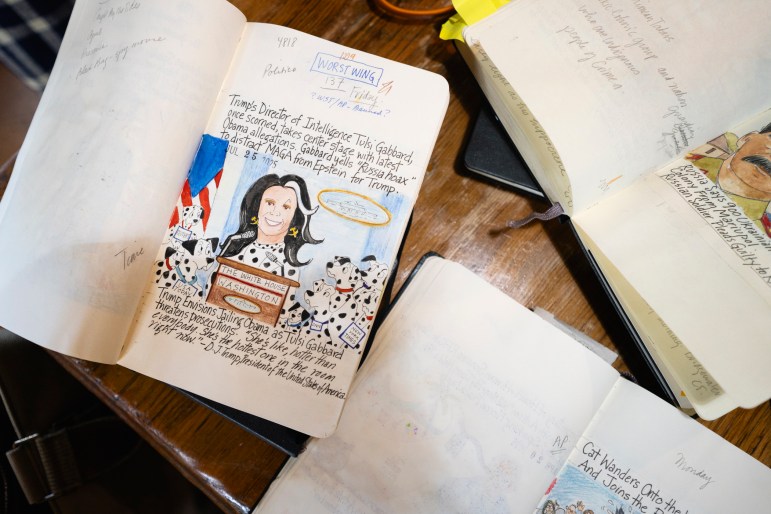
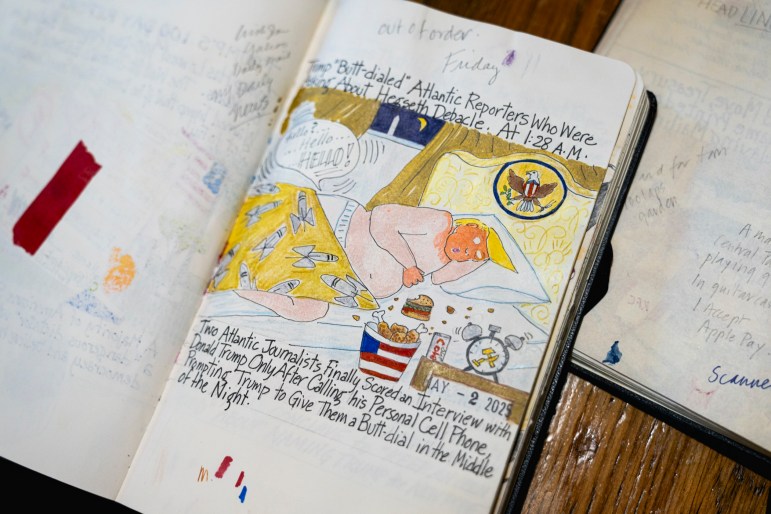
In a notebook she would come to call the “Trump Worst Wing Sketchbook,” Sztybel depicted Vance as a snake and then launched six months’ of pointed political commentary that ranged from humorous taunts to pure outrage about the Trump administration.
Each sketch was packed with mocking details, such as long red ties, Big Macs and lots and lots of gold, to drive home her point. A worm coming out of Health Secretary Robert F. Kennedy Jr.’s ear and his face covered in measles spots. A dig at Elon Musk with a sawed-in-half rainbow-colored peace sign and a clearly freaked out peace dove. Second lady Usha Vance visiting Greenland carrying a Chanel shopping bag and pushing a shopping cart with a polar bear holding a sign that says, “We are not for sale.”
And one titled “Trump signs executive order to eliminate agency that funds museums and libraries” has Trump at the Resolute desk, his recognizable hair showing above a copy of Mein Kampf.
When asked whether she ever worries that her political criticism will make her a target, Sztybel recounted a conversation with her husband when she asked, “If I go on a trip and they look in my phone, am I going to get arrested? And he said, ‘No, they’re going to send you straight to El Salvador. No, you’re not going to have the luxury of getting arrested.’”
But she drew her dog Jack taking over her drawing project while she’s visible in jail in the background. And she’s not shying away from her hardline images.
“I thought, am I going to tiptoe around things like swastikas and Klan outfits? I’m either going to put them in or I’m not,” she said. “I didn’t overdo it, I don’t think, but I did put them in when I thought it was necessary.”
A new style
Her style has taken a distinct turn in the last several months. She is now drawing pen and ink portraits, mostly of newsmakers in what she has variously labeled the Good Trouble sketchbook, the Silence=Complicity sketchbook, the Freedom of Speech Sketchbook, or the First Amendment Sketchbook.
The portraits — something Sztybel said she isn’t that proficient at — include Renee Good and Alex Pretti, both killed by ICE officers in Minneapolis, and an array of those who have had harsh words about Trump or have made other news. Bruce Springsteen, Bad Bunny, Rob Reiner, the historian and prolific Substack author Heather Cox Richardson, a Boston judge who has ruled against the Trump administration, Jesse Jackson, Stephen Colbert, Robert DeNiro, humorist Andy Borowitz and Pope Leo.
She’s not doing one a day, but if somebody pops up that warrants a drawing, she will do it and post it. It’s the First Amendment, after all.
“It’s important. It’s the most important, maybe,” she said. “I feel a lot of solidarity with people like (cartoonist) Barry Blit and Stephen Colbert and Jimmy Kimmel. Satire and comedy is a form of protest, and it’s really important, and it’s exactly what got silenced in the Nazi era.”
She believes her work in this era of U.S. politics is something of a full circle back to her own family that escaped the Nazis.
“You can never be too vigilant. It’s astonishing to me that this is happening in this country,” she said. “It’s important to never look away.”
At the same time, Sztybel said she still feels very helpless and that there’s not much she can do.
“But I can do this. I know how to do a little bit,” she said of her art, calling her drawing a superpower. “So I do this a little bit. Maybe somebody got a sandwich from World Central Kitchen because I did a drawing of a bombed-out building.”