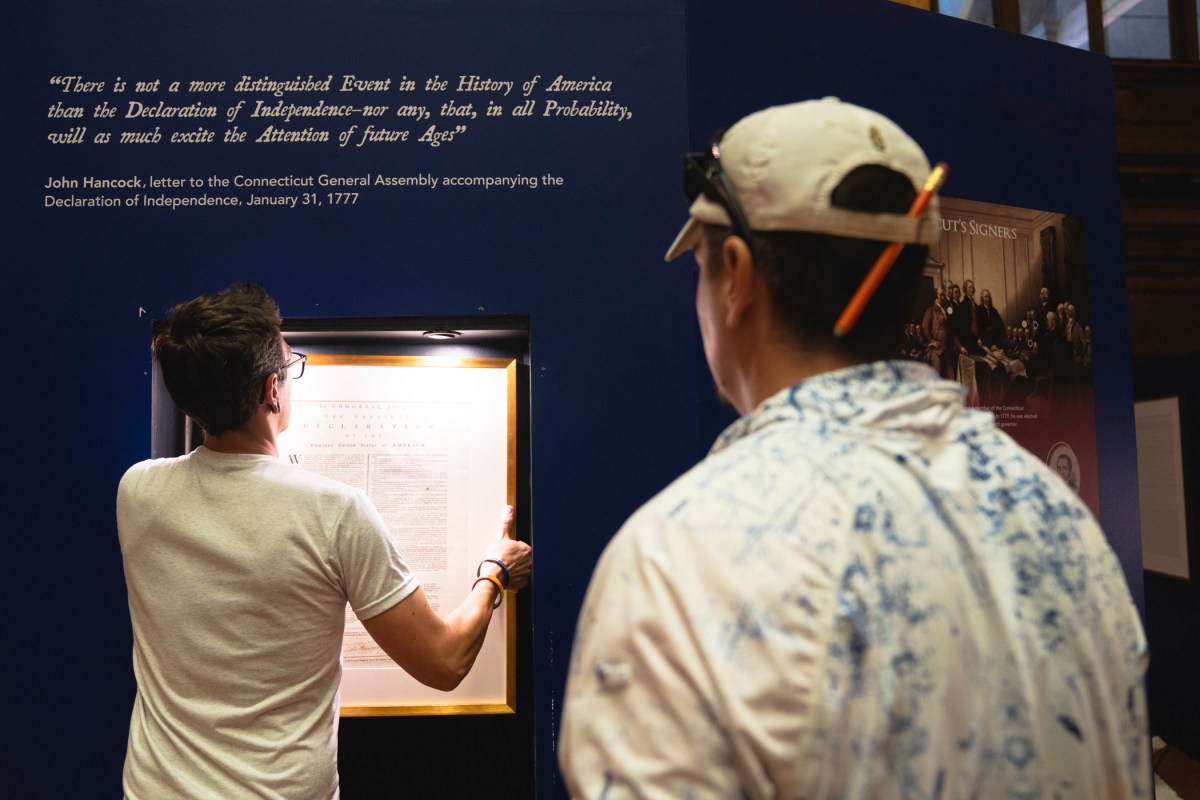



The first thing visitors at the exhibition will likely notice is a tall blue panel featuring a framed piece of paper covered in spidery cursive. When they step closer, a label will inform them that this document is Connecticut’s version of the Declaration of Independence — a resolution signed by the General Assembly 20 days before July 4, 1776.
“Connecticut’s Revolution,” an exhibition curated by the Museum of Connecticut History to commemorate the America’s 250th year of independence, opens July 4 and will be on display until July 9, 2027. According to Jennifer Matos, the museum’s administrator, it is the largest exhibition the museum has installed in decades.

Unlike most of the museum’s exhibitions, which are located in smaller galleries, this exhibition resides in a hall nestled between the State Library and the Connecticut Supreme Court. Known as Memorial Hall, the room is 85 feet long, 51 feet wide and seems to glow thanks to the tinted skylight stretched across the high ceiling. Portraits of former Connecticut governors line the walls, as if watching over this celebration of the state’s history.
“We know that so many Connecticut soldiers fought in the war and went to lots of different famous battles…but there was actually a lot of action here in Connecticut as well,” Matos said. “We would argue that the efforts of Connecticut and its residents really helped affect the outcome of war.”

In 2024, the museum’s team of four — Matos, Beth Burgess, Christine Pittsley and Patrick Smith — began brainstorming what to include in a special exhibition exploring Connecticut’s role in the Revolutionary War. After receiving approval, they combed through catalogs of the 44,000 objects and 55,000 cubic feet of archival records at their disposal.
Grants from Connecticut Humanities and the National Endowment for the Humanities, along with corporate donations, supported the development of the exhibit, while 17 museums across the country agreed to lend objects for display.
The exhibition asks a seemingly simple question: How was Connecticut affected by the Revolutionary War? “When we ask [that], we mean every single person who lived here,” Matos said. “It affected every single person, and that’s really what we’re trying to have come across in the exhibit.”
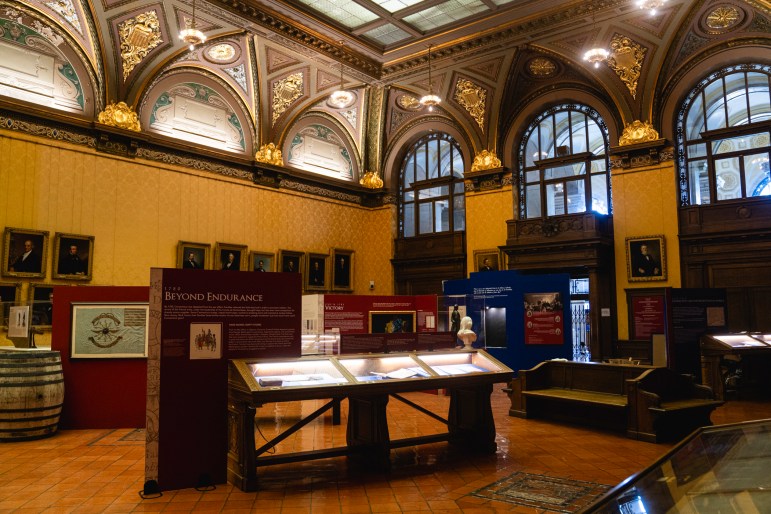
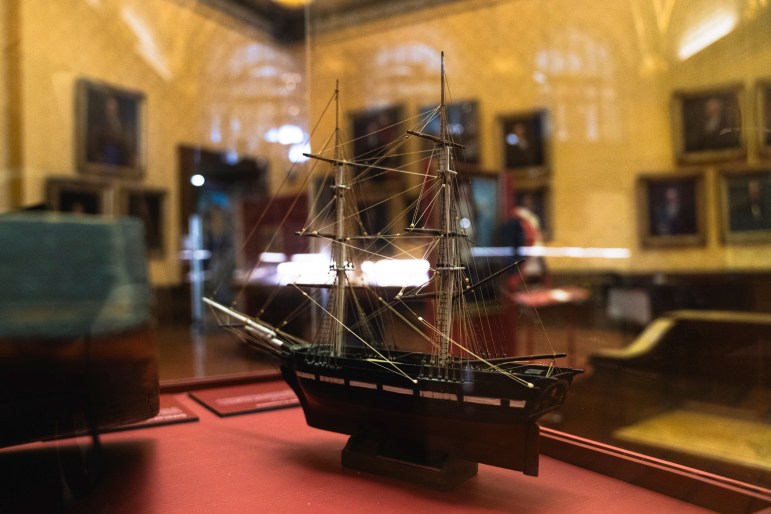
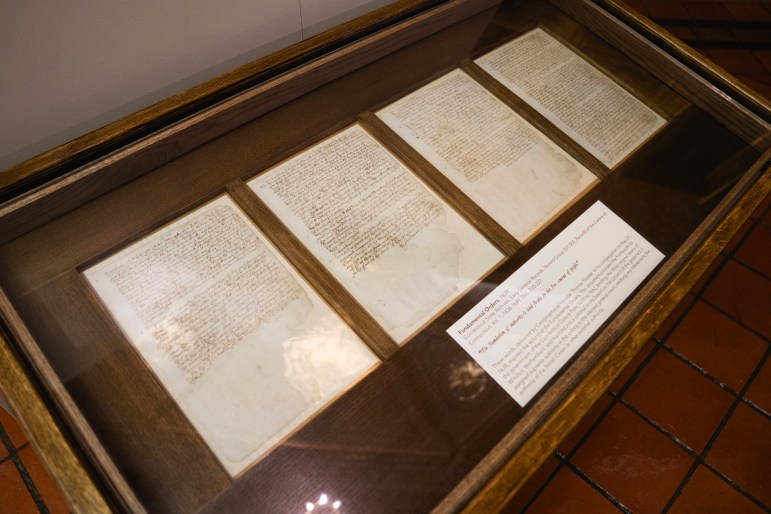
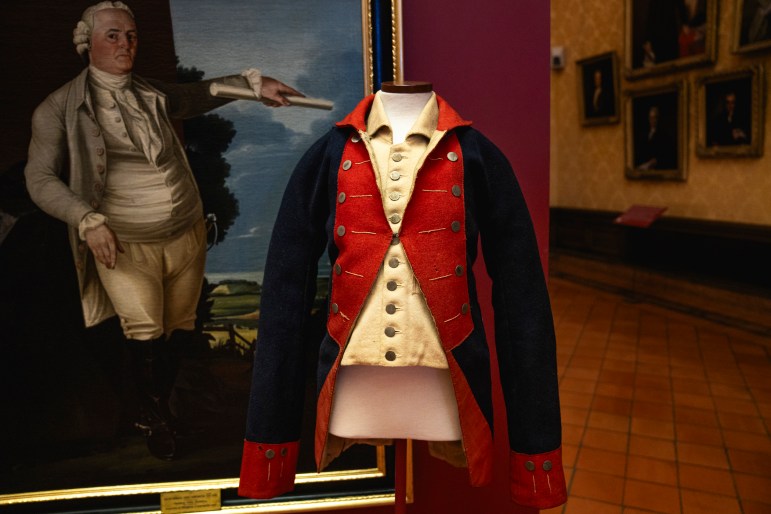
The exhibition’s circular arrangement encourages visitors to walk through the hall counterclockwise, following a chronological narrative from Connecticut in the decades preceding the Revolutionary War through post-war struggles. Objects on display range from historically striking artifacts, such as one of nine extant copies of the Declaration of Independence printed by Mary Katherine Goddard, to everyday items like pitchers from Ridgefield’s Keeler Tavern and strings of onions commemorating Wethersfield’s early reputation as “Oniontown.”
Matos described the theme of the exhibition as “presenting the expected in an unexpected way.” Familiar narratives of historical figures from middle-school Connecticut history, such as Benedict Arnold and Jonathan Trumbull, feature on the exhibition’s panels. But other stories accompany theirs: diary entries of loyalists who fled to Canada, military records of enslaved Black soldiers fighting for freedom in all senses of the word, and testimonies of female survivors from Major General William Tryon’s coastal raids in 1779.
“All of us really tried to focus on taking stories that people may have heard of and telling them the bits they didn’t know,” said Pittsley, the museum’s special projects curator.
In its most powerful moments, the exhibition breaks away from eighteenth-century objects to create space for figures that evade material history. One of the exhibition’s final panels bears a large oil painting of a Black woman gazing away from the viewer. Unlike the muted hues and neoclassical art style of other paintings displayed in the exhibition, this painting is largely in black and white, with pops of vivid red, yellow, and blue in the woman’s hair and dress.
Painted by Kern Bruce in 2025 as a commission for the Alex Breanne Corporation, this portrait depicts Esther Wallace Jackson, born free to formerly enslaved parents in the mid-1700s and a longtime Simsbury resident. Her three sons fought in the Revolutionary War, while seven of her grandsons would fight in the Civil War. Though no photographs of Jackson survived, Bruce based her likeness on her three living great-granddaughters.
Until the exhibition closes, Jackson’s portrait will join the 73 paintings of Connecticut governors hanging on the walls of Memorial Hall, all of whom are white and whose roster includes only two women.
Matos envisions the hall serving as a site for future exhibitions. In the meantime, she hopes visitors will leave “Connecticut’s Revolution” with a sense of wonder and pride.
“I hope they will feel proud of the state, the people who came before us, and the role they played in securing the freedom we have today,” she said.