



After the first half of Donald Trump’s second term, Democratic voters across the country, including Connecticut, have been skeptical of the influence of money in politics.
Voters have seen that politicians subject to the whims of super PACs are less likely to defend the interests of the people in their governance. And when politicians do not deliver on popular policies, voters lose trust in the ability of our political institutions to reliably and successfully govern.

In Maine, 75% of voters approved a ballot initiative that would limit the amount of contributions from individuals and entities to super PACs to $5,000, effectively eliminating super PACs from the state. Dinner Table Action, a conservative organization dedicated to fostering “limited government,” sued the state, and now a key case, led by the campaign finance reform nonprofit Equal Citizens, will be heard by federal judges and may head to the U.S. Supreme Court.
While debates over the future of super PACs are held in courtrooms, everyday citizens can act now to renew American democracy. Change is possible through public financing programs at the state and local levels.
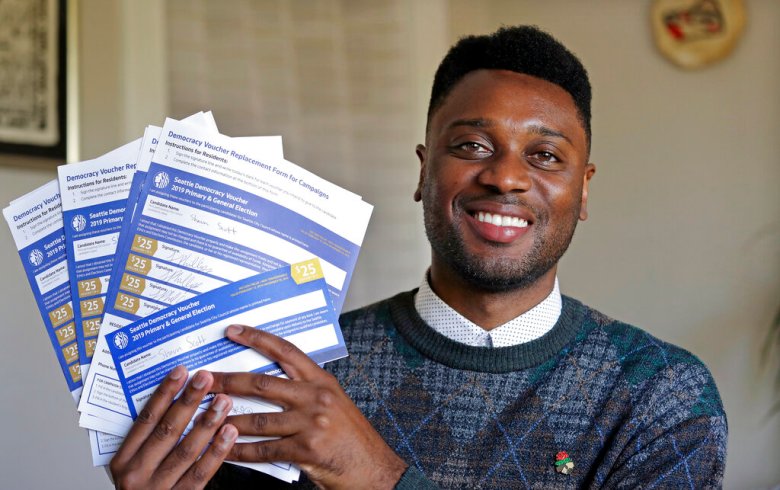
In Seattle, residents participate in the Democracy Voucher Program created after a citizen-led initiative, called “Honest Elections Seattle,” passed a suite of campaign finance reforms in November 2015. Those reforms also included limits on campaign fundraising and lobbying, added penalties for violations of election law, and instituted new reporting requirements for candidates’ and their families’ finances.
As of March this year, the Seattle Ethics and Elections Commission distributes four $25 “Democracy Vouchers” to each resident who may assign a voucher to a candidate and thus donate to their campaign. The Democracy Vouchers are funded by property taxes, costing the average property about $13 a year. The candidate may use their Democracy Voucher to finance campaign activities, instead of cozying up to wealthy donors or super PACs.
This electoral program combats distrust in political institutions by directly involving citizens in the campaign finance process. After ten years of implementing the program, campaign donors are more representative of Seattle in terms of race, income, age, and geographic location. Voter engagement and the diversity of candidates have also increased. The Democracy Voucher Program has reinvigorated Seattle’s democracy.
“Most of the people who heard of the program supported it,” said Cindy Black, former Executive Director of Fix Democracy First, a Washington nonprofit dedicated to democratic strengthening. “And when we explained what the program was to people who didn’t know, they supported it.”
Closer to home, New York City’s Campaign Finance Board manages the Matching Funds Program, helping candidates rely on the city’s residents for small-dollar donations instead of super PACs and special interests. Candidates voluntarily participate in the program, and the program matches small contributions from New York City residents up to $2,000 in public funds per eligible contributor. Notably, Mayor Zohran Mamdani funded his campaign through New York’s Matching Funds Program, and many other legislators and government officials have been elected through the program.
As a student organizer and registered voter in New Haven, I was elated to discover that New Haven has a “ Democracy Fund ,” and it is the only municipality in Connecticut to have such a fund. New Haven’s Democracy Fund uses appropriations from the Board of Alders and citizens’ donations to publicly fund mayoral candidates. By accepting public funds, these candidates agree to abide by limits on campaign donations and expenditures: they must not accept more than $400 from individuals or a town committee, they cannot accept contributions from political committees or businesses, and they must not spend more than $400,000 in a primary election or a general election. If they abide by these restrictions and obtain at least 200 small donations of at least $5, they will receive up to $125,000 in public matching funds and a public financing grant of $25,000 for both the primary and general elections.
Current Mayor of New Haven Justin Elicker is a Democracy Fund recipient . And as of this year, the Fund has celebrated two decades of operation. 2027 will be the first election cycle when mayoral, city/town clerk, and alder candidates will run for four-year, instead of two-year, terms. New Haven’s Democracy Fund will likely be crucial in financing a busy field of candidates.
Before the next election cycle, cities and municipalities across Connecticut should join Seattle, New York, and other local democracies in building “democracy funds.” They encourage citizen involvement in campaign financing and ensure candidates are responsive to citizens’ demands. This ensures candidates represent voters instead of big moneyed interests. With political will and smart budgeting, municipalities like Hartford, Stamford, and Waterbury can fund these initiatives. At the state level, it would ensure that Connecticut adequately represents all people’s interests.
To transform Connecticut’s democracy, we must transform how we fund the campaigns of our representatives.
Richie George lives in New Haven.