Communities across Connecticut, regardless of socioeconomic profiles, are struggling to access childcare options, often due to a lack of affordable options or available spots, according to a new study.
The 2025 Parents/Caregiver Survey, led by a University of Connecticut researcher in collaboration with 140 partner organizations and the state’s Office of Early Childhood, found that 53% of families across the state found childcare to be too expensive.
The study also found families of toddlers — from 18 months to 35 months — were having the most difficult time accessing care, with nearly half of those respondents searching for care or on a waitlist. Accessing care was especially challenging for low-income families.
Caregivers struggled most to find drop-in care, weekend care, full-time care and care for school vacation days, while the least sought-out type of care was overnight and school age care, according to the study.

University of Connecticut researcher Samantha Lawrence, an assistant professor in the UConn School of Social Work, surveyed 3,719 parents and caregivers across Connecticut in the third iteration of the survey, which was also conducted in 2020 and 2022. Lawrence called the survey “a really important first step to hold us accountable, to make change.”
Around a quarter of respondents said that they care for their children themselves, while nearly half used childcare centers. Two-thirds of respondents reported at least one barrier to accessing childcare. The most common obstacle was cost, followed by waitlists, lack of available openings, distance and the inability to access financial assistance programs like Care 4 Kids.
Notably, caregivers in two regions in the state with vastly different demographic and geographic profiles — a swath of the northeast and a couple of towns in lower Fairfield County — are finding it especially challenging to find spots, according to the study.
A grouping of towns — Brooklyn, Canterbury, Killingly, Putnam, Sterling, Thompson and Plainfield— had the greatest percentage of parents searching for childcare and/or on a waitlist, at 71% in 2025, when the survey was conducted. The Early Start Network in Greenwich and New Canaan came in a close second at 66%.
Around a third of parents across the state say that their current childcare does not meet their needs.
But change is already underway. A historic investment in early childhood education by Gov. Ned Lamont’s administration promises to reform the sector, with the eventual goal of offering such care at no cost to all families making less than $100,000 and capping care at 7% of income for families making more.
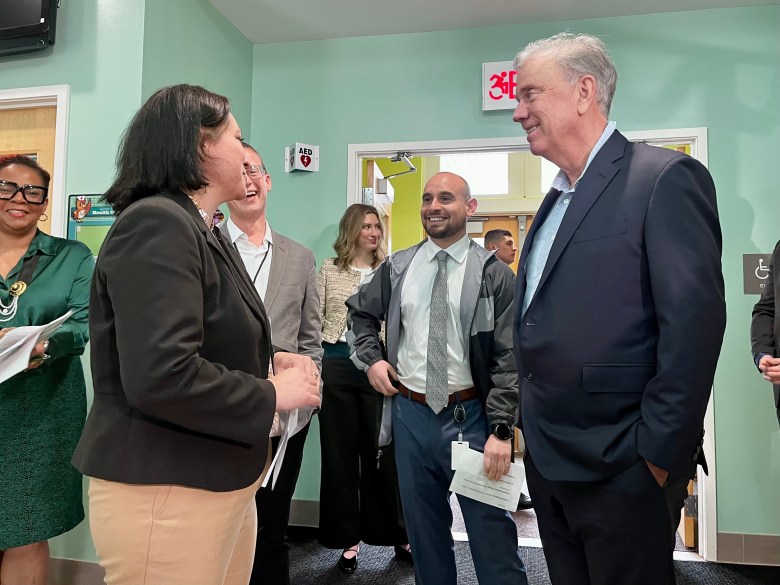
At a press conference on Wednesday, Office of Early Childhood Commissioner Elena Trueworthy said that the survey provides direction on where the system may be falling short and where it’s working, information that will inform decisions going forward.
“Your experiences are really helping to shape the now and the future of early childhood care across our state, and we are listening,” she said, adding that Connecticut has the resources to do better for families.
Treasurer Erick Russell said on Wednesday that marginalized communities, including people of color and those living in rural areas, are most impacted by the struggle to find childcare. When children don’t have those opportunities, it also limits their opportunities for learning and cognitive development in the crucial early years.
“I’m proud of the work being done in Connecticut to address many of these issues,” he said.
Russell, who estimated the endowment at around $723 million currently, said the investment in early childhood is also part of a broader picture of investing in the state’s economic health. “This is all going to be something that is going to be lifting up our state, that’s going to help fill these 80,000 jobs we have to get people back to work,” and contribute to the longterm economic health of the state, he said.
Comptroller Sean Scanlon told those gathered Wednesday a story about how his dad, a house painter, bartered an early childhood education program with his services to enroll Scanlon. “That’s what parents do. We find a way to make it work, it’s not easy,” he said. It’s a struggle for a diverse group of families, “whether you live in the richest part of Connecticut or the most rural part, it doesn’t matter.”
The survey’s results reflect this.
Lawrence said that the northeast corner of the state struggles with a variety of access concerns, from the need for more full-time care options to the proportion of parents traveling long distances to access childcare.
In the lower Fairfield County towns, availability is fluid especially in the summer months, said Louis Josephson, the CEO of Family Centers of Greenwich. He said his group currently has spots available. It provides sliding-scale tuition assistance and scholarships, as well as full-day care.
“I’ve heard about this as a longstanding phenomenon, that families are finding it really challenging to find the right slot for the right age child in the Greenwich community at a price they can afford,” he said. As for the need reflected in the survey for more spots, “We’re not feeling it, but it doesn’t mean it’s not happening.”
At Wednesday’s press conference, Vanessa Hawke recounted her experience when she, then a stay-at-home mom, was asked to become the deputy director of the Connecticut Early Childhood Alliance. She struggled to find her son a childcare spot and ended up bringing him to her first day of work.
She said she cobbled together childcare through 30 hours at two different centers. The amount her family paid was more than their mortgage, she said.
“We all know the work isn’t done yet,” Hawke said. Putting more money into the endowment will mean kids get the care they need in years to come, she said.