


This story has been updated.
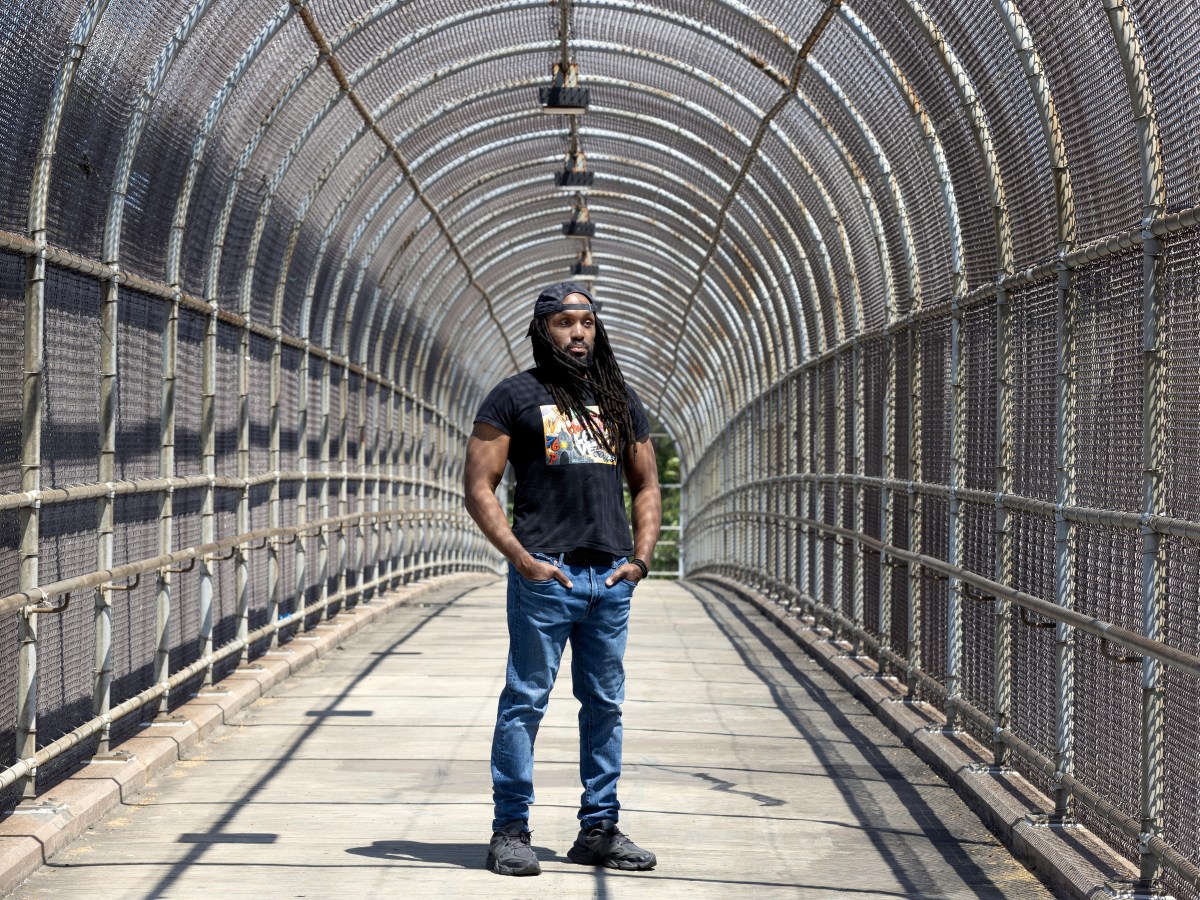
In Rashad Frett’s award-winning film “Ricky,” the audience is introduced to his titular protagonist as he walks home from work through a chain-link tunnel suspended over a Hartford highway.
Through another person’s eyes, that bridge might be an unremarkable hunk of urban infrastructure hovering on the edge of a city that has seen precious little attention from filmmakers. But to Frett, who grew up in Hartford, the bridge was a staple of its visual landscape that he knew he’d include in his first feature — a workaday vista from which his main character might regard the city skyline as he walks across the screen.
“When he’s walking to the right of frame, it shows that he’s trying to progress in his life,” Frett said. “It’s one of the subtle things we’re taught” in film school.
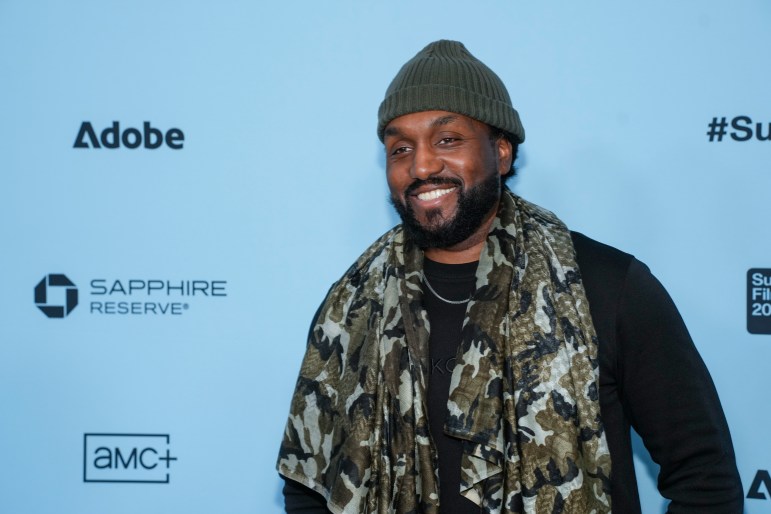
That moment is one of thousands of tiny choices Frett crafted into “Ricky,” choices that added up to his win for Best Directing at the 2025 Sundance Film Festival. “Ricky” had a national theatrical release in April and is now available for streaming.
Frett’s own journey brought him from a childhood split between the U.S. Virgin Islands and Hartford, to the Army just out of high school, where he was a combat medic who responded on 9/11 and helped evacuate people from Manhattan. After he left the military, Frett wasn’t sure what he’d do next. There was the dream of being an actor. The pragmatic plan of going to business school. But his ambition of becoming a filmmaker was simmering in the background.
As he prepared to enroll at Central Connecticut State University, Frett visited the campus and met with Jeffrey Teitler, a professor there and Emmy-winning documentary filmmaker. It wasn’t a chance encounter —Frett had already been experimenting with film. He showed Teitler a comedic short he’d made with some family and friends.
The technique wasn’t there yet, and the nicest adjective Teitler could summon about the short was “quirky.” But Teitler came away from the meeting impressed by Frett and his commitment.
“Very rarely do you have a film student come in to meet with somebody, to talk to them about what it is that they want to do — and not only talk to them but follow up in really rigorous ways,” he said. “With Rashad, or with any student, it’s not about talent,” Teitler said. Once you master the use of a basic light, for example, a character on screen “can become luminescent and contrasting, and that could be beautiful. Rashad started to love these things. He started to embrace technique and love technique.”
Many of Teitler’s students dove in. They’d take the automatic settings off the camera, they’d experiment with pacing and cinematography. “All students can do this — all students can tell a story and use cinematic technique to speak to their interests,” Teitler said. But Frett? “He lived in the lab.”
“It was kind of like the sink or swim type of thing,” Frett recalled. “I felt like I wasted most of my 20s just trying to figure out my life. By the time I got here, I was like, ‘This is what I’m doing.'”
Teitler connected Frett with a Hartford police officer named Mark Manson, who had come up with a TV show idea called “The Second District” along with Felix Soto, a “career criminal” he met while in the field. Manson and Soto were both fans of “The Wire,” the celebrated series about the Baltimore police and local gangs. “The Second District” follows a struggling Hartford police department trying to rid the streets of drugs. Manson funded the pilot, which Frett directed.
“He was really the type of person I was looking for,” Manson recalled — someone with the energy to take on the project who was also deeply rooted in Hartford.
The trailer for the pilot went viral, and the prospect of a series attracted media attention, yet efforts to produce the show fell through. Manson said he was naive to the industry at the time, and trusting of every contact who showed interest in the project.
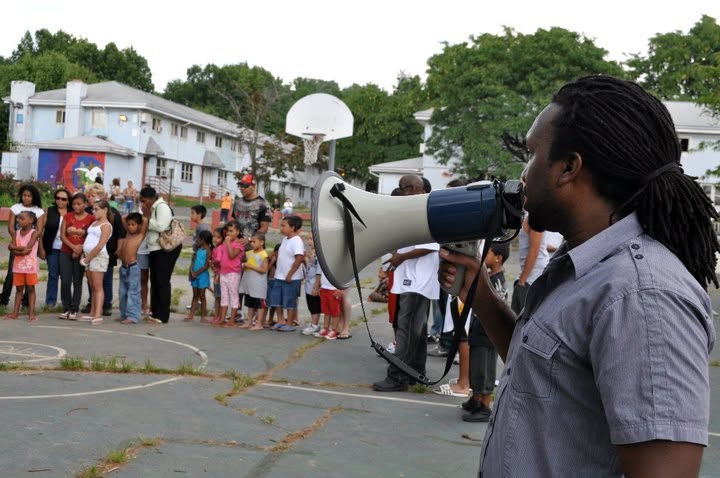
But making the pilot would cement a long-term working relationship: Manson was a co-producer of “Ricky” and has a small part the film, as does Soto. Manson has since left a career in policing to be a full-time filmmaker and is currently working on a documentary and his first feature.
Frett’s effort on the pilot for “The Second District” convinced Teitler, more than ever, that Frett needed to go to graduate school at New York University’s prestigious Tisch School of the Arts, a program Teitler attended.
“He just needed to be at the highest place of storytelling,” Teitler said, to learn from icons like Spike Lee and Todd Solondz, who were then teaching in NYU’s graduate program.
To Frett, NYU seemed like a pipe dream. From his military days, though, Frett had learned to prepare for a mission. Only this time, he had Teitler’s help. For nearly a year, teacher and student got together weekly at a sandwich shop to work on the application: a personal statement, resume, letters of recommendation and a sample script.
Frett interviewed for the program.
“Normally when I get nervous, I start cracking jokes,” he recalled. When he left the interview, he was convinced he’d blown it.
A month later, while he was watching a play in Hartford, a call came into his cellphone from a New York area code. The department chair left him a message. Instead of returning her call, Frett, still in the audience, called Teitler.
“I was like, ‘Jeff, they called me to tell me I didn’t get in,'” Frett whispered into the phone. Teitler was confused: why would they call him to tell him he didn’t get in? Another call beeped in: it was the department chair again. This time, Frett picked up. The whispered phone calls got him kicked out of the play, but he’d been admitted to NYU. “It was unreal.”
“Ricky” is based on a short Frett made during his final year at NYU. The lead character has spent half his life incarcerated since being convicted of a crime as a teenager. The film begins as he is tenuously starting his life again in Hartford, still under the watch of a parole officer.
That scenario was one Frett grew up witnessing.
“I knew a lot of people that went through the criminal justice system, and I saw how they were stunted when they came back home,” he said. Ricky has made it out of prison only to find that freedom is fragile, contingent and terrifying. The narrative tracks the question of whether Ricky will be able to hang on to that freedom. Played by Stephan James, Ricky often wears a wounded, wary expression as he goes to work, negotiates rides and tries to steer clear of trouble. At times, as when he meets a love interest, the raw hope in his eyes is shattering.
Ricky is a sympathetic character; his journey reveals many of the obstacles, small and large, that can unravel a person’s chance of starting life again after incarceration. But Frett also dares to make him flawed: he lies, steals and makes bad choices.
The character is still stuck, as Frett says, in the immature mindset of a younger man. In Hartford, he is surrounded by people with varying degrees of desire to help him, but who are also motivated by their own struggles and goals and frustrated by the strain of the character’s need.
The film is rooted in a city that Frett knows well. Frett co-wrote the feature with former NYU classmate Lin Que Ayoung, and to make the world of “Ricky” believable they “sat in arraignments, spoke to judges, spoke to parole officers,” Frett recalled. Frett also drew on his work on “The Second District.”
One critic described what distinguishes Frett’s directing as “a sixth sense for where to place the camera, so that the film is always drawing in your eye with a weaving, bobbing, voyeuristic intimacy.”
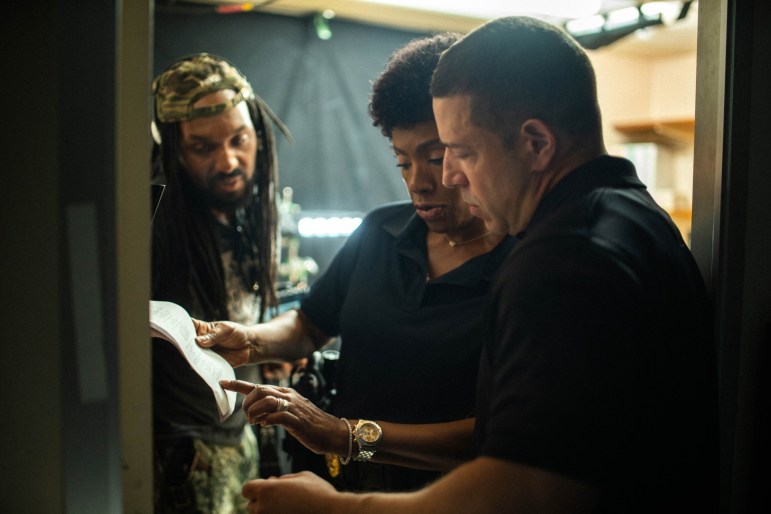
Frett’s intuitive sense of where the camera belongs is based on a confluence of experience: as an editor choosing the best cuts in post-production, as an actor who understands how to capture the nuances of performance and from working as a cinematographer composing the frame.
“When I’m directing, I’m mashing all of that,” he said. “I’m like, ‘wait, dip here,’ because when you dip here it could be an editing point. That’s how my brain works.” Before shooting, Frett and his cinematographer create a shot list as a backup, but he rarely references those plans on the day. “For the four weeks we shot, we looked at the shot list twice.”
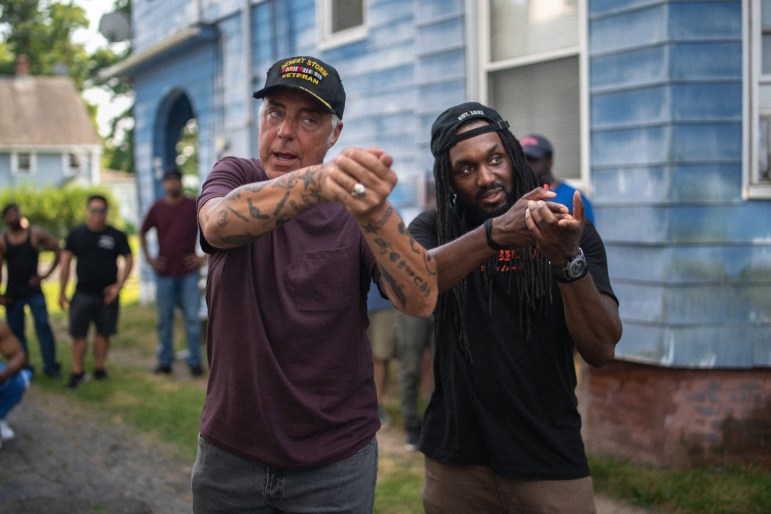
“Ricky” has proven his abilities as a filmmaker. But Frett also wants the film to spark conversation about the perils and potential for formerly incarcerated people.
“There’s a lot of opportunities, depending on where you are. What I’ve learned is some prisons have great programs to help formerly incarcerated people, and there’s a lot of others that aren’t,” he said.
Though Frett never did time, he can relate to the feeling of being spit back out into the world and having to shift your mindset: “When I went to boot camp and I went to training and I came back to the civilian world, I was still on high alert. I was in soldier mode. It took me some months to readjust to being outside.”
Frett lives in New York City now and teaches film at Brooklyn College, where he tries to pay forward the mentorship that Teitler provided him. Thanks in part to that relationship, and to his own relentless drive, he has the world at his doorstep.
The directing award at Sundance has opened up a vast range of filmmaking opportunities, and his time at NYU has given him a circle of friends that spans the globe. But he’s still interested in the possibility of reviving “The Second District” in some form, putting Hartford back on the screen.
Correction: A previous version of this story incorrectly stated that Frett directed and edited the pilot of “The Second District.” He directed but did not edit the pilot. The story also incorrectly stated that he co-wrote the short for “Ricky” with Lin Que Ayoung; he co-wrote the feature of “Ricky” with Ayoung but not the short.