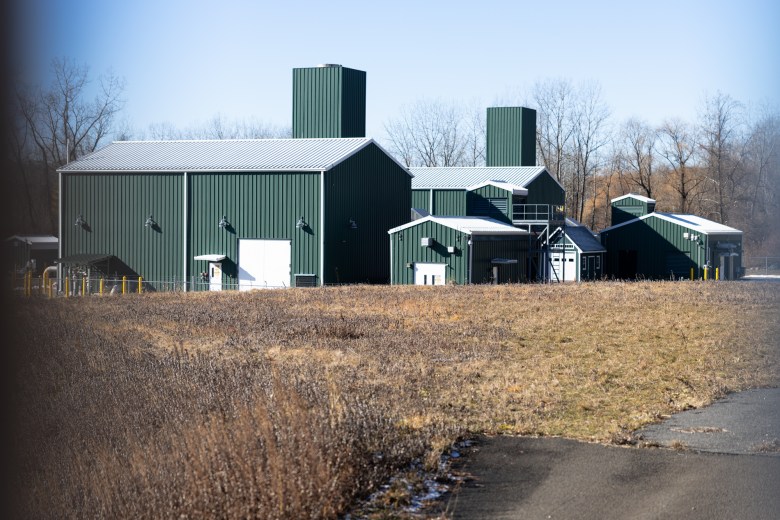
Opponents of a controversial natural gas expansion project in Brookfield celebrated this week after state environmental regulators agreed to reopen the public comment period and impose new enforcement measures to limit potential emissions.
On Friday, the Department of Energy and Environmental Protection concluded its monthslong review of the project by announcing that it would require the developer, the Iroquois Gas Transmission System, to implement continuous monitoring of certain airborne pollutants as a condition of the project’s approval.
At the same time, however, the agency said it would agree to Iroquois’ request to amend its application to allow for greater releases of carbon monoxide, a potent gas which contributes to global climate change.
As a result of the later change, DEEP said it would launch a new public comment period, giving critics and supporters 30 days to weigh in on the amended project. That will effectively delay a final decision until later this year, at the earliest, as regulators will again have to take time to review and respond to any comments.
“Our position [is that] transparency is very important to us,” Acting DEEP Commissioner Emma Cimino said in an interview on Monday. “Public participation is key to our permitting processes, and so we decided to go back out to notice so that the public could review and provide comment on these carbon monoxide numbers.”
While the decision left open the door for DEEP to eventually approve Iroquois’ application, it was welcomed by critics who have called for greater scrutiny over the project’s design.
In a post on social media announcing the decision on Friday, Brookfield First Selectman Steve Dunn said that the town will be able to request a new, more robust public hearing in addition to the public comment period — which could add further delays to the project timeline. He also suggested the town would continue pushing for additional revisions, including the use of all-electric compressors that do not release any emissions.
“At this point, a final decision has NOT been made to require Iroquois to use electric compressors,” Dunn said. “However, this is a WIN for Brookfield and our residents who have been fighting for changes.”
A spokesperson for Iroquois was not immediately available for comment.
The Brookfield project is a key component of Iroquois’ compression-only expansion of its 414-mile pipeline running from the Canadian border to its terminus in New York City. The project will increase the capacity of the pipeline by about 8%, or an additional 125 million cubic feet of gas each day.
In order to increase the flow of gas without actually expanding the size of the pipeline, Iroquois owners want to build two additional gas turbine compressors at an existing compressor station in Brookfield. The new compressors will be fueled by burning some of the gas within the pipeline, releasing emissions of carbon and other pollutants.
The expansion project had been projected to cost $272 million before the last changes announced by DEEP.
Much of the criticism of the project, particularly in Brookfield, has focused on the issue of local pollution, as well as the site’s proximity to a nearby middle school. More broadly, the project has encountered opposition from environmental groups who argue Connecticut officials have pledged to wean the state off planet-warming fossil fuels and this instead doubles down on those.
Gov. Ned Lamont, who has spoken favorably of gas expansion in the past, met with Dunn in April to discuss the local opposition to the project. He later told the Connecticut Mirror that he would not interfere with DEEP’s review of the project’s air quality permits.
DEEP received a total of 428 responses during its initial public comment period, resulting in several delays as agency staff worked to prepare a response.
One recurring criticism that appeared in those comments, according to the agency’s response, was that Brookfield — along with the rest of Fairfield County — already struggles with poor air quality as a result of out-of-state pollution that blows in from the west. Other commenters pointed out that Iroquois’ proposed increase of smog-forming nitrogen oxide, or NOx, emissions fell just below the 25 ton-per-year threshold that would have triggered a more extensive permitting process.
Without a way to constantly monitor the facility’s actual emissions, critics argued, it would be all-but impossible to determine whether those limits are being met.
“Those comments were well taken,” Cimino said. “Upon reviewing them, we decided that [the continuous air monitoring] requirements were appropriate here, and they will just allow for real-time nitrous oxide, NOx, emissions testing from each turbine, which will allow both the permit holder to ensure that they’re staying under the cap, and will ensure that DEEP has very complete information about what’s coming out of the stacks of this facility.”
Even with the anticipated increase in NOx emissions, the expanded facility should be able to operate under its current permit levels for those gases — around 42 tons per year — because it has historically operated well below its limit, according to Jaimeson Sinclair, director of engineering at DEEP’s Bureau of Air Management.
The expansion is also expected to result in a reduction of CO emissions from the Brookfield facility because Iroquois is planning to retrofit its existing equipment with more modern pollution-control equipment, in addition to constructing two new turbines, Sinclair said.
Iroquois’ original application would have resulted in a 90% reduction in allowable CO emissions, Sinclair said. However the company’s revised application, if approved, will result in a reduction closer to 69%.
Jessica Roberts, an attorney with the environmental nonprofit Save the Sound, said she and other advocates remained concerned about the project’s impacts on air quality and public health. While she said she was still reviewing the agency’s responses to the initial round of public comments, she said the agency made the right decision to continue fielding input on the project.
Roberts was involved in a lawsuit earlier this year that unsuccessfully sought to block DEEP from issuing a final ruling on the project.
“I’m very pleased to see that DEEP’s accepting comments on the entire permit as a whole, rather than the new modifications,” Roberts said. “So yeah, I do see that as a win, absolutely.”