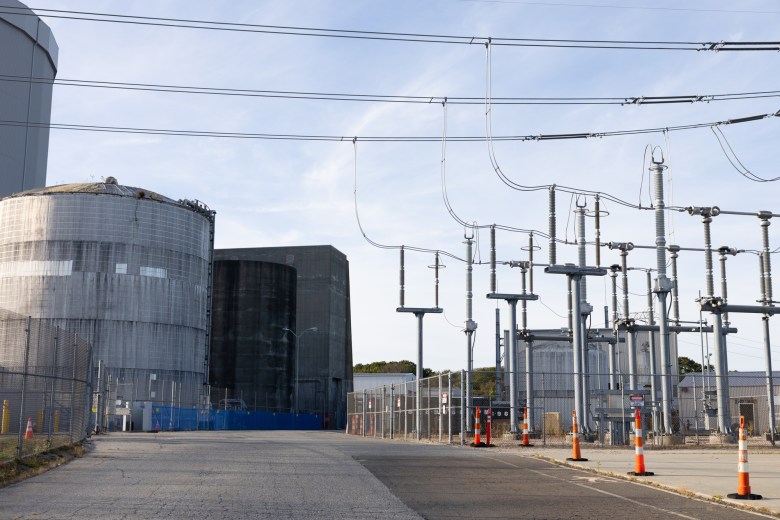
Gov. Ned Lamont announced on Tuesday that his administration is seeking to intervene in federal regulators’ review of a proposed merger between two utility giants that would consolidate control over New England’s two nuclear power plants.
While neither of the companies involved in the merger — Virginia’s Dominion Energy and Florida’s NextEra Energy — sell power directly to residential customers in Connecticut, together they control more than a quarter of all the electricity produced in the region through their ownership of nuclear, solar and natural gas power plants. Much of the power those plants produce is sold to the utility companies that serve Connecticut customers.
The deal requires approval from the Federal Energy Regulatory Commission, or FERC.
Two Connecticut state agencies, the Department of Energy and Environmental Protection and the Office of Consumer Counsel, have filed formal motions to intervene in the case before FERC, as has Attorney General William Tong, who joined Lamont in issuing a press release Tuesday warning the deal could reduce competition and raise prices for consumers.
“We’ve seen what happens when utility companies establish near-monopolies: Connecticut families pay the price while shareholders reap the rewards,” Lamont said in a statement. “We’re intervening to protect the best interests of Connecticut families and businesses and to ensure the regulatory review process considers the potential risks this merger poses for Connecticut ratepayers, who already pay some of the highest utility prices in the country.”
Cathryn Vaulman, a spokesperson for the governor, later clarified that Lamont was not yet calling for regulators to reject the merger between the two companies.
Instead, she said, Lamont was “raising concerns and seeking very strict scrutiny” over the deal’s potential impact on ratepayers.
Tong, however, went further with a statement opposing the deal, which he said comes at a time when customers are already “getting crushed by surging energy costs.”
“The last thing we need is consolidated corporate control over the core of Connecticut’s energy supply,” Tong said. “I cannot support this merger. The Office of the Attorney General has intervened in this proceeding and is weighing all legal options to protect Connecticut’s access to affordable, clean, reliable energy.”
In a statement Tuesday, Dominion spokesman Ryan Frazier did not address the proposed merger but said the company shares Lamont’s and Tong’s concerns about energy affordability.
“Nuclear power is the region’s most reliable, efficient, and cost-effective form of electricity,” he said in the statement. “We will continue working with lawmakers and policymakers throughout Connecticut and New England to ensure that nuclear power remains a viable option in the region.”
A spokesperson for NextEra did not respond to requests for comment on Tuesday.
NextEra, the larger of the two companies, announced its plans to acquire Dominion in May for $67 billion. If approved, the deal would create the world’s largest regulated utility company, with more than 10 million customers and 110 gigawatts of electric generation.
Dominion owns the Millstone Nuclear Power Plant in Waterford, which is the largest power plant in all of New England. NextEra owns Seabrook Nuclear Power Station, a slightly smaller facility in New Hampshire.
NextEra also owns gas power plants, solar and battery facilities and high-voltage transmission lines throughout the region.
Lamont’s statement on Tuesday coincided with a release from the New England States Committee on Electricity voicing similar concerns, which the committee said where shared by five New England states (New Hampshire being the exception). NESCOE pointed to NextEra’s previous efforts to block the construction of a major transmission line through Maine as evidence the merger deserves close scrutiny.
“The proposed acquisition would concentrate an unprecedented amount of leverage in NextEra,” the group’s statement said. “NextEra is an entity with a history of using its already considerable resources to obstruct new transmission infrastructure projects that New England needs.”
NESCOE also accused Dominion of having a “problematic history” in the region, specifically referring to the company’s threats to close Millstone in 2018 amid negotiations with the state over long-term power purchase agreements.
That outcome was avoided the following year when Lamont announced a deal to purchase half the plant’s output — roughly 9 million megawatt-hours a year — through 2029. Connecticut has a similar contract to purchase power from Seabrook.
In January, DEEP began seeking bids for new grid-scale clean energy procurements, including successors to its current contracts with Millstone and Seabrook. Both NextEra and Dominion submitted bids on behalf of their respective plants, spokespeople for the companies previously told the Connecticut Mirror.
That procurement process is expected to be completed before the merger between NextEra and Dominion is final. Neither company has announced plans to close or significantly expand either facility.