

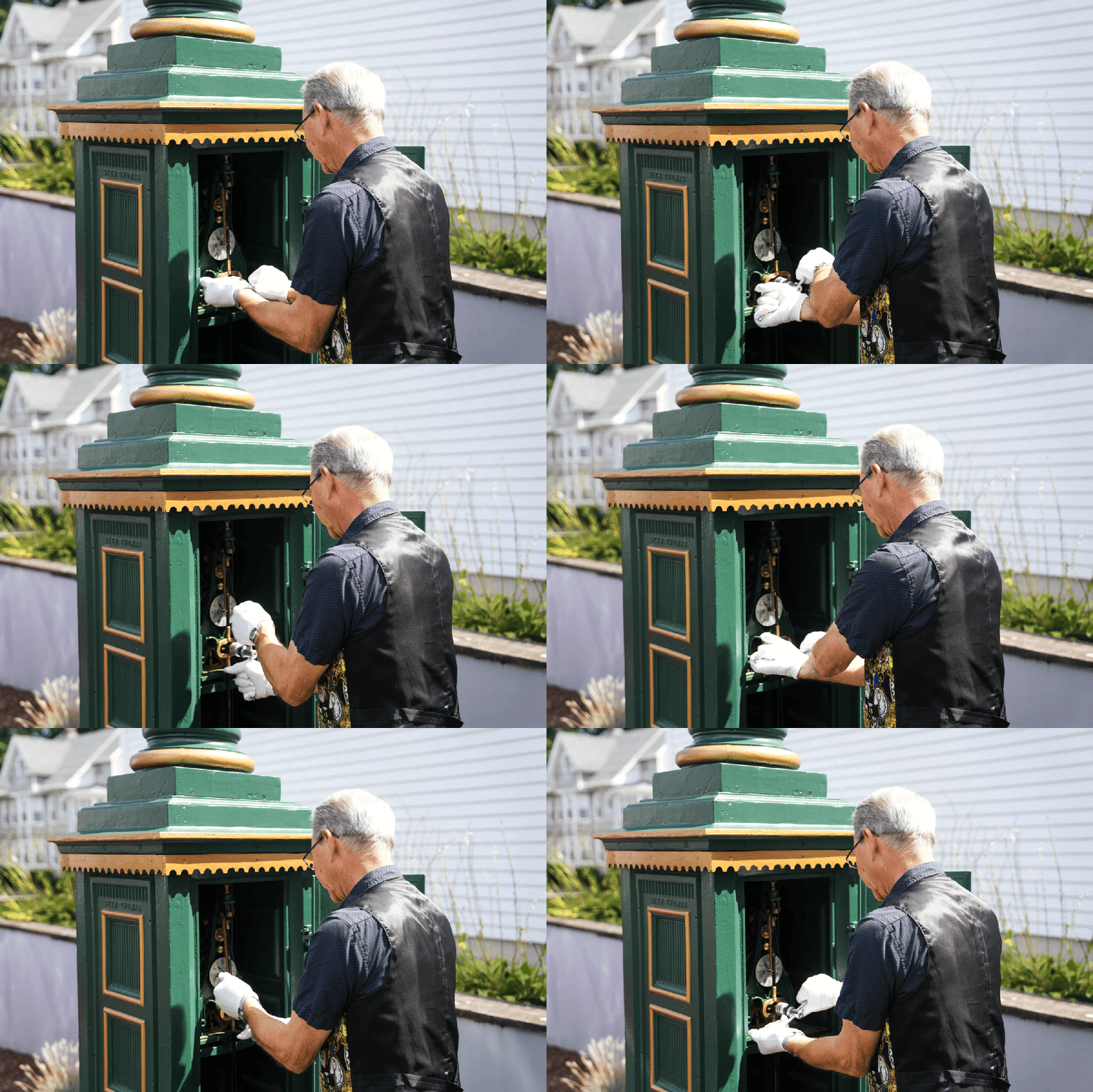



Bruce Thorin ticks when he walks.
The rhythmic sounds emitted by his trusty gold pocket watch and rotating array of wristwatches provide accompaniment (and the time) as he sets clocks throughout the American Clock and Watch Museum in Bristol.
Thorin, 77, is one of two “Old Cranks” — the other is 73-year-old Michael Dion — who volunteer every Friday to wind 65 clocks. Their tools: white cloth gloves and a cardboard box full of clock keys.
“You’ve got to make sure you’re not cranking like a crazy person,” Thorin said. “Everything is being respectful of the clock itself.”

The museum is a time capsule of timepieces. The white temperature-controlled building, a renovated 1801 house, opened in 1954 as the only museum devoted to horology in the country. There were initially 300 clocks on display, but the museum expanded to include another wing as the collection grew.
It currently holds more than 6,500 timekeeping devices, from shelf clocks to grandfather clocks, railroad watches to character watches from a range of eras. The oldest clock in the collection, a tall-case clock from Philadelphia, dates to 1720.
Most of these timepieces were acquired from private collections, through auctions and donations.
The Old Cranks regard the locally made clocks most fondly — like 19th and 20th century Ingraham clocks that were made right in Bristol, or Seth Thomas clocks made in Plymouth.

When Connecticut kept the time
The American Clock and Watch Museum celebrates Connecticut’s role in the storied history of clockmaking.
One of the earliest Connecticut producers of clocks was Thomas Harland, an English immigrant who set up shop in Norwich. At the time, clocks were expensive to make, requiring skilled craftsmen to measure and assemble intricate internal parts from brass.
But many clockmakers were interested in finding a way to speed up the process.
“These guys used to get together and talk shop time to time,” said Mel Brown, 87, who pioneered the Old Cranks with former curator Chris Bailey and now helps out at the museum with clock repairs. “There was a lot of interest in finding a way to make clocks that average people could afford. People started experimenting.”
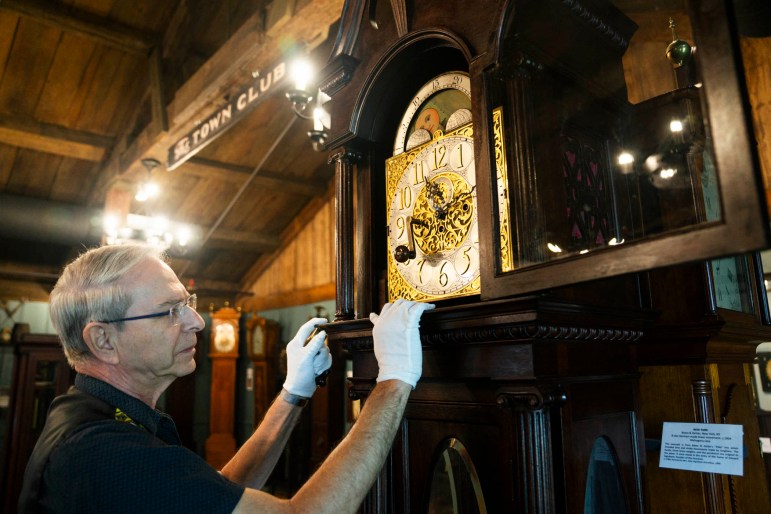
Then, in 1807, a Connecticut clockmaker named Eli Terry — who had trained in the craft with a protege of Harland’s — developed a new form of wooden clock parts that were interchangeable.
That innovation made it possible to mass produce clocks at a far lower cost, which made them affordable to a wider swath of Americans. His factory, in Plymouth, took advantage of the plentiful local wood supply and water-powered machinery along rivers in the area.
Soon, his operations were churning out smaller “shelf clocks” that could be sold door-to-door, and timepieces flooded American households. For a time, Connecticut became known as the “Clock Capital of the World.” (The village of Terryville, in Plymouth, was named in Terry’s honor.)
There’s around six Terry-style shelf clocks in the museum, and one of these “clock boxes” was made before 1825, the year his career took off. None of these clocks are wound, though.
“We don’t really wind any wooden works,” Thorin said.
Though wooden parts spurred mass production, the gears would warp and swell, making it harder to ship them overseas. Factories shifted to stamping out parts on thin brass sheets.
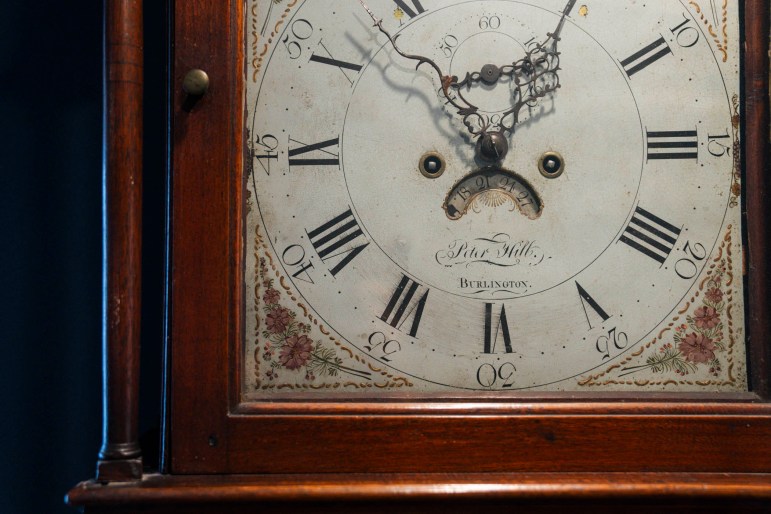
With mass production came changes in how factory workers were paid. Piecemeal rates shifted to hourly wages, and workers needed a way to log their time. So they started punching in and out, at the beginning and end of their shifts, on clocks that kept track.
In a nod to this, the American Clock and Watch Museum placed an 1885 timeclock near the entrance. Visitors can punch a timecard when they arrive.
With the advent of electricity, it was only a matter of time before mechanical clockmaking went into decline. The Flood of 1955 nearly destroyed one of Connecticut’s major factories in Thomaston, and Brown said the industry never returned what it once was.
The clock had run out.
The memory is still ticking
While the title of “Clock Capital” doesn’t spring to mind these days in Connecticut, there is a devoted community of timepiece enthusiasts who still celebrate its past. One local chapter of the National Association of Watch and Clock Collectors meets every few months in Newtown, where they share their collections and exchange spare parts and repair tips.
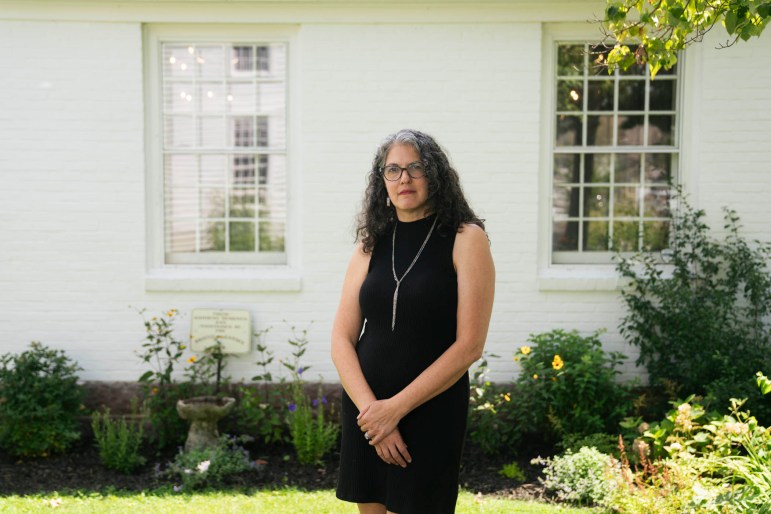
Patti Phillippon, executive director of the American Clock and Watch Museum, is regularly in attendance. The Old Cranks go too, of course.
They’re recruiting.
Anyone who’s interested in clock winding can be an Old Crank, Thorin and Dion will tell you.
Paul D’Aprile, a late member of the group, recruited Thorin at church. He convinced Dion to join after helping him fix a grandfather clock. Thorin and Dion still remember which clocks in the museum were D’Aprile’s favorites. He took particular care of a 1848 wall clock originally made for Charter Oak Insurance Company; in honor of a son who’d died, the D’Aprile family provided the museum with funds for its maintenance.
Lately, Phillippon has been working to raise the museum’s profile among Connecticut collectors and beyond. Recently, she held focus groups to hear ideas and perspectives as the museum was developing its upcoming exhibition, “The Story of American Watchmaking.”
“We have so many different American watch manufactures, so we really want to make sure everyone is represented,” Philippon said.
The exhibit is slated to open next February.
