


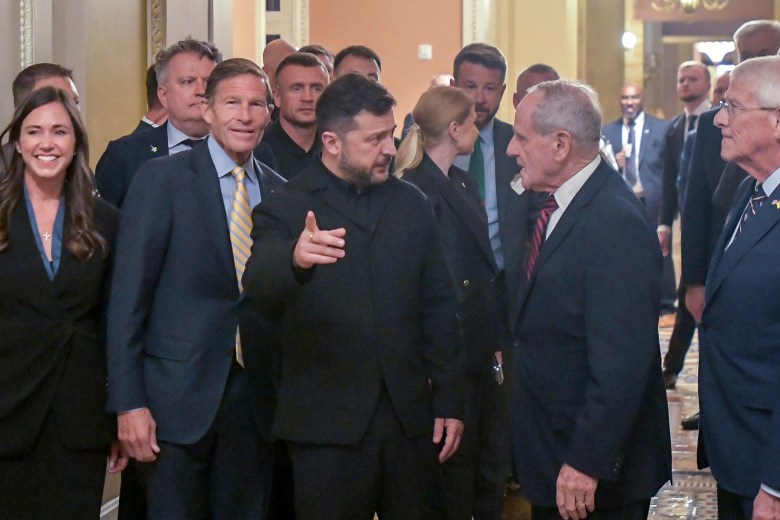
After a years-long effort to exert pressure on Russia for its war in Ukraine, Congress took the final step in passing a sanctions bill before lawmakers departed for campaign season.
But the effort faced resistance from some House Democrats, including those in Connecticut, who fear it gives more latitude to President Donald Trump. The party needed to weigh its support for Ukraine while considering giving such authority to Trump, who’s been sympathetic to Russia and its leader Vladimir Putin and has exercised an aggressive tariff agenda since taking office.
The bill ultimately overcame that opposition in a Wednesday night vote, with several dozen House Democrats backing the bill alongside most Republicans. Notably, all five of Connecticut’s Democratic members opposed it, with those concerns in mind.
For U.S. Sen. Richard Blumenthal, who played a major role in crafting the bill, he’s still in a bit of euphoric disbelief a day later.
“I still have to pinch myself, quite honestly, when I think we’ve done it because there were so many moments when it seemed impossible, with this White House and all the complexities of sanctions and tariffs and international relations,” Blumenthal said on his way to votes on Thursday. “There are very few major bills that get through the United States Congress these days, especially dealing with an issue as challenging and controversial as this one.”
Passage of the legislation was the culmination of years of work on a bill alongside the late Sen. Lindsey Graham, the South Carolina Republican who died in July as he finished negotiations on it. Blumenthal has made nearly a dozen visits to Ukraine since Russia invaded in early 2022 and visited as recently as a couple of weeks ago.
The reception the Connecticut Democrat got from his colleagues at the U.S. Capitol on Thursday underscored the gravity of the moment: getting a bipartisan bill across the finish line in the current political climate right before a pivotal election.
Following House passage, Blumenthal and members who played a role in its passage celebrated the legislative victory, which they said was a testament to Graham’s work on the legislation up until his death.
The legislation named for Graham will impose tariffs up to 100% on the top five importers of Russian oil or gas, including China and India. It will also place sanctions on Russia’s energy sector, its financial institutions and officials as well as the country’s “shadow fleet” of oil tankers that seek to circumvent sanctions. It will also extend sanctions to Iran.
“On this day of joy and pride, I want to try to channel my inner Lindsey Graham: This is a big freaking deal,” Blumenthal said to laughs from his colleagues Wednesday night. “He used a different word, and there is no way of my imitating or replicating Lindsey Graham.”
Blumenthal noted the challenges they encountered along the way: holding together a majority in the Senate and then doing the same in an “obstacle-ridden” House. There were also hurdles to getting the White House on board, but when Graham met with Trump at the beginning of the year, the senator said the president “green lit” the bill.
But support for a vote didn’t come to fruition until the summer.
The bill got significant momentum and attention after Graham’s death. The Senate passed it a few weeks after in early August and just before its month-long recess. Connecticut’s other U.S. senator, Chris Murphy, also voted for the bill.
Congress fully returned to D.C. this week, but the House has already wrapped up its work and won’t come back into session until after the midterms. But the Russia sanctions bill was one of the House’s final acts on Wednesday evening, sending the measure to Trump for his signature.
In a joint statement penned by U.S. Reps. John Larson, Joe Courtney, Rosa DeLauro, Jim Himes and Jahana Hayes, the delegation explained the reasoning behind their vote while pledging their support for Ukraine and commending Blumenthal’s work on it.
The Democrats pointed to a different bill that passed the House in June that would provide military assistance to Ukraine along with enforcement language on sanctions. They noted the bill that ultimately passed leaves sanctions to the discretion of Trump “who has repeatedly demonstrated bias towards Russia’s war goals of seizing the eastern Donbas” and could “enable the President’s penchant for imposing reckless tariffs at the expense of the American consumer” without more military aid.
“Our delegation has staunchly support Ukraine and are determined to provide tangible assistance as well as enforceable sanctions against Putin’s war machine. We recognize the Senate’s hard work and applaud Senator Blumenthal and his colleagues for their efforts,” the joint statement reads. “Due to our concerns, we could not vote for this bill in its current form and remain committed to continuing to stand unwaveringly with the Ukrainian people and enacting tough sanctions that hold the Putin regime accountable.”
Other members of the delegation have visited Ukraine in recent months. Himes visited with Blumenthal in May to meet with President Volodymyr Zelenskyy, and DeLauro, the top Democrat on the House Appropriations Committee, traveled there in August.
Connecticut’s entire congressional delegation has continued to push for additional aid to Ukraine and a continued commitment to the country amid four years of war.
But Democrats were largely wary of the tariff authority it grants to Trump, who has aggressively sought to implement sweeping tariffs and is currently engaged in a trade war with Canada. The result has led to an increase in prices for U.S. consumers.
Blumenthal said he shares those concerns with his Democratic colleagues and had spoken with the Connecticut delegation. At Wednesday’s press conference, he urged Trump to “aggressively and effectively” implement the bill.
He said he doesn’t know the timing of when it’ll move over to Trump’s desk. The president supports the bill and is expected to sign it into law.
“I was sympathetic to the concerns about the bill. Obviously, with a different president and a different majority in Congress, there would be a different bill,” Blumenthal said in an interview on Thursday. “But I sensed all the way along, talking to President Zelenskyy and Ukrainians on my trips there, that this bill really mattered. And they are the best judge of what matters to them in their fight. And I think it will matter.”
“This bill is far from perfect, but we couldn’t let the perfect be the enemy of the good. And I hope those concerns are unfounded, and if Trump misuses his existing authority or any of the new authority, I will be all over it with very blunt criticism,” he continued, noting that the courts have already struck down the “misuse” of his current authority. He now believes there will now be bipartisan support in Congress to address it.
While he sees it as a major step forward, Blumenthal said more needs to be done for Ukraine, including additional aid. But a full Congress won’t be able to move legislation until after the Nov. 3 elections. And when they return, lawmakers will only have a short window in the lame duck session before the end of the year as they contend with other priorities and government funding.
Still, he hopes the momentum of enacting this new law will bode well for future action.
“But alone, it’s not enough. We are far from done,” Blumenthal said. “The momentum that we have as a result of this bill should enable us to fight for the military aid, the economic support, the political and moral bolstering that Ukraine needs and deserves.”
