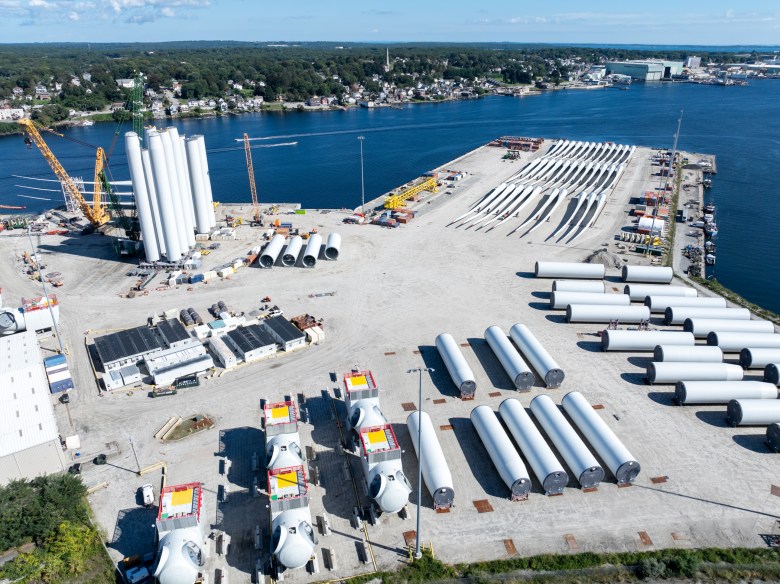
Last Friday, The Connecticut Mirror, along with three other nonprofit newsrooms — ProPublica, the New Bedford Light and Ocean State Media — published a major reporting project on the Trump administration’s war on offshore wind construction in New England.
Trump’s effort to end future offshore wind development has led to massive uncertainty in the New London area, where residents were promised steady jobs and an economic boost from the industry.
John Moritz, our energy and environment reporter, has followed the progress of wind energy development in the region for years. For this project, he spent time with workers and leaders in New London to understand what the promise of this new industry meant to them — and how it feels to see it fade away.
Here’s the story behind that story.
This interview has been edited for length and clarity.
The CT Mirror: How did you first get wind of this story?
John Moritz: I’d been covering the renovation and overhaul of the State Pier dating back several years. During the Biden administration, the state, along with Ørsted and Eversource, invested about $300 million to basically turn what had been an old, underutilized public pier in New London into this massive heavy lift platform for the offshore wind industry.
And when the Trump administration started attacking that industry and trying to shut down some of these projects last year, I wanted to answer the question of what happens to that investment. What’s the long term impact going to be on the pier? And as it turns out, there were reporters at some of our partner publications in Massachusetts and Rhode Island where similar investments were being made, who had the same questions.
CTM: As you said, you’ve reported on offshore wind developments in Connecticut for years now. How did this story feel different?
JM: This story isn’t just a Connecticut story, it’s a global story. The companies that were coming to invest here are some of the biggest energy companies in the world. And these companies invested hundreds of millions of dollars.
As part of our reporting on this project, we went through earnings calls that were being announced very early in the morning, our time, because these are European companies. And if you go into the meeting minutes of these calls, they’re saying they are now shifting their investments to Asia and the Pacific and South America. They’re not investing in the United States any longer because they see the political climate here as being too turbulent.
CTM: What would you say was the hardest part of reporting the story?
JM: The hardest part of the story was getting people to talk openly about the impact of the administration’s actions on their lives. There are so many people who recognize that this is an administration that can change policies kind of on a whim, seemingly. And no one wanted to be seen as the instigator of another fight that could potentially put people out of work or threaten hundreds of millions of dollars of investments.
CTM: How long have you been working on this project?
JM: I remember it was cold and dreary, our first meeting, so it makes me think it was sometime last winter [December 2025].
CTM: You’ve been working on this for a really long time. Can you walk me through how the story came together?
JM: We really wanted to focus on the stories of real people that this was impacting. One of the things I focused on was the mayor of New London and his son. The mayor’s name is Michael and his son is Thomas.
The mayor went to England for a trip to view that country’s offshore wind industry. He talked to me about his vision of having old shuttered factories in Connecticut be repurposed similarly to what he saw in England, which was one of the world’s leading producers of wind. And his son actually went to work as a union laborer on the pier. So it’s a multi-generational story of people who saw a resurgence happening in their community and now are left wondering what’s going to happen next.