


Until recently, when Amazon customers typed “melatonin” into the site’s search bar, a variety of sleep supplements would appear in the most coveted real estate on the listings results — top left on the first page.
One of consultant Jason Boyce’s clients, a seller of natural supplements, often sought to outbid competitors for the best spots by promising Amazon about $6 each time someone clicked on the product. While the brand never attained the top left slot, it regularly landed in the top row. But in late March, Boyce noticed that Amazon’s own brand, Solimo, had taken over the top left, while his client’s product had been bumped to a lower row. Then Boyce typed “ground coffee” in the search bar, only to find AmazonFresh Colombia ground coffee in the top left, pushing down another client.
“This is madness,” Boyce said. “They’re putting their own product right in the front of the line.”
He said the clients, whom he declined to name because they feared retaliation from Amazon, were outraged. “They were thinking, ‘What is Amazon going to do next?’” he said.
Although customers don’t necessarily realize it, brands have for years been able to bid on search terms to secure the most visible listing positions at the top of Amazon’s product search results pages, where their products carry a “sponsored” tag above the description. Now, they still bid for top-row placements, but the best spot — the top left on the first page — is unavailable across dozens of product search terms, according to consultants and ProPublica’s own review. During the pandemic, Amazon has begun to use that position for its own private-label products, without bidding, under the heading “featured from our brands.”
The domino effect of Amazon’s new strategy has demoted competitors’ listings for products including diapers, copy paper, kids’ pajamas, mattresses, trail mix and lightbulbs. By putting its own private brands in some of the most valuable slots, Amazon is sacrificing short-term ad revenue to build up sales of its private brands over time, consultants said.
The new approach violates Amazon’s mantra that every decision must put the customer first, said Tim Hughes, a consultant who used to work in product management at Amazon. “Why would their brand be a better option for consumers?” said Hughes, chief operating officer of a firm that helps brands manage Amazon accounts. “It doesn’t necessarily have to be cheaper, or better, or anything. So then what’s their justification to say, ‘We’re just going to put this up in front of everybody else’? This is just another example of Amazon being able to manipulate the platform for its own good use.”
While Amazon has promoted its own private-label products in various prominent spots on its site over the years, consultants and legal experts said this latest iteration takes advantage of the surge in online buying during the pandemic and may accentuate antitrust concerns for a company already juggling domestic and global probes. Amazon’s share price has increased more than 30% this year, although the company missed earnings estimates for the most recent quarter because of higher costs.
Amazon’s dedicating of prime positions to its own brands could be viewed under U.S. law as “exclusionary conduct” — which, along with proving a company has substantial market power, is a key element of antitrust cases, said Christopher Sagers, a professor of antitrust law at Cleveland State University in Ohio.
Anti-competitive move?
“If I were their lawyer, this would definitely make me nervous,” Sagers said. “It’s hard to explain the search results finagling as anything besides a nasty, anti-competitive move.”
Amazon acknowledged that it recently introduced this “featured from our brands” strategy, which the company described as “merchandising placement” rather than advertising. “Like all retailers, Amazon regularly makes decisions about how to use the space in our stores based on a variety of factors, centered on what customers will find most helpful,” a spokesperson said. “That’s a normal part of retail that’s happened for decades.” There is no real estate reserved for Amazon brands, and they may be placed anywhere, Amazon said.
Amazon highlights its private-label brands because customers prefer them, the spokesperson added. “Amazon’s private brand products have on average higher customer review ratings, lower return rates and higher repeat purchase rates than other comparable brands in the Amazon store,” he said. “As a result, like other retailers, Amazon highlights its private brands in promotions and marketing.” Most private-label sales are for staples such as paper towels, baby wipes and batteries, Amazon said.
Absent favored treatment by Amazon, though, its private-label brands sometimes don’t have enough sales under the algorithm’s criteria to justify a listing on the first page of search results, said consultant James Thomson, the former business head of an Amazon team that recruits third-party sellers. Amazon Essentials regular and slim-fit short-sleeve pocket Oxford shirts, both listed on the first page of results for “men’s shirts,” had about $4,400 and $1,600, respectively, in sales over a recent 30-day period, far less than the surrounding unpaid listings. Their sales should have put the Oxford shirts at best at the bottom of the second page, according to Thomson and Jungle Scout, a service that analyzes Amazon sales rank data.
Amazon “confuses consumers into thinking these products are more popular than they really are,” Thomson said. Amazon said its shopping results don’t favor private brands, and sales is only one of many factors considered by its algorithm.
Amazon has 45 private-label brands with a total of 243,000 products available, accounting for about 1% of retail sales, the company said. “Private labels are playing an increasingly important role in Amazon’s overall strategy,” Coresight Research said in a report last month.
Since people read from left to right, the top left is the most desirable spot in the search results. When we searched for “almonds,” Amazon’s Happy Belly brand whole raw almonds occupied that spot. In the “bra” results, it was Amazon’s Iris & Lilly brand. A search for “envelopes” revealed AmazonBasics security tinted version in the top left, ahead of three paid listings. A search for “shaving cream” featured Amazon’s Made For You shaving cream, to the left of two paid listings from The Art of Shaving brand. A spokesman for The Art of Shaving said “there aren’t any issues at the moment” with sales or how its products appear on Amazon.
The prominent positioning for its own products enables Amazon to boost prices, Boyce said. When Boyce, who used to own a home recreation equipment company and remains interested in the category, happened to type “bocce” into Amazon’s search bar in April, he saw an Amazon brand bocce ball set featured at the top, before all the other listings, he said. When he checked again weeks later, the price of Amazon’s product — still top left — had gone up several dollars, he said. “We’re always looking to deliver consistently low prices to customers on all products we offer,” the spokesperson said, adding, “No amount of advertising will fool customers into paying more than they want if there are competitive offers for competitive products.”
Amazon has an advantage over competitors because it doesn’t have to pay itself for the best placement, Boyce said. Brands pay between 10% and 30% of sales for a sponsored slot, he said. “The deck is hugely stacked in favor of Amazon,” he said.
Amazon is facing at least one European antitrust investigation and two in the U.S. The House Judiciary Committee last June announced an investigation into possible anti-competitive conduct by large tech companies including Amazon. The House investigation is ongoing, according to a spokesman for Rep. David Cicilline of Rhode Island, the chairman of the committee’s antitrust subcommittee. Cicilline last month threatened to subpoena Amazon CEO Jeff Bezos if he ignores a request to testify. The demand followed a Wall Street Journal report that Amazon used data about third-party sellers on its site to develop competing products under its private-label brands.
In addition, the Federal Trade Commission has reportedly been looking into possible anti-competitive practices at Amazon for nearly a year. The FTC declined to comment. Other big tech companies also have been under scrutiny. Media outlets reported last month that the Justice Department and a group of state attorneys general are likely to file antitrust lawsuits against Google, focusing in part on its online advertising business.
Amazon declined to comment specifically on the investigations. It said that it faces “intense competition in every segment” in which it operates.
Amazon represents less than 4% of the U.S. retail market but nearly 40% of U.S. online sales. It’s the third-biggest player in the U.S. digital advertising market, behind Google and Facebook, with about $10 billion in U.S. digital ad revenues in 2019, according to market research firm eMarketer. Amazon’s share of that space is about 8% and growing, eMarketer said. Three-fourths of Amazon’s digital ad revenues come from keyword-targeted, cost-per-click search ads, including the “sponsored product” listings, according to eMarketer estimates.
Pay to play
A desktop search on Amazon generally yields multiple pages of results. Each page may show a dozen or more rows of products, typically with three or four listings per row. The top row may feature between one and four paid listings, known as sponsored products. For example, a recent search for “curtains” showed AmazonBasics curtains in the top left spot, followed by two sponsored and one “organic” — or unpaid — listing across the row.
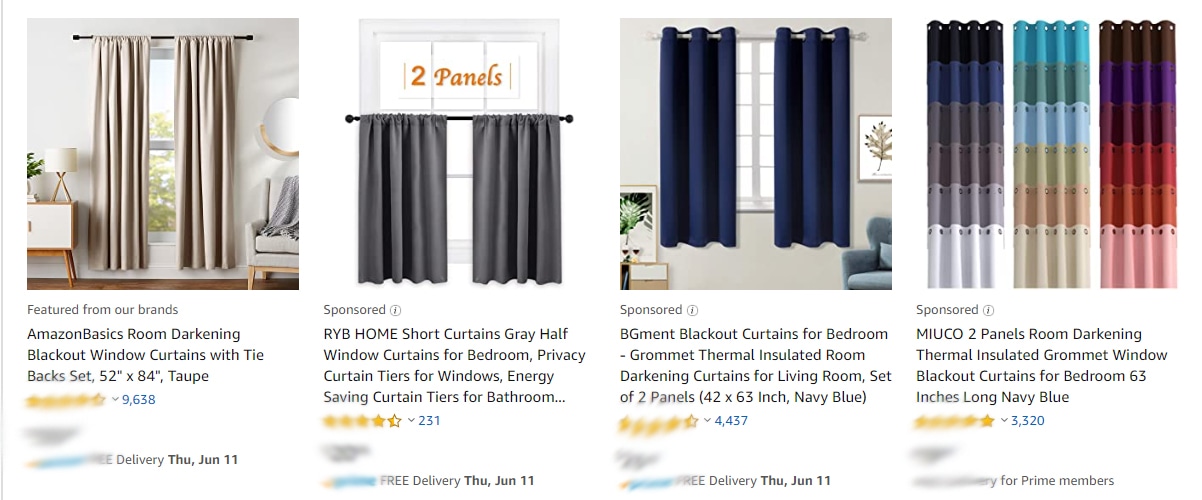
Under what Boyce calls a “pay-to-play” system, brands compete for sponsored product placement on Amazon’s website, bidding on a specific search term such as “curtains.” Brands pay nothing upfront for these listings. Rather, they bid on what they’re willing to pay Amazon per click — amounts typically ranging from about a nickel to $20 per click, depending on the search term, consultants said.
Many brands may be competing for the same limited ad space, and they can learn estimated winning bids before placing theirs. Having the highest bid doesn’t guarantee placement. When determining which brands will get the coveted spots, Amazon’s algorithm takes into account a brand’s sales and inventory availability, and the product’s relevance to the desired search term. Placement for individual brands is constantly changing.
Amazon offers sponsored product ads at the bottom of the first search results page as well as on subsequent pages, but those are less expensive since they generally lead to fewer sales, consultants said. If products — like the sleep supplement sold by Boyce’s client — lose their sponsored position, they no longer have to pay for placement.
Amazon began offering pay-per-click ads on its site in 2012, said Mike Ziegler, a former senior product manager for Amazon’s advertising program. Since then, it has gradually increased both the number of paid listings on product search results pages as well as the amount of space that features Amazon-brand products, said Thomson, who advises brands working with Amazon.
In recent years, Amazon has sometimes featured its own products in headline ads that run across the top of the results page, just below the search bar. This area is now known as “sponsored brand” space and is available to brands willing to bid on it. In addition, Amazon has featured its brands in the middle of the results page in a section called “top rated from our brands.” It still sometimes promotes its products in this way. But, prior to the pandemic, Amazon’s private-label brands only entered the top row of listings through competitive bidding, the company said.
By giving itself the top placement, Amazon is guaranteeing the success of its brands, Hughes said. Since customers are more likely to buy products listed at the top of the search results, Amazon is boosting sales for its products — and increasing, by the same token, their rating in the eyes of the algorithm. So even if Amazon ultimately cedes the top left, its products will end up in a better position relative to competitors than before, Hughes said. Amazon said this isn’t part of its strategy.
When Hughes worked for Amazon between 2012 and 2015, his job was to maximize advertising revenue on the Amazon-owned website IMDb, a database of movies and TV shows that then had annual ad revenue of about $50 million, he said. For unpopular or unused advertising space, Hughes built relationships with so-called “remnant providers” that would fill the space with last-minute ads for a discounted rate. Although his job was to get the most revenue out of the available ad space, Hughes said his boss eventually told him to drop the remnant ad suppliers in favor of running unpaid ads for Amazon services including Prime Video.
“I was told flat out we’re not doing remnant providers anymore, we’re just showing Amazon house ads,” he said. “There was no rationale. It came from senior leadership. You have to do it.”
Amazon said it only shows house ads in the program described by Hughes when it doesn’t have a relevant paid ad.
Hughes said that Amazon’s efforts to promote its own brands have become more aggressive over the years, first with the headline and middle-of-page placements and now with the top-left slot. “They don’t have to fight like everybody else to get positioning” for their private-label brands on the product search pages, Hughes said. “They just put ‘our brands’ there, and boom, instant sales. The difference between being in slot one versus slot 10, even on the first page, is going to be an order of magnitude different in terms of sales. It is an exponentially decreasing curve. It is a huge drop off.”
Dan Brownsher, CEO of an agency that advises sellers on Amazon, said brands compete to be in the top row of search results because the “further down you go on a page, the less likely you are” to click on a listing and buy a product, he said. “If you’re on Page 2, you’re basically dead,” he said. “If Amazon is taking up key real estate, then that’s pushing everybody else down.”
As a result, Amazon’s private-label sales are likely to increase, even on products that currently aren’t popular, Brownsher said. So while the company may forgo advertising revenue in the short term, as its own brand displaces a paid advertising slot, it’s “going to win in the long term,” he said. Brownsher also said Amazon may promote products that are overstocked and need to be sold quickly. The Amazon spokesperson said this isn’t its strategy.
Not all sellers are upset. Ziegler, the former senior product manager who now advises brands who advertise on Amazon, said his clients — which include Unilever Food Solutions — accept that Amazon has in the past promoted its own brands alongside competitors and that it will continue to do so. “It’s a fact of life,” Ziegler said. Unilever did not respond to a request for comment.
Randall Fields, CEO of retail advisory firm Park City Group, said grocery and discount chains have long created private-label products. Amazon putting its brands in the most lucrative web space is akin to a grocery store featuring its own brand of trail mix in the most prominent shelf space, he said. Like Amazon, brick-and-mortar stores also charge fees for premier display space.
“They’re not doing anything that any other supermarket chain is not doing,” said Fields, co-founder of cookie maker Mrs. Fields. (He’s no longer involved with the company.) “It’s just the scale of it is so immense at Amazon.”
There is an important difference, Thomson and Sagers said. Because of Amazon’s dominance over online retail, many sellers and suppliers rely on it as their primary or only source of sales revenue, they said.
“An open marketplace means anybody can show up, anybody can sell their products, anybody’s got an opportunity,” Thomson said. “But what happens when prime real estate gets created and only Amazon can have access to it? It only pushes you further and further away from the marketplace actually being so-called ‘open.’ It’s not like somebody else can say, ‘I’m prepared to pay to have that real estate.’ Nope. That real estate is not available.”
This story first appeared June 6, 2020, in ProPublica.com.