



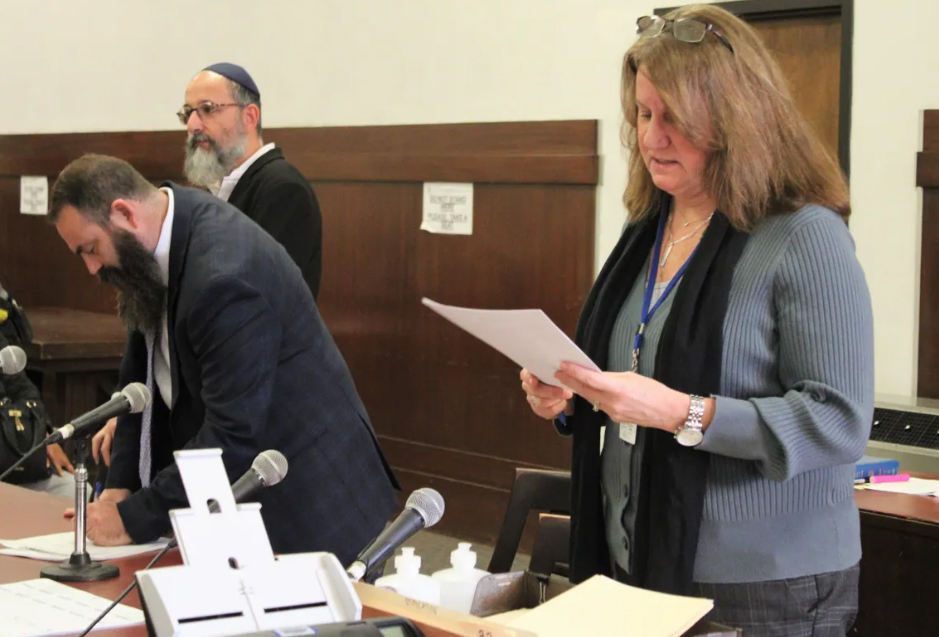
One of New Haven’s largest landlords was fined another $1,500 in state court for six more now-fixed housing code violations — as New Haven leaders pushed at the state Capitol to quadruple the cost of those same types of penalties.
The landlord, Shmuel Aizenberg, runs the local megalandlord-property management-real estate investment outfit Ocean Management, which through its affiliates controls over 1,000 mostly low-income apartments across the city.
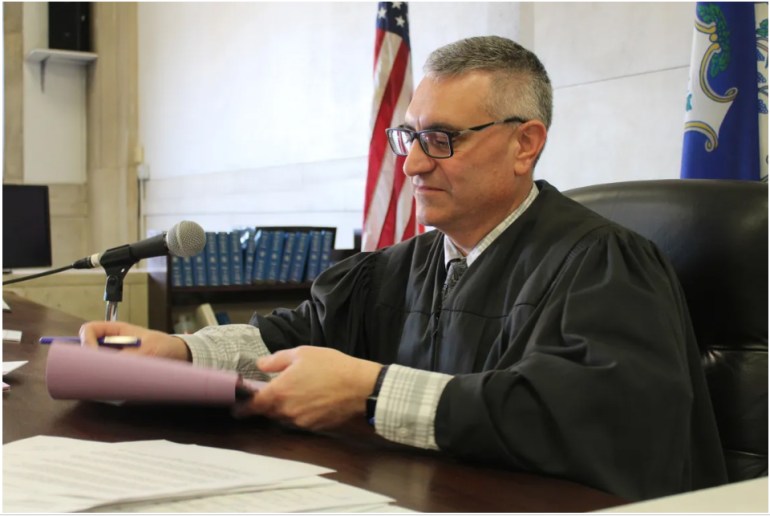
On Tuesday morning in the third-floor housing court at 121 Elm St., state Superior Court Judge Walter Spader Jr. ordered Aizenberg to pay a total of $1,500 in fines — or $250 apiece for six different code violations — stemming from problems that Livable City Initiative (LCI) inspectors found at three Ocean-controlled rental properties.
This marked the fifth time since October 2021 that Aizenberg has been fined in court for LCI-found housing code violations. It also came several days after Mayor Justin Elicker, a top LCI official and a Downtown alder testified before the state legislature in support of a bill that would increase these types of fines from $250 to $1,000 apiece. And it took place two weeks after the Board of Alders signed off on the Elicker Administration’s plan to pay Aizenberg’s companies a total of $1.3 million to purchase four rundown Dixwell properties, including the former Monterrey jazz club.
According to LCI inspection reports for each property, the latest code violations that landed Aizenberg in court on Tuesday include missing or broken smoke and carbon monoxide detectors, loose electrical wires, broken sidewalks and accumulated trash at a 70-unit complex at 311 Blake St.; window and ceiling problems in a second-floor apartment at a four-family home at 56 Blake St.; and accumulated trash, missing gutters and a front porch in danger of collapsing at a two-family house at 57 Carmel St.
“Our plan is not to visit here anymore”
Standing alongside his attorney Ian Gottlieb, Aizenberg pleaded guilty to six different counts of violating state statute 7 – 148C(10)(A). Senior Assistant State’s Attorney Donna Parker told the court that those six violations stem from two different criminal housing docket cases; the state chose to nolle, or drop prosecution, for a third case because the housing-code violations involved had all been addressed before the matter’s first court appearance.
Parker and Spader also emphasized that all of the housing code violations — which date back to August and September 2022 — have all now been addressed.
“Everything was completed prior to the first time this was” before the court, Gottlieb said.
“I appreciate your attention to these matters,” said Spader.
Aizenberg’s latest round of court-ordered fines come after he was ordered to pay $6,250 in fines in December 2022 for now-fixed housing code violations at 429 Poplar St. and 181 Fairmont Ave., $2,500 in fines last August for now-fixed housing code violations at 87 Willis St. and 191 Ferry St., $3,750 in fines last May for now-fixed housing code violations at 133 Plymouth St., 267 James St., and 167 Scranton St., and $500 in fines in October 2021 for now-fixed housing code violations at 55 Carmel St. and 76 Thompson St.
After Tuesday’s hearing, Aizenberg said that “there’s nothing to say” about these three latest housing-code violation court cases. He pointed out that one was nolled because all of the issues had been addressed even before the matter made its way before a judge.
“We’ve hired a special outside contractor” with 10 employees who are charged with addressing LCI-found concerns at local Ocean properties, he said. “We’re not going to have any cases like” these before the court anymore, he said. “This is a priority.” He also said it can be quite difficult to arrange with a tenant to have maintenance workers come by to make repairs to an occupied rental unit.
Asked about the ongoing state legislative push to increase fines for these types of housing-code violations from a maximum of $250 to $1,000 each, Aizenberg replied, “Our plan is not to visit here anymore.”
City to state: Bump up fines to $1,000 each

Meanwhile, up in Hartford, Mayor Elicker, LCI Manager of Neighborhood and Commercial Development Mark Wilson, and CT Voices for Children Legislative Coordinator Eli Sabin, who is also an alder representing East Rock/Downtown’s Ward 7, testified last week in support of a bill introduced by New Haven State Rep. Roland Lemar that would increase the “maximum fine for municipal ordinance violations” from $250 to $1,000. That bill had a public hearing before the state legislature’s Joint Committee on Planning and Development on Friday. (The governor has also included the $1,000-fine-increase in a separate budget bill slated for a public hearing on Thursday.)
In pre-submitted written testimony in support of Lemar’s proposed bill, Wilson recalled his time serving as LCI’s acting director of housing code enforcement.
In that capacity, he wrote, “I witnessed firsthand the deplorable conditions that many of the residents in New Haven are subject to. Early last year I responded to an afterhours no heat emergency call at a four-family dwelling. I arrived to find all four families with no heat and living in what I would describe as sub-human conditions. There were holes in the roof, missing windows, non-working toilets, leaking plumbing, faulty electrical wiring, non-working appliances and no smoke or carbon monoxide detectors.”
He wrote that LCI reached out to the landlord, who lived out of state, “and when we described the condition of the property, they responded that they were not interested nor were they going to make any repairs and that we should begin the legal process. Less than a week later, our office responded to another after hours call for burst water pipes due to inadequate heat. The responding inspector found 3 families living in units with no heat, the electrical utilities in two units had been disconnected due to nonpayment, a vacant unit with burst pipes and no access to the water supply to shut them off.
“As it turned out, this property was also owned by the same landlord, who when reached told us to add this building to the legal process as well. The City was forced to uproot these families and relocate them while the legal process was played out. NO ONE SHOULD HAVE TO LIVE UNDER THESE CONDITIONS.”
Most of the housing code violations that LCI finds are “not this egregious,” he continued.
“Many can be abated rather quickly and generally avoided altogether with a proactive maintenance plan. Implementing such a plan across hundreds of rental units can be challenging but doable. We have many large landlords in New Haven who do a fine job in maintaining their properties. But there are, however, some landlords who are more likely to chance gambling on paying a small fine rather than implementing a preventive maintenance plan, because simply put, the payoff is bigger.
“If the stakes were raised and the cost to play was much higher, we believe that more landlords would come to see the overall good in maintaining their properties and if not, the potential cost of failing to do so.”
In his pre-submitted testimony, Sabin also threw his support behind the bill. He specifically called out Aizenberg’s rash of court-ordered fines over the past year-plus as reason enough to increase the relevant fine from $250 to $1,000 each. “Raising the maximum fine for local ordinances from $250 to $1,000 would protect tenants and give municipalities a greater ability to enforce their laws,” Sabin wrote. “The value of the $250 maximum fine has eroded greatly due to inflation since it was established in 2003, and it is time to increase it to empower municipalities and ensure local ordinances such as housing codes are followed.”
Elicker also backed the proposed bill in still more pre-submitted testimony written for last week’s committee hearing.
“An increased ceiling for fines municipalities could choose to enact to $1,000 would allow a graduated penalty and help us modify behavior to ensure better compliance with the law and a better lifestyle for New Haven residents,” the mayor wrote. “Our intention, as it always has been, is to give violators the support they need to come into compliance, and only when that is not successful would we implement fines on a graduated increasing scale.
“Our challenges are particularly acute with violations of the housing code. While the majority of landlords comply with the law and provide safe environments for renters, there are some who consistently and repeatedly violate city law and create unsafe and deplorable environments for tenants. From rodents to mold to broken plumbing to broken heating systems, our housing inspectors see repeat violations and an unwillingness of certain landlords to address the problem. Our assessment is that some large companies see paying fines simply as the cost of doing business and deliberately fail to fix problems, because the savings of not addressing housing issues is more than the cost of the small fines they potentially could incur. This must change. Giving municipalities the option to increase fines after repeat offenses to $1,000 will give us the tools to hold companies accountable when all other options fail.”
This story was originally published Feb. 21, 2023, by the New Haven Independent.