



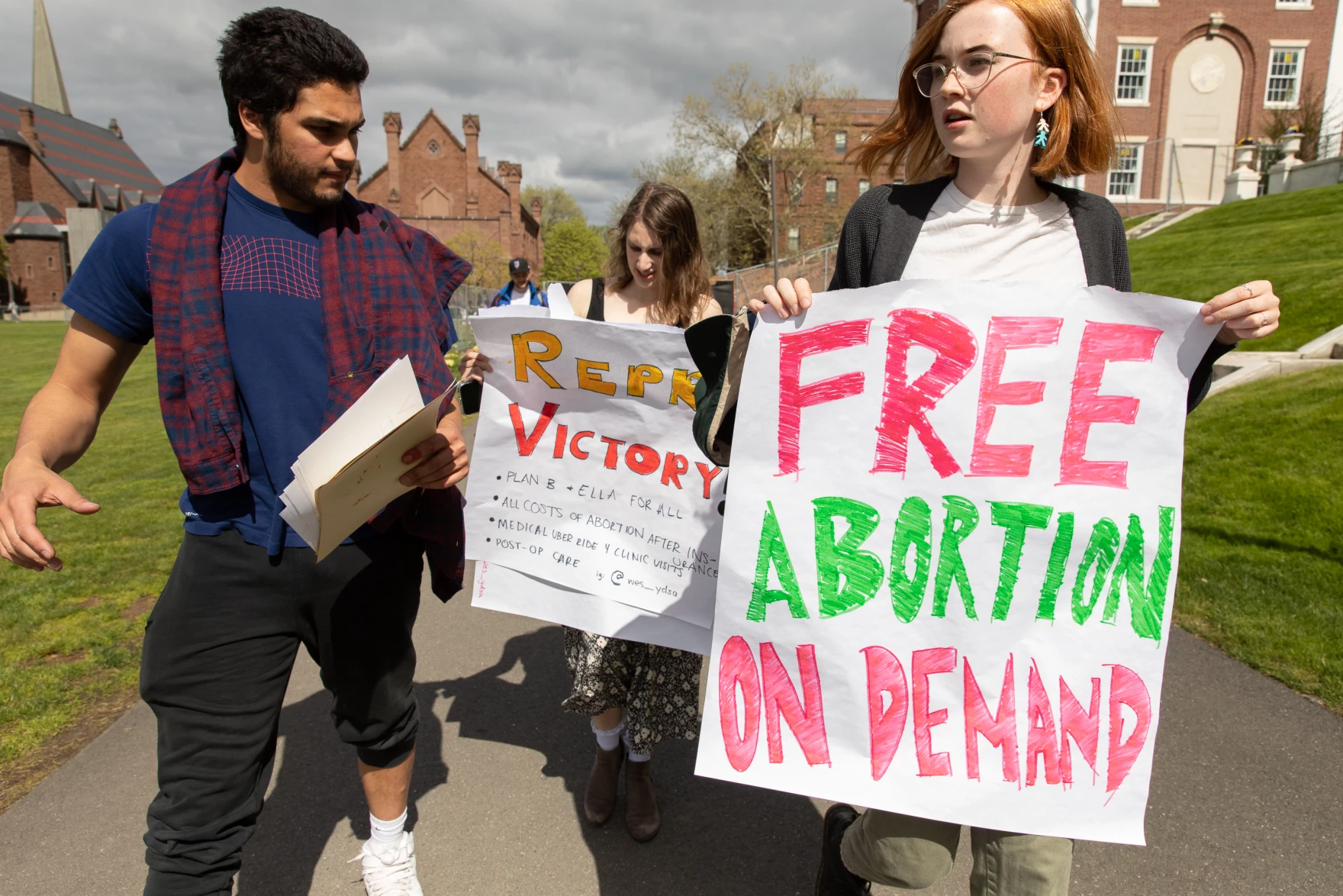
When Roe v. Wade was overturned, Gov. Ned Lamont reassured women in Connecticut that their right to choose would not be affected and passed the Reproductive Freedom Defense Act during a 2022 legislative session, putting Connecticut at the forefront of protecting reproductive rights.
Public universities such as UConn and the Connecticut State Colleges and Universities system are being required to create a plan for their students to have access to abortions. Today, the UConn Sexual and Reproductive Health webpage provides information about acquiring STI screening and Plan B, or emergency contraception medication. It does not, however, provide information on the pricing or availability of abortion services on campus.

It is great to see some universities taking essential steps in providing access to their students in need, but it is unfortunate that not all institutions are willing to follow suit.
I had the opportunity to interview a young Connecticut college student who found herself in need of an abortion a couple of years ago. She found out she was pregnant over summer break, and when she returned to school, was faced with making a complex decision. With an unplanned pregnancy, she was afraid and uncertain about what would happen next. The young woman shared with me that her first thought was that she did not have the funds to afford an abortion, nor did she want to tell her parents about what was happening.

This affected her mentally, physically, and emotionally. She did not eat, attend class, or even leave her room. She was confused and had nowhere to turn. She said that she wished that her university had a plan like others did, with support set in place to help her deal with this unexpected, life-changing event. She told me, “If my university would cover abortions like other universities in Connecticut do, then I would feel less stressed knowing that I had a safety net and somewhere to turn.”
This young woman found herself in a challenging, stressful situation where she had no choice but to use her mother’s credit card to pay for her abortion. As she awaited the unavoidable conversation about a $670 charge at Planned Parenthood, the added stress made her suffering continue. She said that all she could continue thinking about was how this could have been avoided if her university had provided access to abortions.
As a 21-year-old female college student at Sacred Heart University, the worry of being faced with such a life-changing decision is very real. Many young women my age are faced with difficult reproductive decisions as the unintended pregnancy rates per 1,000 women were highest among women who were aged 18 to 24 years. Many women never even get the chance to consider whether to pursue their education unencumbered or become a parent at a youthful age.
The terrible truth is that for many young adults, financial barriers determine their choices rather than them having true reproductive freedom. This can have long-lasting impacts. Recent research from the Turnaway Study indicates that women who were unable to access abortion and had to give birth reported greater household poverty for at least four years, struggled to meet essential living expenditures, and endured severe economic effects such as poorer credit scores and debt. On the other hand, women who received a wanted abortion were more likely to be financially stable, set higher goals, and raise children in healthier conditions.
Abortion Out Loud advocates for the importance of giving college students access to complete reproductive healthcare services. College health centers should help their students make informed decisions by providing the financial and emotional support they need to get an abortion, which helps improve their mental and physical health.
It is time for Connecticut’s private universities to align their regulations with public universities to establish an open and equal environment for all students. Reproductive health decisions are extremely personal and can be difficult, especially for young women. Denying women access to important services because of financial barriers is not only unfair, but it also has serious consequences for their health and well-being.
Maya DiNapoli is a senior at Sacred Heart University, majoring in Health Science with a minor in Psychology.