



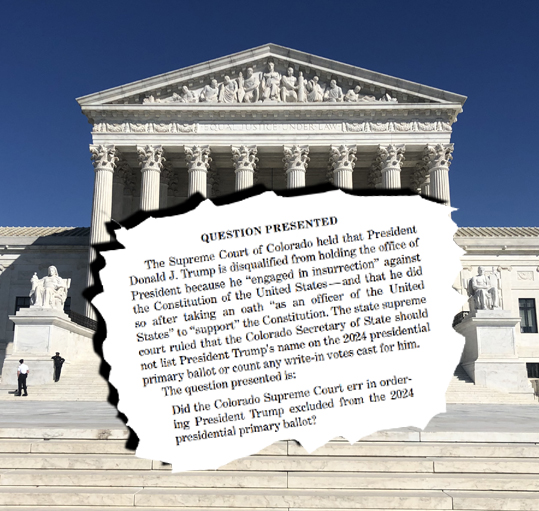
My form of Monday morning quarterbacking is making the arguments that I thought should have been made at the U.S. Supreme Court. Since the state of Colorado went up against SCOTUS in the matter of the 14th Amendment and Donald Trump’s eligibility for office, I am haunted by what didn’t get said.
Today’s Supreme Court is a new thing. It’s a gerrymandered court; an Obama appointee would be serving, but Sen. Mitch McConnell stiffed him. Also, fully a third of the justices are there under a new sort of contract: Trump had the Federalist Society vet judges for conservativism in general and anti-abortionism in particular, and ran on the promise of a right-wing court. Everyone understands that his picks weren’t hired for their judicial impartiality. They were hired to overturn Roe for starters, and they got right to it. That’s different.
The 14th amendment says no insurrectionists can hold office, and Colorado says that means Trump; we’re pretty sure SCOTUS is going to overrule. Here are a couple of junctures at which Colorado’s counsel Jason Murray could have helped us all understand the new Supreme judicial philosophy as revealed that day.
Chief Justice John Roberts argued that if the court went along with this no-insurrectionists thing they put in the Constitution after the Civil War, states on the other side would then start removing people from the ballot for no reason other than revenge, and then there could be revenge against revenge, on and on. Therefore, apparently, it would be best to let an insurrectionist run, no matter what he did and no matter what the 14th says.
Thinking non-legally, with no reference to any article or statute or “judicial philosophy”, we see his point. Trump was impeached twice, in each case after lengthy investigations into serious matters; now Republicans don’t even feel called upon to name their grounds when they impeach Biden. But for a chief justice of the Supreme Court to suggest that the court’s hands are tied by the prospect of these sorts of shenanigans is truly novel.
The basic protection against the revenge scenario is ordinary judicial procedure: bogus claims of insurrectionism would be revealed in their bogosity in due course. The people who think Trump is disqualified have an enormous amount of evidence; if these notional revenge-seekers have nothing real against the people they accuse, that should come out in the wash. But no; Roberts apparently assumes we will be unable to deal with false claims, and that we therefore dare not pursue any claims at all.
It is perfectly understandable why Colorado’s counsel did not seize the opportunity to run this logic down and expose its jettisoning of everything about the case in favor of a justice’s dark speculation about the future. It is so outside the box! Attorney Murray was ready for some extended verbal calisthenics about office and officer, but he didn’t go into the Supreme Court reminding himself that a Supreme Court justice might blow off all the legal particulars and argue that (a) people are spiteful, (b) our system can’t handle them, and (c) the case should turn on our inability to deal with spiteful people. In a perfect world, Colorado counsel would have synopsized this approach and then politely asked “Is that textualism, would you say, or originalism?”
For the heck of it, I’ll give it a name: nihilist defeatism. Our system won’t be able to deal with the imagined repercussions of a legal outcome, so avoid that outcome regardless of the law. If the chief of SCOTUS is talking that way, maybe we’ll see it cropping up elsewhere.
The other moment I wish I could re-script was when Justice Brett Kavanaugh asked, simply, shouldn’t people be able to vote for who they want to vote for? The question came without any observation about this case, these particular facts; the Justice simply wanted to raise the issue of whether restricting voters’ choices was perhaps a bad idea.
The Colorado attorney’s answer was rooted in the actual case, about the risk of harm to the republic if Trump took power again. But there is a more basic counter-argument that didn’t get made, and it wouldn’t have been a miracle if Murray had made it.
Section 3 of the 14th Amendment does one thing only: it disqualifies insurrectionists from public office. It doesn’t authorize fines, imprisonment, or anything other than disqualification. So the thrust of Kavanaugh’s argument was, basically, “is this part of our constitution a good idea?”
The right answer to that question would have been “Justice Kavanaugh, the 14th Amendment is not on trial here. I don’t feel called upon to respond to your question.” That wouldn’t have been the end of the colloquy, but it would have got it off to the right start.
As with Roberts’ judicial nihilist argument, the fault is so basic that an attorney might not be on the lookout. Apparently, Colorado’s counsel did not go in there figuring he would have to go to bat for the 14th Amendment itself– but he should have. That same argument– isn’t it just a bad idea to take somebody off the ballot?– has been making the rounds for months.
I even heard it from Eric Holder. He made no pretense of parsing the text or applying it to any candidate’s words or deeds; he just said it wouldn’t be a good idea. (Some people wouldn’t like it, you see.) Well, if a Democratic attorney-general (retired) is out there making the never-mind-that-stupid-amendment argument, we shouldn’t be surprised to hear it from Brett Kavanaugh either. Attorney Jason Murray could have been prepared for it.
Again, it would probably be a good idea for us to flag and name this bold new approach to statutes, constitutions, things we thought were the law. What shall we call it when the jurist peruses the text, assesses the intention, considers the matter closely and decides “This is a bad idea. I see what it’s trying to do, and I’m going to prevent it from doing it”?
I would suggest judicial activism, but I guess that’s already taken.
Eric Kuhn lives in Middletown.