



Marline Nadeu is sitting in her living room at the house she’s lived in for nearly two decades.
The blue two-storied home in Meriden is filled with photos of her children, grandchildren and great grandkids. It’s also filled with photographs of the man she’ll always love, her deceased husband, Claude.
“I really, really miss him a lot,” she says. “They say it gets better as days goes by. This has been 20 years, it does not get better. Especially when I get depressed a lot.”
Older adults are at an increased risk for depression. Nadeau, 82, also has progressive memory loss, worsening tremors, and is prone to falls.
But she is home.
Her family and medical professionals are able to take care of her there through Connecticut’s Adult Family Living Program. This unique housing model lets qualifying older adults stay at home and receive care, primarily from a family member or a friend.
To qualify, adults must be 65 years or older, financially-eligible and be at risk of nursing home placement due to a number of age-related conditions.
At home, Nadeau doesn’t stay unhappy for long. She’s surrounded by mementos from her past, including a plaque given to her husband who drove for Gulf Oil.
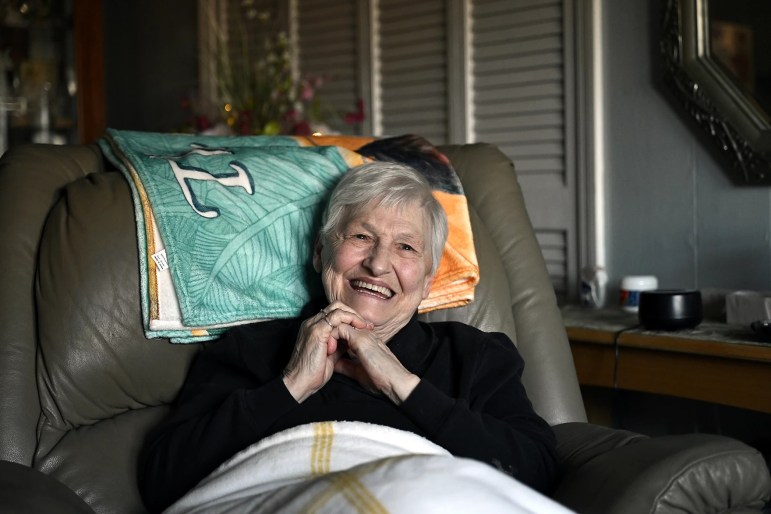
“It was from his boss. He got an award, because he never had an accident as a truck driver,” she says.
There’s food she loves, too. Her daughter, 57-year-old Gail Lewis, opens the fridge and reveals a stack of frozen candy.
“Her Snicker bars, she loves them and she likes them cold,” Lewis says. “I say to her ‘Mom, don’t eat them cold,’ because it breaks her dentures.”
Mom and daughter laugh.
‘If I end up there, I won’t make it’
Lewis has been taking care of Nadeau at home for years.
But now she’s getting paid for it. She receives $500 a week tax free, as part of the Adult Family Living program.
Lewis, who recently enrolled in the program, lives with her family upstairs, including her husband, their daughter and their two tiny dogs Natalie and Claude, named after her father.
She cooks meals for her mom. The whole family will sometimes help Nadeau climb the stairs so they can play cards and listen to old records, which Lewis pulls off the shelf.
“Dick Clark’s Rock and Roll, remember that one?” she says. “Charley Pride. Stonewall Jackson, Conway Twitty and Loretta Lynn.”
Aging at home is better for quality of life versus aging at a nursing home, says Dr. Neha Jain, a geriatric psychiatrist at UConn Health.
“There’s plenty of data to support that,” Jain says.
Nadeau had to qualify for Medicaid to be enrolled in the Adult Family Living Program. Often, aging populations on Medicaid seeking care are pushed toward nursing homes, but to Nadeau, moving to a nursing home is unthinkable.
“I don’t want to go there. Because if I end up there, I won’t make it,” she says. “Why would I want to go there? My granddaughter? Oh, my God! She doesn’t spend one day without coming downstairs to see if I’m all right.”
‘I was hanging on’
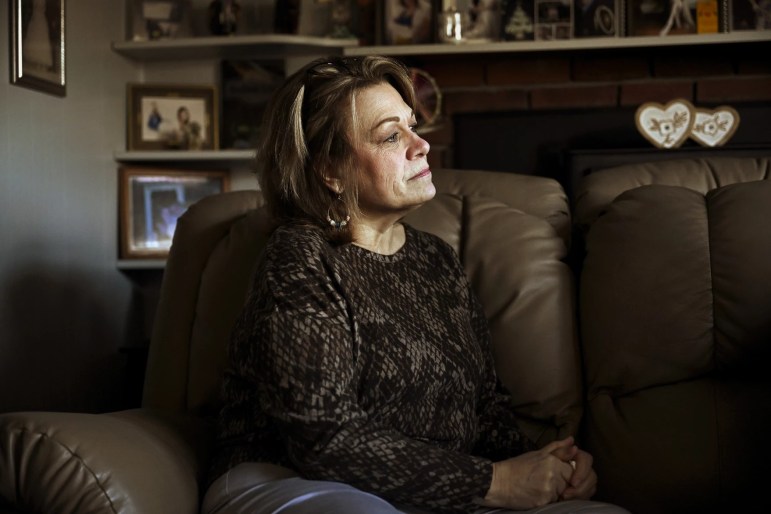
Lewis says she applied to get into the Adult Family Living program after her husband fell off a roof and could no longer work. She has a full-time job in information technology working from home, but says the money wasn’t enough.
“I was hanging on, it was really tough,” she says. “And the tough part is, you can’t look vulnerable to the people you’re taking care of because they look to you to be strong … But inside, it is a real lot. But I’m super lucky that I get the opportunity.”
The program partners caregivers with licensed medical professionals. Lewis is working with a for-profit company called Assisted Living Services, which employs registered nurse Julie Nuzzolillio.
Nuzzolillio says more people are asking for these in-home support services.
“We’ve seen a good 20-to-30% increase in people signing up on the program and being referred to us as their provider since the whole pandemic started,” she says.
‘Not going to go calmly into that good night’
Connecticut’s Adult Family Living Program has been around since 2013. But as the state gets older it’s seen a surge in demand from all providers. Connecticut has 820,000 residents aged 60 and older, which is nearly one quarter of the state’s population, according to the Connecticut Healthy Aging Data Report.
From 2020 to 2023, the number of people in the AFL program jumped 42% to 3,862 with a total spending of $98.9 million as of 2023.
The program is funded by the state and recipients must qualify for Medicaid.
More people could qualify for care, but have trouble accessing services because they’re not diagnosed with a qualifying age-related condition like Alzheimer’s, advocates say.
“Blacks are about two times more likely than whites to have Alzheimer’s or other dementia, Hispanics are about one and a half times more likely,” says Christy Kovel of the Alzheimer’s Association of Connecticut. “There may be warning signs that are presenting themselves, they may not have access to primary care.”
The AFL program also currently excludes a vast demographic of potential caregivers from qualifying for compensation: spouses of aging people.
Advocates are hoping this will soon change.
The Aging Committee of the Connecticut General Assembly has just raised HB 5296 which, if passed, would allow spouses to be paid under the AFL program.
The Commission on Women, Children, Seniors, Equity & Opportunity supports the concept, says Michael Werner, a legislative policy analyst with the group.
“[We] recognize the value and untapped potential of the existing Adult Family Living Program, especially in a post-COVID world,” Werner says. “With workforce staffing shortages, transportation access issues, rising costs of institutionalized care, and growing recognition of the value of keeping our older adult residents in the community, Connecticut is in a strong position to make a profound impact by opening-up this vital program to spouse caregivers.”
As more of the state’s population ages, the question of how to best care for people will only continue to grow, says anti-ageism activist Ellen Goodman. She’s founder of the Conversation Project, which works to raise awareness of how people want to live at the end of life.
The Baby Boomers started and faced the Civil Rights revolution, the women’s rights revolution, the gay rights revolution, and now are faced with “what you can only call the longevity revolution,” she says. “And we’re probably not going to go calmly into that good night.”
Back at the house in Meriden, there’s a little toy ice-cream truck in a room painted blue for Nadeau’s great grandchildren when they visit.
It’s a playroom for the kids, but it’s also a spot for Gail Lewis’ mom to get the attention and care she needs.
“Mom will come in here and it’s so funny to see how she reacts with them, like she gets energized and she becomes a different person with them,” Lewis says. “It’s amazing. And I think that they have such an impact on her mental health and her physical [health] because she’ll push herself.”
And the great grandkids benefit too. Learning about family ties and what it means to love.
This story was first published March 5, 2024 by Connecticut Public.