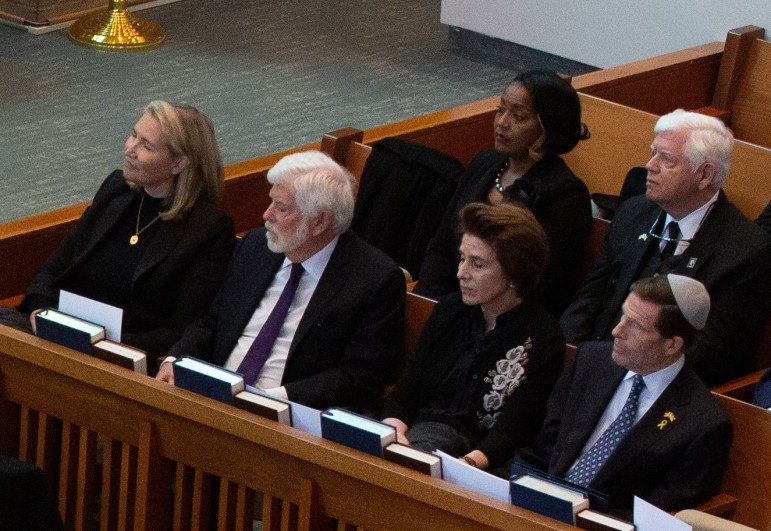


Joseph I. Lieberman was eulogized Friday as a vital voice of civility and reconciliation in American politics by former Vice President Al Gore, his partner on a Democratic presidential ticket in 2000, and by Gov. Ned Lamont, a key player in Lieberman’s exile in 2006 from the party in Connecticut.
Lieberman, 82, who died Wednesday after a fall at his home in the Bronx, was remembered in equal measure for signal accomplishments and small kindnesses in a career that took him to roles in Hartford as a state senator and attorney general and to Washington as a U.S. senator and vice presidential nominee.
Mourners filled Congregation Agudath Sholom in Stamford, where Joe and Hadassah Lieberman married 40 years ago, second marriages for both that created a blended family. Eulogists included Lieberman’s son and daughter from his first marriage, his stepson, and the daughter he had with Hadassah.

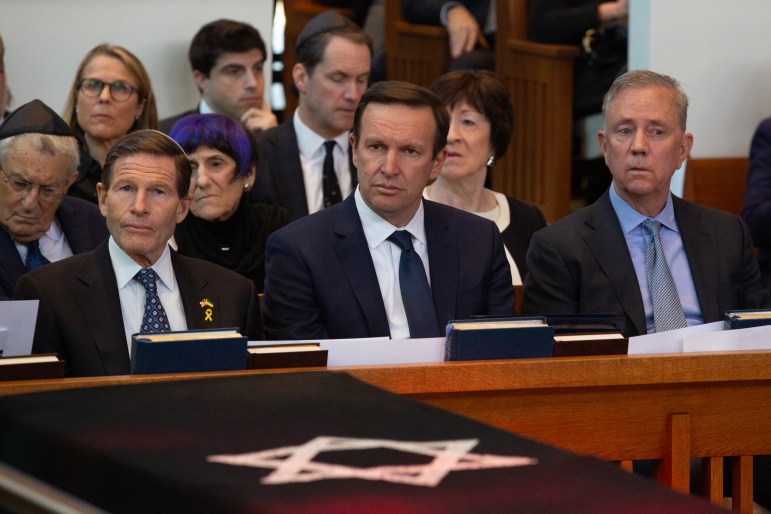
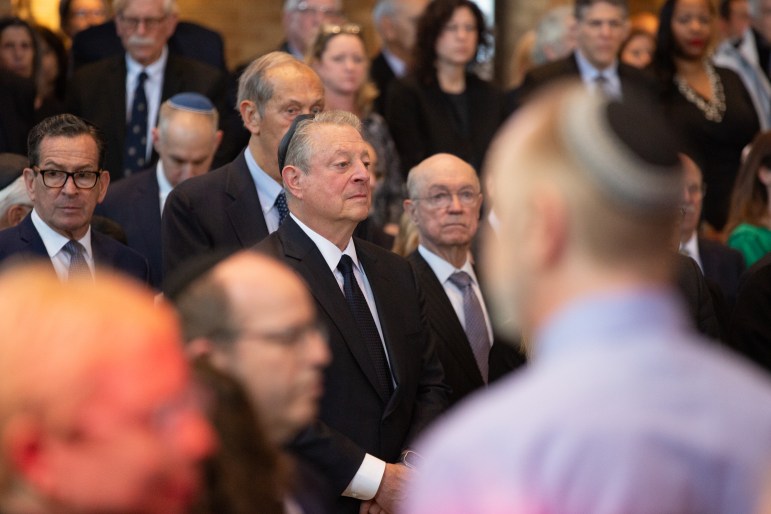
Political dignitaries filled one side of the sanctuary, family and friends the other. In the middle lay a simple wooden casket.
“A friendship with Joe Lieberman starts off in different ways,” said Lamont, who might have been a surprising choice to some as a eulogist. “Mine started on sort of an inauspicious note.”
The congregation laughed, and Lieberman’s widow nodded.
Lamont was the anti-war candidate who defeated Lieberman in a Democratic primary for U.S. Senate in 2006, setting the stage for Lieberman’s victory as an independent. As a governor elected in 2018, Lamont often has governed from the political center — to the delight and amusement of Lieberman.

The governor turned to Hadassah and thanked her for an invitation that he said embodied her husband’s belief in the importance of civility and reconciliation in a business too often defined by division.
Lamont said Lieberman, who was a founding chair of the No Labels movement, refused to be defined by party affiliation. He smiled and added, “I think maybe in an odd way I helped liberate him.”
Gore laughed. He nodded to Lamont as the governor returned to his seat. U.S. Rep. Rosa L. DeLauro, seated behind him, leaned forward and patted Lamont on the shoulder.
The former vice president, who flew in from Nashville on a commercial flight the previous night, was a late addition, not listed in a funeral program that featured a black-and-white portrait of a solemn Lieberman on its cover and a photo of jovial Lieberman waving on the back.
Gore, Lamont, former U.S. Sen. Chris Dodd and Richard Blumenthal and Chris Murphy, the two men who succeeded Dodd and Lieberman in the Senate, delivered eulogies praising Lieberman for his early support for civil rights, gay rights, environmental laws and national security.
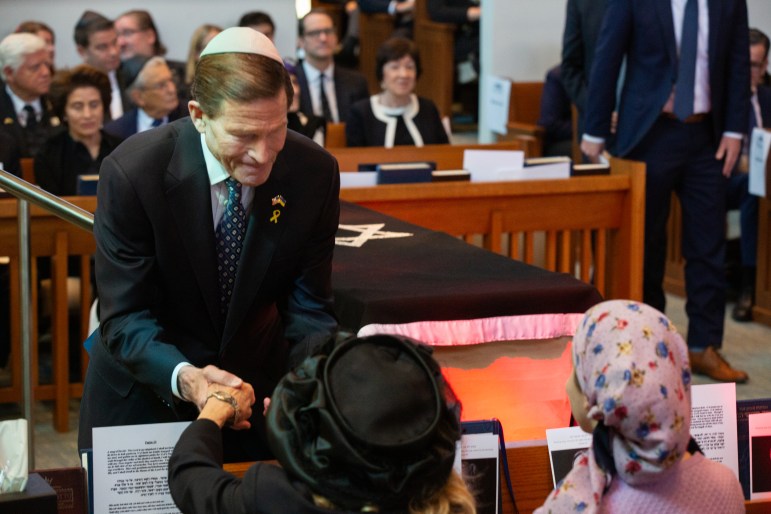
Also speaking: Hani Lowenstein, Lieberman’s youngest daughter, who came from Israel with her husband and five children; his step son, Rabbi Ethan Tucker; his daughter, Rebecca Lieberman; and his son, Matthew Lieberman.
Former Gov. Dannel P. Malloy, whose family lived two blocks from Lieberman’s parents in Stamford, sat behind Gore. U.S. Sen. Susan Collins, a Republican of Maine, and former U.S. Sen. Bill Bradley, a Democrat of New Jersey, represented the Senate.
Former Gov. John G. Rowland, a Republican, also attended. He chatted warmly with Blumenthal and Murphy before the service. Rowland said Lieberman had been a friend, a man of “quiet charisma,” and likely the last of his kind as a believer in working across the aisle.
Matthew Lieberman spoke of his father’s unique penchant for bipartisanship but loudly insisted that the kiss President George W. Bush gave Lieberman at a state of the union was “involuntary.” A photo of the kiss became an emblem in Lamont’s campaign and Democrats’ complaint that Lieberman was too close to Bush.
The audience laughed. Lamont grinned.
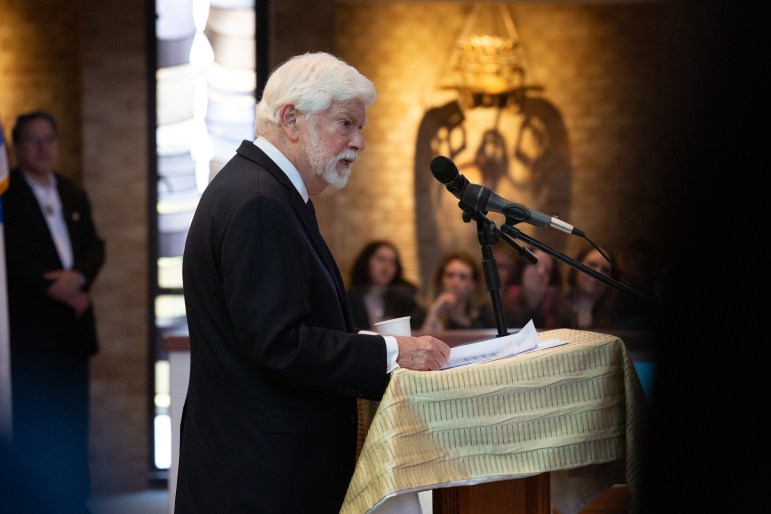
Dodd, whose close relationship with Lieberman became strained after Dodd felt obliged to support Lamont as the Democratic nominee, said nothing of the breach, focusing instead on what generally had been regarded as a warm and effective partnership.
“For all those years, regardless of the circumstances or crisis, Joe Lieberman always conveyed an inner sense of peace and balance, a calmness, a quiet serenity about him, that I think is a hallmark in many ways in how he conducted his business, how he treated others,” Dodd said.
Dodd smiled as he recalled Lieberman’s suggestion for dividing attendance at weekend events in Connecticut. Lieberman, a religiously observant Jew, was unavailable during the Sabbath, from sundown Friday to Saturday.
“In short, I became his Shabbos goy,” Dodd said, grinning as he glanced to the Lieberman family.
He also subbed for Lieberman when conventions conflicted with the Sabbath.
“I am told that I not only nominated Joe for the Senate on one occasion, but I also gave his acceptance speech,” he said.

Dodd said the relationship was personal, not political. He turned to Hani, the daughter of his marriage to Hadassah, and noted he was there for her naming ceremony and her wedding.
“I danced with your father at your wedding as well,” Dodd said. He paused a beat. “He wasn’t a bad dancer, either.”
Men and women dance separately at most Orthodox weddings.
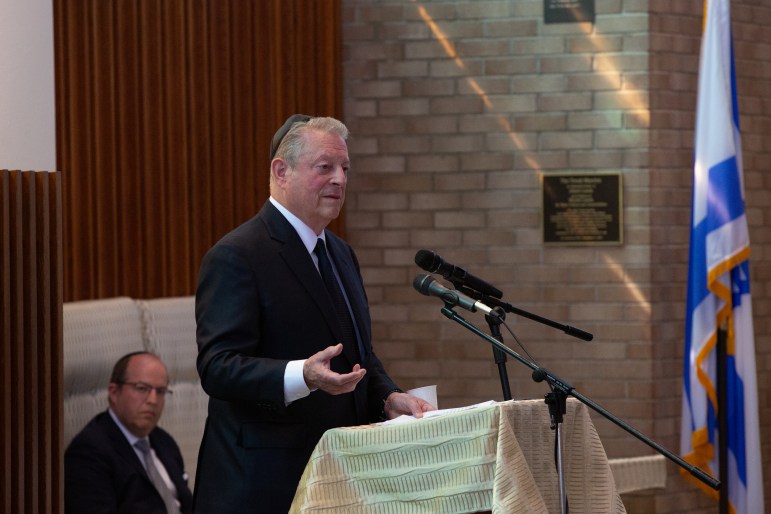
Gore was more direct in talking about differences with Lieberman.
“We were close on climate, on civil rights, human rights, women’s rights, LGBTQ rights, and so many other issues,” Gore said.
And for a time in late 2000, Gore and Lieberman believed they would be the next president and vice president of the United States. Their ticket won the popular vote but narrowly lost the electoral college after a close and chaotic recount in Florida ultimately settled by the U.S. Supreme Court .“You win some, you lose some,” Gore said. “Then there’s that little-known third category.”
“But Joe and I went our separate ways after 2000. I wish I could say this with as much humor as Ned did when you relieved him of that burden of being a Democrat,” Gore said, glancing at Lamont. “Joe and I had some deep and sometimes bitter disagreements on policy and political matters.”
He did not enumerate them. Lieberman famously backed Republican John McCain over Democrat Barack Obama in 2008.
“I for one was tempted to anger at times, frustrated at Joe’s stubbornness and disappointed that he was taking a path that I thought was wrong,” Gore said.
Gore recalled the feud between Thomas Jefferson and John Adams, who collaborated on the Declaration of Independence.
“But time is a powerful medicine,” Gore said. “And after many years at last, Adams wrote to Jefferson to say, ‘You and I are not to die before we have explained ourselves to each other.’ What followed was the most extraordinary correspondence once in American history as these two men unburdened themselves of the rancor they had felt toward one another and returned to their love of country and family.”
Lieberman had the same impulse, Gore said.
“I saw him ready to reclaim the friendships that had been steered by disagreements, ready to look for ways to bridge divisions, ready to see reconciliation, ready to stand for his principles, always,” Gore said.
He said his friend was a “mensch,” a Yiddish word with no exact English equivalent.
“But those who seek its definition will not find it in dictionaries, so much as they find it in the way Joe Lieberman lived his life — friendship over anger, reconciliation as a form of grace,” Gore said. “We can learn from Joe Lieberman’s life some critical lessons about how we might deal with the rancor in our nation today.”