



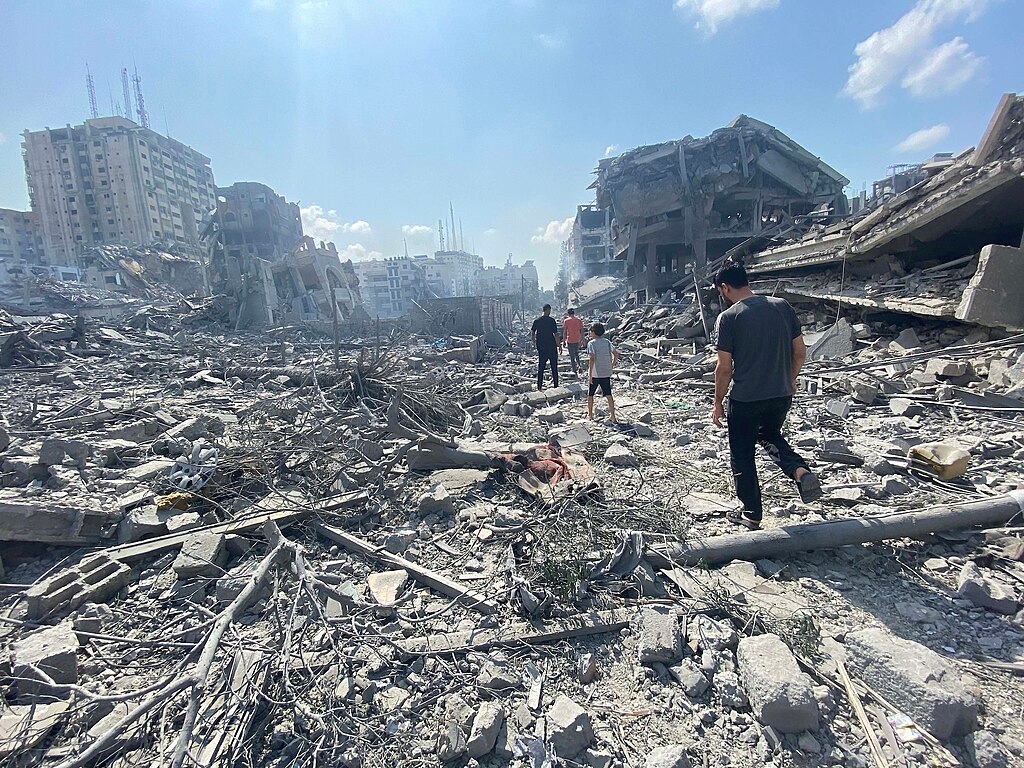
Amid the widespread and well-deserved condemnation of Israel’s war on Gaza, there’s a distinction that is getting lost.
After Oct. 7, the IDF was of course going to go after Hamas. No question; how could they not? And it was always going to be ugly, because Hamas fighters do indeed live and operate among non-combatant Gazans, in tunnels under streets and hospitals, everywhere. The only time Hamas fighters were not marbled in among Gazans at large was on Oct. 7, when they attacked Israel.
If the IDF had prioritized avoiding civilian casualties, everything would have been done on the ground from the start; instead, there was a massive and sustained assault from the air. Somebody came up with the term “domicide” to describe the result; something like a half of all homes in Gaza are now uninhabitable or non-existent.
Just looking at the apartment blocks and whole neighborhoods in ruins, we know that this was not done with rifles and grenades, and that you didn’t have to be a Hamas fighter to die under a mountain of rubble. In combination with Israel’s ongoing refusal to allow relief supplies into the Gaza hellscape, it does begin to look like a war against every Palestinian in Gaza.
Attacking Hamas on the ground would have cost the lives of many more Israeli soldiers than doing it from the air, especially since there is no Hamas air force to defend the Gazan airspace. The ground operation is room-to-room fighting in buildings Hamas knows better than the IDF does. Some of that is happening now; the bombs and missiles didn’t utterly destroy Hamas, so pursuing the war on the ground is unavoidable.
As a political matter in Israel, this was a no-brainer: do we prioritize the safety of IDF soldiers or of Gazan civilians? Of course they chose the strategy that was safer for their soldiers — the air war — for as long as they could. It used to go without saying that any actual war would result in heaps of dead soldiers on both sides, but in the age of mechanized slaughter a nation can hope to defeat its enemies while keeping its own casualties close to zero. The Vladimir Putins of this world don’t have to sweat this sort of thing, but in democracies it’s politically quite risky to take actions that result in body bags.
(This trend already had a decisive effect on our own history. When we invaded Afghanistan in late 2001, bin Laden and his posse retreated to caves in the mountains of Tora Bora that were impervious to our biggest bunker-buster bombs. Going up and in there and rooting them out was going to be bloody in an Iwo Jima sort of way, and our commanders didn’t have the stomach for it. So they gave that job to locals, who didn’t have any truly burning desire to nail bin Laden or die trying, and who let him escape to Pakistan. Having whiffed on bin Laden, it was necessary for the Bush people to redefine the mission, so we embarked on 20 years of “nation-building” in Afghanistan. But we minimized the body bags.)
Now Rafah is the last refuge both for Gazan civilians and for Hamas. We are being told that a ground assault there would be beyond the pale, a bridge too far, too much. I’m afraid that won’t actually do, though. We really cannot expect Israel to let up on Hamas, period. The moral of that story would be that human shields work great, and that all a terrorist outfit needs to do to survive is be in amongst lots of civilians. If you’re Israel, that really is not going to cut it.
A ground assault on Rafah will not be a pleasant prospect for the IDF, and I don’t doubt that there are hard-liners who say they should bomb the place to rubble first, killing tens or hundreds of thousands, and then clean up with a ground operation. Hopefully that will not be the strategy, but I don’t think it’s reasonable to expect Israel to just back off. No, civilian Gazans are not to blame for what is happening, any more than civilians in Kabul were responsible for 9/11. We bombed anyway, and there the connection was much more tenuous. The 9/11 crew were Saudi nationals camping out in Afghanistan; Hamas is thoroughly in and of Gaza.
There aren’t a lot of Israeli civilians being killed by Hamas these days; in that sense, the IDF can take its time with the Rafah project. (What is truly time-sensitive is getting relief supplies into Gaza.) If there was any place for civilians to flee to, they could be allowed to flee. If there was anywhere in Gaza where people had food and water, people in Rafah could be invited to that place and they’d go. There isn’t, but there might be at some point.
I really think the international community needs to do better in this situation than simply tell Israel, in effect, “Don’t you dare.” Having seen what we have seen, no doubt it feels (and looks) good to react that way, but it doesn’t solve anything.
Eric Kuhn lives in Middletown.