


A new agreement between lawmakers and Gov. Ned Lamont’s administration will provide the governor another opportunity to nominate the first independent watchdog over Connecticut’s jails and prisons, but not without approval from the legislature’s Black and Puerto Rican Caucus.
In recent weeks, legislators have expressed concerns about the process that resulted in Lamont choosing Hilary Carpenter, a veteran public defender and death penalty adversary, to lead the Office of the Correction Ombuds. The governor’s nomination went against the guidance of the Correction Advisory Committee, which ranked Ken Krayeske and Barbara Fair, two advocates often critical of the administration and its handling of criminal justice affairs, more favorably.
Unwavering opposition from top lawmakers in recent weeks left Carpenter with a difficult path to confirmation before the legislature’s close on Wednesday night, and the statute governing the position — which will have the authority to investigate complaints from incarcerated people, access agency records and draft a yearly report on confinement conditions in the DOC — does not offer clear instructions on the process hereafter.
[RELATED: Facing deadline, Hilary Carpenter prison ombuds appointment in doubt]
The new agreement, which lawmakers unsuccessfully attempted to codify into state law prior to the session’s end on Wednesday, would allow the Lamont administration and the Black and Puerto Rican Caucus to work together on choosing an interim candidate in July.
In September, the Correction Advisory Committee would reopen the hiring process for the position and send its recommendation to the governor by December. Lamont would then have 30 days to make his nomination to the General Assembly, which reconvenes in January.
The agreed-upon framework eliminated the possibility of Carpenter’s appointment this session, which needed approval from both the House and Senate. It also further delays a process that people in prison have hoped for a swift conclusion to since the passage of a law in 2022.
“I think all the parties are genuinely of the opinion that this is the way to move forward,” Sen. Gary Winfield, co-chair of the Judiciary Committee and a member of the Black and Puerto Rican Caucus, said on Wednesday.
Sen. Patricia Billie Miller, chair of the BPRC, said in an interview that she saw the bill as necessary to clear up the process moving forward. Winfield said his assumption was that if the legislature was unable to codify the process into law prior to the session’s close — due to time running out — both parties would move forward in a “very similar” manner.
Lawmakers inserted language codifying the plan into law in an unrelated revenue bill that passed out of the House late Wednesday night, but the measure died in the Senate.
In a statement, Julia Bergman, a spokesperson for Lamont, said: “The governor is 100% committed to picking a strong Department of Correction ombudsperson and will be working with the Black and Puerto Rican Caucus and legislative leadership to select a candidate.”
[RELATED: Lamont appoints Hilary Carpenter to DOC ombudsperson role]
Reached by phone on Wednesday, Carpenter was not immediately available for an interview.
The agreement between Lamont and the BPRC offers what had previously been an unclear pathway in the event that Carpenter failed to gain approval from the legislature.
The current statute governing the position makes it clear that Lamont can appoint someone in the interim if he makes his nomination while out of session, but not necessarily what he can do if his nominee fails to receive a vote during session.
Following Lamont’s own vetting process, which included having each of the contenders meet with his senior staff, the DOC’s top brass, and not himself, he chose Carpenter. The governor’s office cited her experience as the reason for his decision. But it did not provide an explanation for why he bypassed Krayeske and Fair, both of whom have criticized his administration for its handling of matters pertaining to criminal justice.
Krayeske was the lead attorney in a major Hepatitis C class-action lawsuit, which prompted Connecticut to drastically change how it treats incarcerated people for the deadly liver disease. Fair, leading organizer of Stop Solitary CT, introduced the PROTECT Act to the legislature, which increased the mandated hours of out-of-cell time for incarcerated people, limited the DOC’s use of solitary confinement and created the Office of the Correction Ombuds.
Carpenter was more of an “unknown entity,” as she said in a public hearing, given that public defenders are not often in the public eye. She has said that she believes her nearly 20 years of experience serving poor and low-income residents make her a qualified candidate for the long-anticipated role.
But her resume did not resonate well with some advocates, who have voiced their belief that the state’s public defense system has played an outsized role in the negative experiences people have in the criminal legal system.
In committee, lawmakers cast an unusual two votes on Carpenter’s nomination, the first against her and the second in her favor. And top officials had expressed displeasure about the process leading up to Carpenter’s selection, including Lamont’s requirement that the candidates meet with Department of Correction Commissioner Angel Quiros prior to announcing a decision.
Several lawmakers also said they did not anticipate the public’s opposition to Carpenter’s appointment. The PROTECT Act, as currently written, does not clearly outline steps for when the governor’s designated nominee fails to gain the support of the General Assembly.
Not every member of the BPRC endorses the new agreement with the Lamont administration. Rep. Robyn Porter, D-New Haven, said she is concerned that restarting the process leaves the entire population of incarcerated people in limbo.
“Why aren’t we going back to the two?” said Porter, who is also a member of Stop Solitary CT, talking about Krayeske and Fair. “Because what we’re talking about doing is not even in statute.”
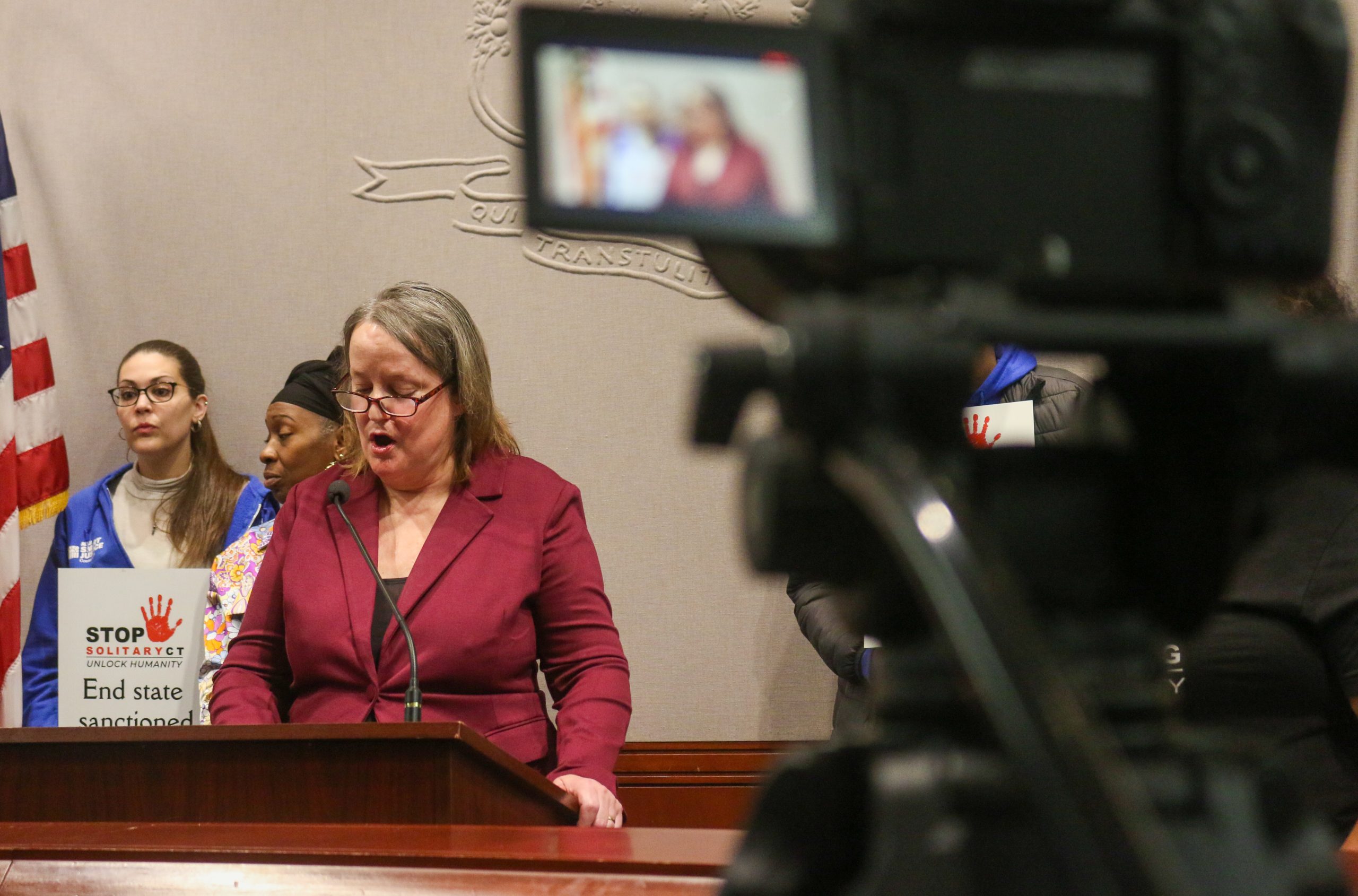
During an event outside the State Capitol on Wednesday, Fair, who has led the advocacy against Carpenter’s appointment, said she supports starting the nomination process over.
“They have to have the approval of the Black and Puerto Rican caucus. And why not? The prisons in Connecticut are filled predominantly with Black and brown people,” Fair said. “So they should have a say in who’s going to provide independent oversight for them. So I’m glad to hear that. We must work with the Black and Puerto Rican Caucus now to make sure that they hear our voice when it’s time to determine who’s going to be our ombudsperson.”
In a follow-up interview, Fair said she is planning to reapply for the position. She is concerned, however, about a possibility that the interim ombudsperson will be the individual nominated officially.
Krayeske said he is unsure about whether he will reapply. He also noted his belief that allowing an interim ombudsperson to lay the groundwork only to appoint someone new would put the office at a disadvantage.
“I think the Department of Correction has dictated this process for far too long, and I’m curious to see the candidate who both the BPRC and Angel Quiros are going to agree on,” Krayeske said, noting his belief that Quiros will select the interim ombudsperson and not Lamont. “I appreciate the desire for compromise, but the Lamont administration’s recalcitrance to independent oversight is frustrating.”
