



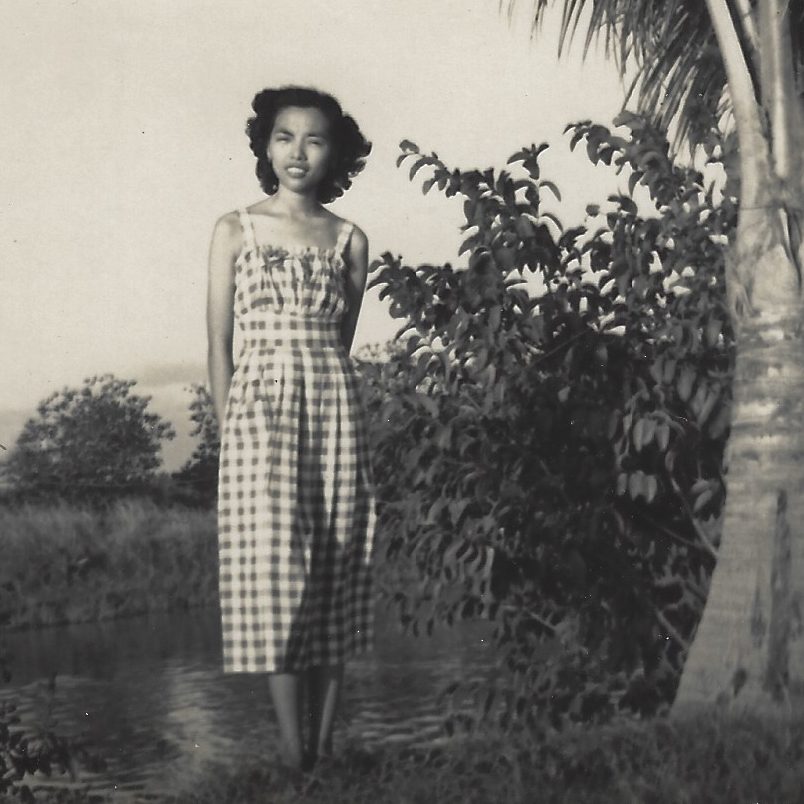
Lily P. Lee is my mother. Like the sun in the daytime and the moon at nighttime, she is always there. My mother.
For the first time in my life, I now sit and think about who she is.
She was born in 1925 in Dagupan in the Philippine Commonwealth, an unincorporated territory of the United States of America. It is famous for its milkfish, locally known as bangus. Her parents owned and operated a bangus farm, and their house was built in the middle next to the Pantal River.
She was born in an archipelago, ruled as a colony by the Spaniards for 333 years and on May 1, 1898, the American Navy arrived in Manila Bay with orders to destroy the decrepit Spanish fleet to bring freedom and democracy. And for now, we’ll skip over the small matter about benevolent assimilation, the Philippine-American War of 1899-1902, and the other historical parts missing in most of today’s high school American history textbooks.
She was born into a world governed by the appointed American military governor general and Harvard-educated physician, General Leonard S. Wood, U.S. Army. Her schools’ curricula designed by the education officials in Washington, D.C., half-a-world away from her reality with books teaching the English alphabet with A for Apple in the tropics where it did not grow nor did the school children of the period ever savor its taste. But their books showed shapes, colors, illustrations, and ideas to educate and uplift them to the American weltanschauung.
She was born to a Chinese immigrant father from Amoy in southern China, who fraudulently enlisted in the US Army as a cook’s assistant at age 14 while claiming to be 18 as the American Army, always in need of dependable kitchen help, was shipping out from China to the Philippines at the dawn of the American Century.
She was born to parents with little to no formal schooling, but who admired and valued higher education. They worked multiple service jobs to send her and two siblings to the best schools and universities in Manila, and all the way to the American heartland and mainland:
1940 – High School diploma, with high honors, Santa Rosa College, Manila
1946 – B.S. Pharmacology, Summa Cum Laude, University of the Philippines, Manila
1947 – B.S., Chemistry, Summa Cum Laude, University of Santo Tomas, Manila
1955 – M.S., Biochemistry, University of Minnesota
1970 – Ph.D., Biochemistry, Boston University
She was born to be an academic topnotcher and to bear three sons –two physicians; the youngest, a lawyer. She would spend her adult professional life in Boston as a scientist and researcher, even though at heart she yearned to be an artist. That, however, was not possible in her life path, and not possible in her bi-cultural Chinese-Filipino family. There were unbending, unspoken and unwritten demands of Asian immigrant children. In her childhood home, she listened, and she knew.
When I study her artwork, only three pieces out of more than a hundred survived the destruction of the WWII, I see they are all Western/Caucasian figures and themes from her American and European art books. No reflections or images of her, her appearance, her being. An Asian woman immersed in over three centuries of Spanish Roman Catholicism and 50 years of the secular American educational system.
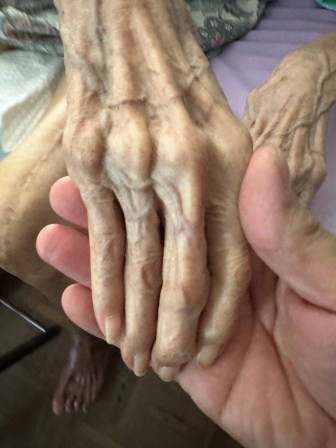
Today, I hold gently and study deeply her hands in the same way I look at her surviving artwork. Delicate. Almost brittle. To touch her life story. Hands that drew countless sketches, drawings, and paintings with her youthful dreams of worlds beyond the fish farm in Dagupan. The hands and fingers that rehearsed, over and over, at the piano in the thick, pre-war Philippine humid air: Beethoven’s Moonlight Sonata, the Chopin waltzes (my favorite is her rendition of Waltz in C sharp, Op. 64, No. 2: soft, lyrical and lilting) and many more music sheets were drilled and practiced daily by a pre-teenage girl.
That was before the “Tyempo ng Hapon”(Japanese Time) began on December 8, 1941, forcing her family deep into the hills to hide as her father was arrested, tortured and jailed by the Kempeitai, the notorious, brutal military secret police, for his service and affiliation with the American Army. Throughout the Japanese occupation, like many Filipinos, the family suffered and survived in stoic silence until MacArthur returned and Liberation Day was declared in 1945.
My mother will be 99 years old this summer.
Sylvester Lee Salcedo of Orange is a retired U.S. Naval Intelligence Officer. He is also a retired private practice attorney and served concurrently as a Small Claims and Motor Vehicle Infractions Magistrate with the Connecticut Judicial Branch.