



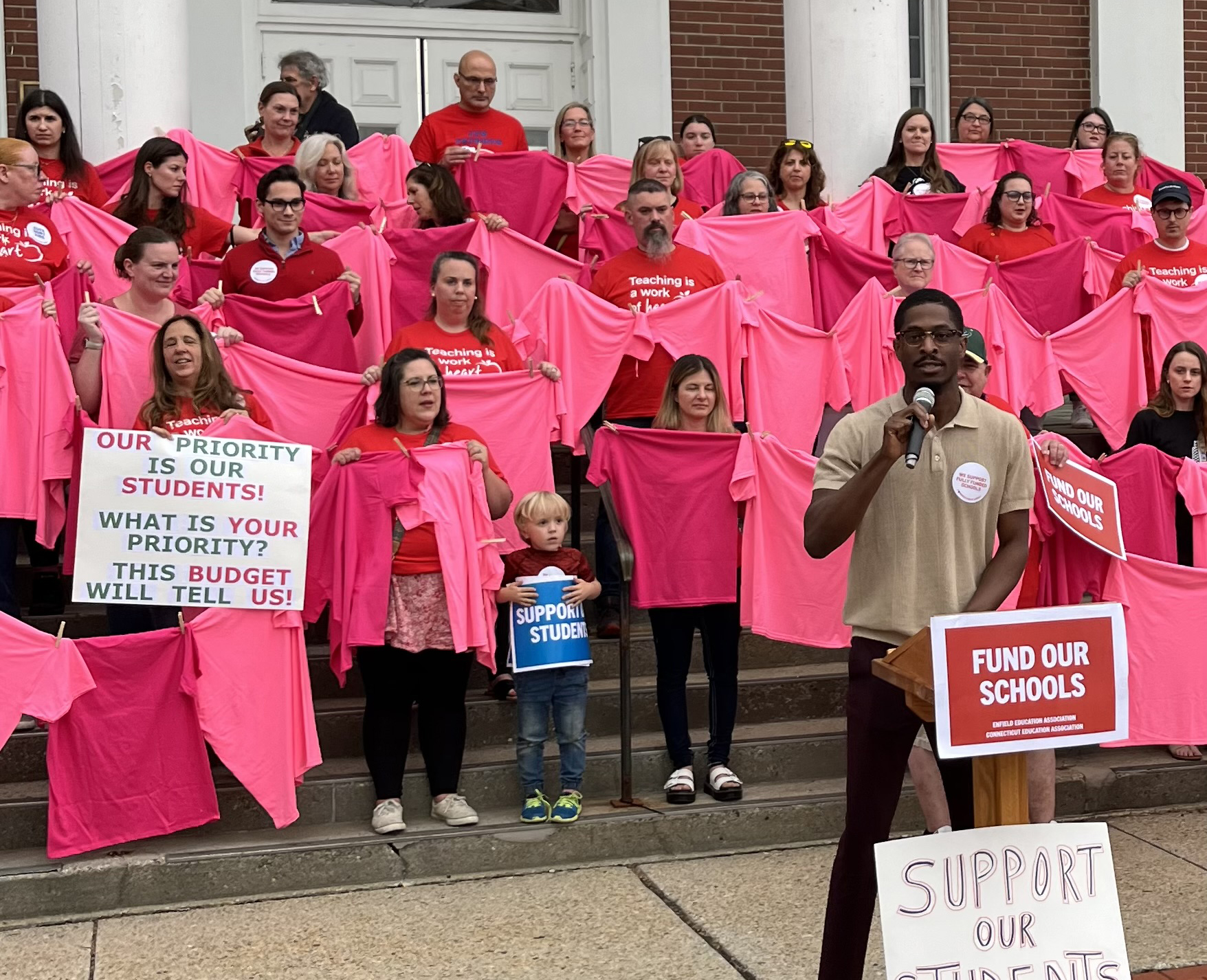
It’s time for Connecticut to start treating our children like they are a priority.
In my three years serving on Windsor’s Board of Education, I have been repeatedly appalled by the way that our state accepts that hundreds of thousands of children will go underserved, educators will go under-resourced, and parents’ needs will go completely ignored.

I recognize that many around me have accepted these conditions as normal, but as a 26-year-old seeking to start a family of my own, I think it is up to my generation to remind us all that underfunding our public schools should be neither normal nor acceptable.
In my native Windsor, the burden of our state’s educational funding structure was felt when legislators on both our Board of Education and our Town Council were forced to debate cuts between important public services, leaving us with a budget that left almost everyone in our community anxious over the effect our students, teachers, paraeducators, parents, and support staff would feel. Additionally, a newly implemented and well-intentioned “Right to Read” state program requires that, rather than paying our educators to develop their own curriculum, our school system must now find $1.7 million dollars for the external purchase of programs, with no incoming funds to support this implementation.
This pattern of debate and sacrifice often feels local, making us view caring neighbors as adversaries, when in reality we are a part of a pattern happening all over the state. In our neighboring Hartford, local officials are scrambling to mitigate a massive cut to their already struggling school system. Enfield, a town specifically identified by the state as an Alliance District, is facing a loss of over 100 teachers as well as sports programs, extra-curricular programs, and more. All across the state, our families are being implicitly told that their children’s wellbeing is not their government’s top priority.
Why do we all happen to find ourselves in similar situations right now? The loss of ARPA funds, the influence of private educational interests in the state legislature, the municipal burden to pay costs associated with state programs, and the persistent push for austerity at the expense of our children all play a role.
The more important question is, how do we break this destructive pattern and give our children and those that serve them everything that they need to succeed? We have to start asking, and expecting, all of our state legislators to be champions for public education. We need our state’s elected leaders to have the political will to treat our future generations as indispensable, because they are. The truth is, ARPA funds that were invested in education only helped reach a close-to-acceptable level of student-facing staff and resources for many of our schools, and losing them only serves to further show us how bad current funding conditions truly are.
The continued funding of expanding charter and magnet school programs create excellent opportunities for a select few students, but we must also imagine a funding formula that equitably serves us all. The quality of education a student receives should not be dependent on the wealth of your town and whether local elected officials decide to invest in the future minds of America, and it certainly should not depend on whether or not your parents win a lottery. The only way for our state to create this reality is to equitably fund our traditional public schools and remove some of the burden that our local school systems face.
Cuts to education are more than a number on a piece of paper, they are a young student who feels ignored because her teacher is struggling with increasing class sizes, they are a mother paying additional costs for child care because there is nowhere for her student to go after school, they are a young man making dangerous and short-sighted choices because he does not see himself as a part of a system that is investing in him.
While the complacency of many of our state legislators leaves much to be desired, there is hope to be found in the response from everyday people around the state who are fighting back and speaking up for their students. In Windsor I have seen parents, educators, and students themselves speaking up about the damage that cuts to the school budget will do to their future.
In Enfield, Hartford, and towns all around the state, large educator-led actions and organized events are bringing people together to break the cycle of disinvestment and say it loud and clear: it is time for our legislators to start acting like they care for our children as much as we do.
Nathan Wolliston is a Member of the Windsor Board of Education.