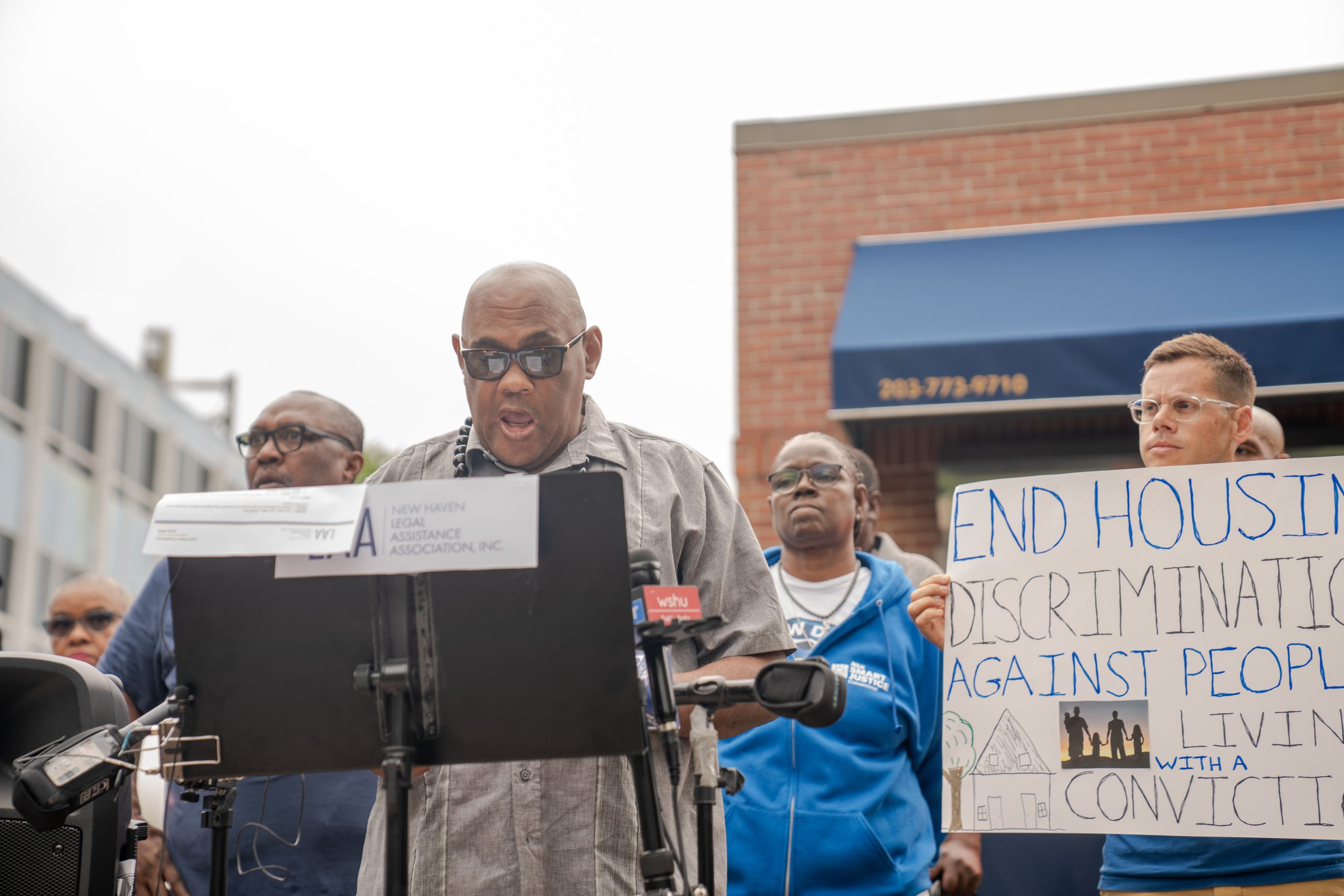
A New Haven couple denied housing by one of the city’s largest mega landlords because of a decades-old misdemeanor record announced Thursday they have lodged an official complaint alleging racial discrimination.
The case, now before the state Commission on Human Rights and Opportunities, could set precedent and have broader implications for landlords across the state when deciding whether to rent to prospective tenants. Advocates for a bill that died during the 2024 legislative session that would have explicitly outlawed the consideration of certain criminal records in housing applications are already pushing for change in the 2025 legislative session.
Mark Griffin was convicted of two counts of third degree assault, a Class A misdemeanor, on Sept. 20, 1989. Over 34 years later, he and his fiancé, Cheryl Rabe, are struggling to find a place together.
Griffin and Rabe, alongside their legal representatives from the New Haven Legal Assistance Association, addressed a crowd on Thursday morning outside the office of the landlord who denied their application — Mandy Management LLC on Whalley Ave. in New Haven.
“Two minor convictions that are more than three decades old do not reflect on how he is as a person and how he will be as a tenant,” Rabe told the crowd. “Instead, they are simply refusing to rent to him, or to us, as a couple because of his criminal record. We demand an end to this type of discrimination… Everyone should have access to state housing and affordable housing.”
NHLAA Attorney Amy Eppler-Epstein echoed and expounded on that.
“[The] kind of policy of refusing to rent to somebody because of a criminal conviction, without regard to how long ago it was, what it was for, what may have happened in the intervening 34 years, any other mitigating circumstances, any information about what kind of a person and tenant they would be, that constitutes racial discrimination, because that kind of policy has a disparate impact, falling more heavily on people of color,” said Eppler-Epstein.
Yudi Gurevitch, Mandy’s chief executive and the son of the company’s founder, disputed claims of racial discrimination. He said in an emailed statement the company does not discriminate against tenants or potential tenants on any basis prohibited by law.
“At Mandy Management, we are committed to providing equal housing opportunities,” Gurevitch wrote. “To maximize transparency and fairness in rental decisions, we apply the same screening criteria and procedures to every applicant so we can make informed decisions to protect our rental community and to promote fairness and inclusiveness.”
Since taking over the company from his father, he’s aimed to continuously improve Mandy and has not been fined in criminal housing court for violations during his tenure, Gurevitch said.
A case against Mandy Management and P2P Realty
Griffin and Rabe are looking to move-in together before their wedding in July 2025. Through their recently granted housing choice voucher, the couple began to look for apartments in New Haven. Given its massive real estate portfolio in the area, they quickly encountered Mandy Management.
Mandy owns over $125 million worth of property in New Haven, primarily in the city’s lower-income neighborhoods. Around 40% of their tenants receive Section 8 rental subsidies.
After touring properties, the couple filled out the company’s application and paid the $35 fee on April 4, 2024. Four days later, they were denied.
The couple said Rabe passed all aspects of the application’s background check, while Griffin passed every aspect of the review with the exception of the criminal record. His misdemeanor convictions from over three decades ago were the only charges listed, they said.
Griffin said he has had no involvement with the criminal justice system since then and has served for a decade on the Board of Directors for his current co-op: Seabury Cooperative, a housing complex of 87 housing units within two separate buildings.
After being rejected by Mandy, the couple continued their search. P2P Realty Group, also named in the complaint, refused to work with them given Mandy’s earlier denial.
P2P Realty could not be reached for comment Thursday.
“When I was sentenced in court, the judge didn’t tell me that it was going to be perpetual,” said ACLU-CT Senior Policy Organizer Anderson Curtis. “They said my sentence had an ending date, a discharge date. But is that really true? If Mark [Griffin] is still being denied housing based on a criminal record, well, that amounts to perpetual punishment. I didn’t know that I was gonna have to carry this record with me for the rest of my life. He didn’t know he was gonna have to carry that record for the rest of his.”
Discrimination on the basis of race when securing housing violates both state law and the federal Fair Housing Act. The NHLA, American Civil Liberties Union of Connecticut and the Connecticut Tenants Union argue that Griffin and Rabe’s case constitutes just that.
“Because people of color are disproportionately incarcerated in our state, housing is even more difficult,” Curtis said. “79% of formerly incarcerated people have been denied housing due to a criminal conviction. And guess what? That’s also the recidivism rate in our state. I wonder why.”
A Call to Revive Bill 5242
In the recently concluded legislative session, Connecticut Democrats introduced House Bill 5242 which would have strictly limited landlords’ ability to consider certain criminal convictions from more than three years ago. If the conviction occurred in the preceding three years from the application date, however, the bill would require landlords to consider the nature and severity of the crime, as well as information pertaining to rehabilitation, their ability to be a good tenant and the time since the conviction.
[RELATED: Formerly incarcerated, landlords at odds over criminal history bill]
The bill would also require landlords to notify prospective tenants of this extra review and allow them to provide relevant mitigating information. This was not done in Griffin and Rabe’s case with Mandy and P2P, they said at Thursday’s press conference
“The idea is landlords should not be able to look back indefinitely at all convictions forever, Eppler-Epstein said. “They need to be restricted to looking at convictions that have to do with how you’re going to be as a tenant, and tenants need to be given an opportunity to show what’s called mitigating circumstances: changes in their life, to show what was going on at the time they had their conviction, and what has happened since then.
“To show who they are as a person and why that conviction, just because they have a conviction, doesn’t mean that they should be denied housing. People should be given a chance to do that.”
Supporters from the crowd applauded and cheered as Eppler-Epstein concluded.
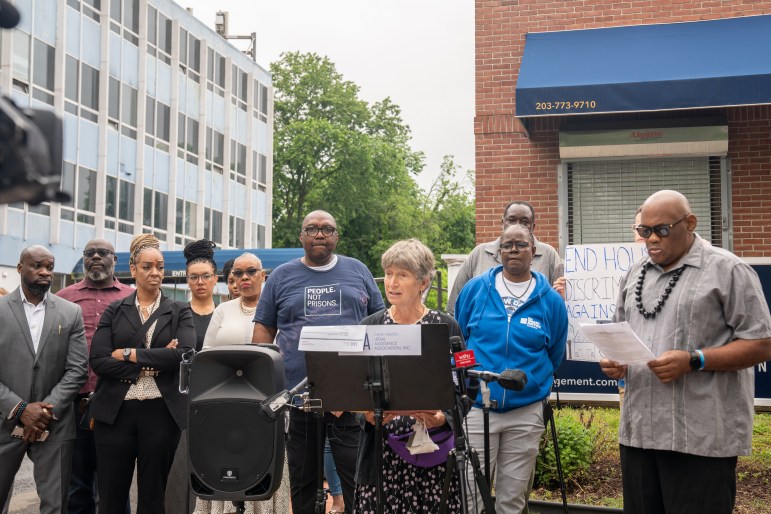
House Bill 5242 ultimately passed out of committee but wasn’t called on the House or Senate floors. However, “Mark and Cheryl are here to fight,” Rabe told the crowd, fist in air.
By bringing the case, they hope to “inspire” a change in the law next session and reintroduce a similar bill to 5242. Many legislators agree.
“Lack of housing is an all too common experience for people as they work to become productive citizens after a conviction,” said Senate President Martin Looney, who co-authored HB 5242, in a written response to questions from the CT Mirror. “Limiting the use of criminal records to reject applicants would help resolve this situation and many more. I hope the General Assembly will pass this legislation next year.”
While the language of future bill remains “up for discussion,” attorneys and advocates reaffirmed the unfairness of perpetual punishment for individuals who have already been adjudicated.
“This is about changing the conversation throughout the whole state, because this state is a state of great disparities,” Curtis said. “In 20 minutes, we can drive out the road and be in million dollar homes. But this is happening right now… Denying these people the right to housing, well that’s the issue going on at the moment. But the broader conversation is, what does safe housing look like?”
Curtis ended his speech leading a chant of “people, not prisons.”