


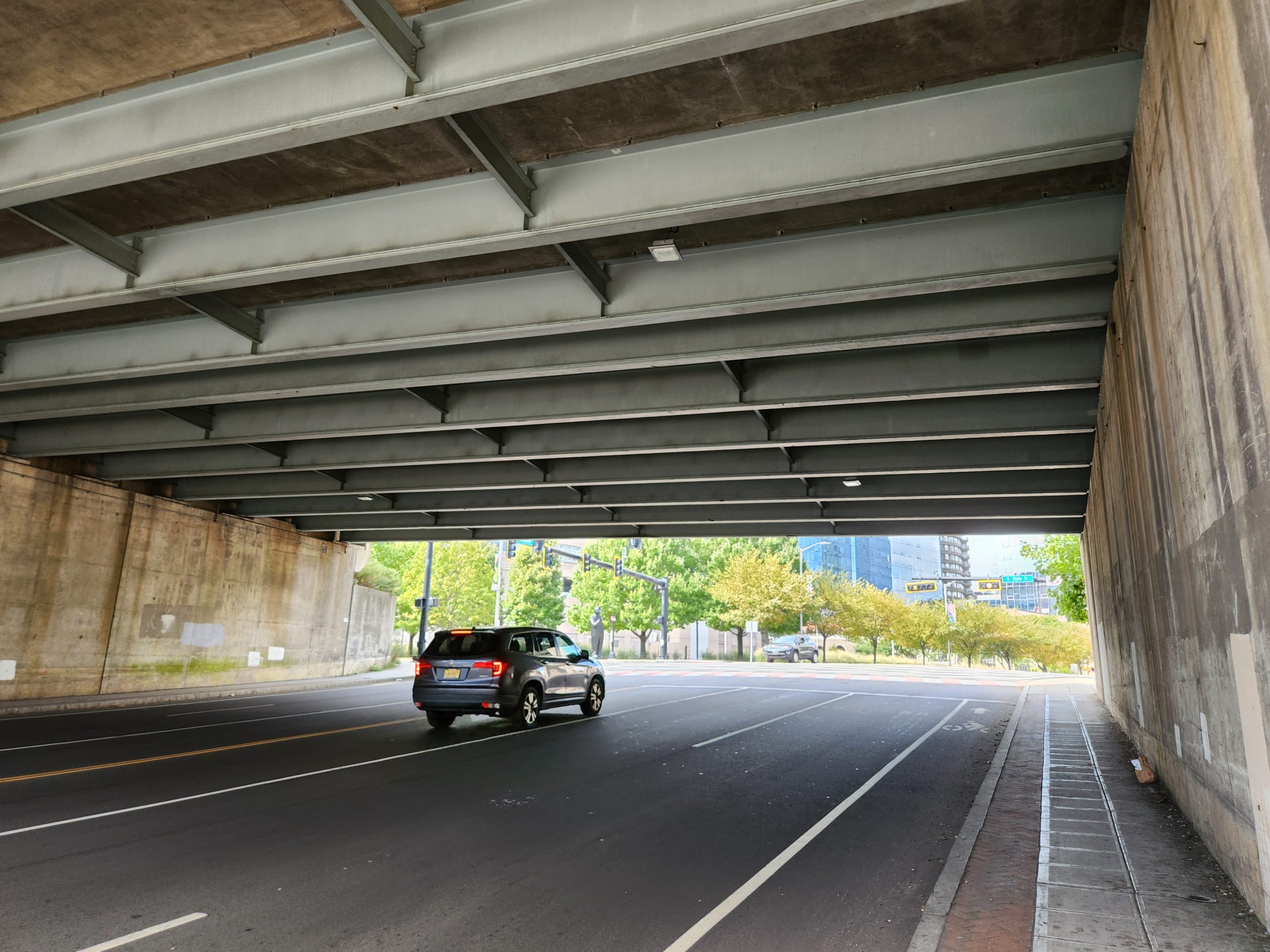
Connecticut may be “the land of steady habits” but one corner of it, Stamford’s South End, is anything but. It has undergone a dramatic reinvention in recent decades, and if the neighborhood’s numerous construction sites are any indication, there is still much yet to come.
The area was once a hodgepodge of intense industrial uses. Paper mills, pet crematoriums, car crushers, asphalt plants, you name it. “Anything nobody wanted, they threw in the South End,” longtime resident Sheila Barney recalls. More recently, a slew of ambitious projects, including one of the country’s largest brownfield redevelopments, have eradicated most of the South End’s worst offenders, which have since been shut down and turned into high-end apartments, a revamped marina, and a necklace of small parks.

But one noisy, polluting, eyesore of an outlier remains, and it is possibly the neighborhood’s worst: I-95. The stretch of I-95 running alongside the South End, which hems the neighborhood in from the rest of the city, is consistently ranked among one of the country’s most congested, and the pollution from all that congestion wafts over to the South End.
“When you got a bottleneck in that section,” Barney says, “all the fumes and emissions get stuck in the South End.” She says she gets notifications on her phone when there’s poor air quality in the neighborhood. “I get alerts saying it’s gonna be a bad day for breathing…if you’re getting alerts like that, that’s pretty bad.”
The impact of traffic-related noise and air pollution on the health of people living near freeways is well-documented: increased rates of heart disease, lung cancer, diabetes, asthma, birth defects, and more. In Stamford, the state’s second-largest city, tens of thousands of people live within close proximity to I-95, including me, and the entirety of the South End. There’s no home in the South End that’s more than a mile from the highway.

Unfortunately, when the highway planners of decades ago plowed through America’s cities, they often targeted racially diverse and working class neighborhoods. In fact, per the Stamford city government’s Neighbor Statistical Area data, all six neighborhoods in the city which border I-95 (the West Side, Waterside, Downtown, the South End, the Cove, and the East Side) are majority-minority, and four of them have a per-capita income lower than the city average. The history and the data paint a damning picture, where the most vulnerable swathes of Stamford were simply deemed “sacrifice zones,” and had a major polluter forced onto them.
Fortunately, it seems like the state has come to acknowledge this, and is aiming to right this wrong. In 2022, the state Department of Transportation launched a Planning and Environment Linkages Study, which has embarked on the gargantuan effort of trying to “fix” this stretch of I-95.
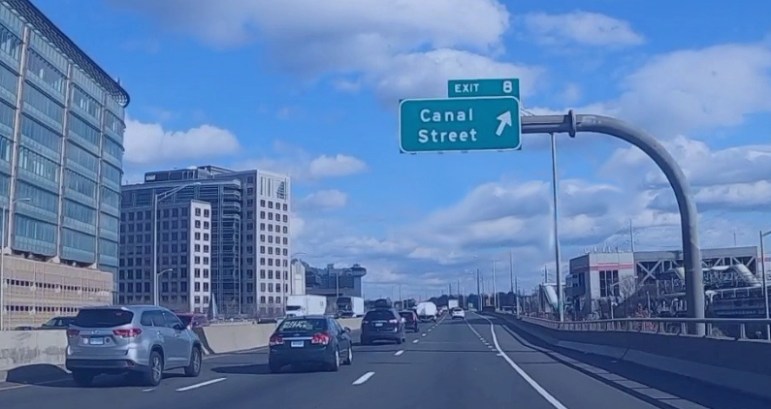
Beyond simply looking at remedying the intense traffic, the study has examined the highway from many angles, including its sizeable environmental impact. I serve on the study’s Project Advisory Committee (PAC), a group of community stakeholders brought in to help guide the study to better reflect the community’s needs. Through lively participation and listening ears, a mosaic of community groups in Stamford have been steering the project toward not just tweaking I-95 and maintaining the status quo, but helping piece back together the fabric of the areas I-95 has so strongly impacted.
But the study is expected to go on for multiple more years, and even imagining any sort of change to one of our country’s most important pieces of infrastructure is challenging at times. The highway is still belching noxious fumes into the heart of Stamford’s air, as countless drivers sit idle in it every day.
Barney, who also serves on the PAC, is encouraged by recent changes in her neighborhood, and feels the government is being more responsive to the neighbors’ concerns. But she can’t envision a silver bullet resolving all the ailments I-95 has brought onto her neighborhood. “I don’t know,” she says. “I don’t know how to do it.”
And this is where Connecticut is at today. All of our state’s cities, not just Stamford, have major highways running through some of their densest communities, ruining the air and producing a non-stop cacophony of car horns and tire screeches. Is there any way of fixing this, or is this just an inevitability of America’s car-centric policies?
Fortunately, other places in Connecticut are trying to reverse the damage. In recent years, New Haven has successfully removed part of Route 34, a highway running through the historic city, haphazardly constructed during the urban renewal period. In Hartford, advocates are dreaming bigger, and have lobbied for a plan to redesign the footprint of the city’s many freeways.
Other cities throughout the country have removed their freeways, or even buried them underground. Boston’s Big Dig project buried I-93, Seattle buried its Alaskan Way Viaduct, and Rochester tore up part of its Inner Loop freeway without even building a replacement.
Knowing everything we know about the impact of urban freeways, and the environmental damage they cause, what will come of plans to reimagine Stamford’s I-95? The answer is still unwritten, but Stamford’s residents do have the power to nudge it towards a more just, environmentally friendly future. They can voice their concerns to the I-95 PEL study, CTDOT, and the mayor’s office. I am confident that if they do so, we can right some major environmental wrongs, and push towards a future where I-95 doesn’t choke its surrounding neighborhoods, even if that future may be hard to envision at the moment.
Angelo Bochanis is a member of the Connecticut Mirror’s Community Editorial Board.