


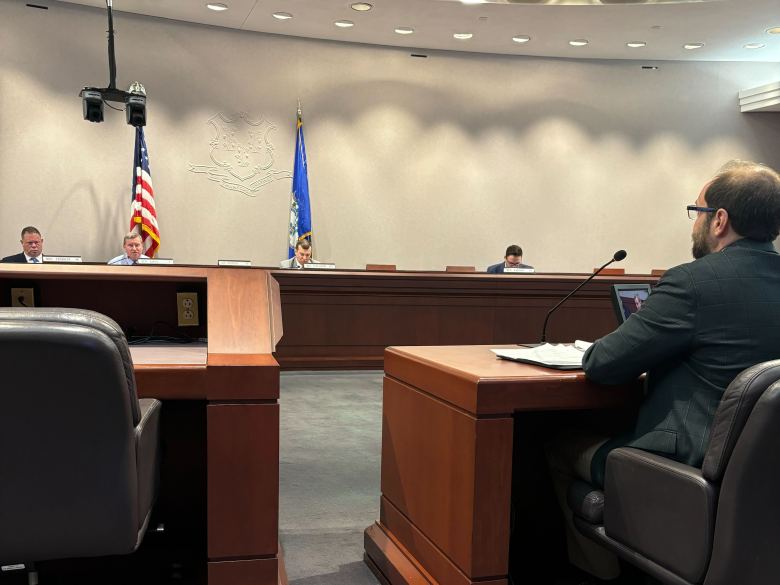
The Judiciary Committee on Wednesday interviewed two nominees for the state’s Board of Pardons and Paroles, focusing on how likely the nominees would be to approve sentence modifications and to take into account the experiences of victims of crime.
Gov. Ned Lamont nominated Aileen Keays and Alex Tsarkov to fill vacant seats on the board on April 1.
The 10-member board is able to grant, deny or revoke parole and offer reductions of people’s sentences, known as commutations.
The board came under scrutiny in 2023 when Gov. Ned Lamont removed then-board chair Carleton Giles after the board approved 71 sentence commutations in 2023 — a massive jump in comparison to earlier years, where fewer than five commutations were granted per year. Lamont also suspended commutations for a period of time.
Keays has worked with Children with Incarcerated Parents Initiative, a project under UConn’s Institute for Municipal Regional Policy, since 2007. The project provides services for children with incarcerated family members — for instance, collaborating with the Department of Correction to build a playground at York Correctional Institution and create “child-family” visiting spaces at MacDougall-Walker Correctional Institution.
The initiative also conducts studies on the needs of these children and the efficacy of certain programs designed to support them.
Tsarkov serves as the executive director of the Connecticut Sentencing Commission, a 23-member panel tasked with making recommendations to the governor on changes to the state’s criminal justice system. Before that, he oversaw contracts that the Judicial Branch made with nonprofits for programs offered to pre-trial individuals or people on probation.
Republican lawmakers questioned whether the applicants had enough experience working with victims of crime. Rep. Craig Fishbein, R-Wallingford, said members of the board needed to be “neutral” in their decisions when modifying someone’s sentence or approving parole.
Fishbein questioned whether Keays would consider herself an “advocate,” a term that she pushed back on. She said the decision to offer a pardon or to parole an incarcerated individual needed to be based on a wide variety of circumstances, including that individual’s behavior since the crime was committed, how the crime impacted a victim and the potential for that incarcerated person to be a risk to public safety.
“I do not want to be part of a decision that leads to victimization in the future. I take that very seriously. I do have a young daughter. I think about her welfare all the time. As a parent, as a female, I think about my safety and welfare,” Keays said.
Keays noted that many people who commit crimes were also, at some point, victims of crime themselves. But she said that if she were on the fence, she would be more likely to lean toward continued incarceration rather than release.
Keays said she believed parole allowed people who were demonstrating remorse and changed behavior to reenter their communities at an appropriate time, before falling further into the criminal justice system or losing connections they had in the community. It also gives them the opportunity to modify or revoke parole if need be.
“If we don’t afford … that opportunity to check in with a board of experts who have been trained or are going to look at this seriously, then we lose that opportunity to let them out under community supervision. We also know that community supervision has much greater success in terms of a reduction in reoffending than end-of-sentence,” she said.
Tsarkov said he also had little experience working directly with victims of crime, besides some work on legislation with the Sentencing Commission. But he said victim input was important for the Board of Pardons and Paroles.
“Victims have constitutional statutory rights here in Connecticut to be notified of a hearing and to participate in the hearing by providing a statement, and I think those statements are very powerful,” he said. “I think they should be acknowledged, valued and respected throughout the process.”
Tsarkov said he expected the Board of Pardons and Paroles to be “the toughest job I’ve ever had” but said he was looking for “a real challenge.”
“I think the board plays such an important role in the criminal justice system when it comes to public safety and rehabilitation. I think the board members do a tremendous job,” he said.
Sen. John Kissel, R-Enfield, warned the nominees that being on the Board of Pardons and Paroles required them to be “like the actuary of human behavior” — that it was a difficult job that became visible to the public only when the wrong decision was made.
Rep. Patrick Callahan, R-New Fairfield, also emphasized the need to include victims in their calculus.
“When it comes to making decisions on the board of pardons and parole, the person on paper may have done everything right, but I hope you can consider that there was a victim in many of these cases, there was a victim and there’s community safety involved,” he said.
The committee will vote on the nominations on Friday.
CT Mirror reporter James Watson contributed to this story.
