



When I was in my freshman year at UConn, my mother – who had immigrated to the U.S. from Ghana and worked as a nurse for more than 35 years – became very ill. I was doing so well at school, but as soon as I got that call in early November, the financial burden of attending college as an out-of-state student loomed very large.
Just a year before, in 2020, in the wake of the murder of George Floyd, we all saw a renewed movement advocating for racial justice and equality. I was still in high school, and the event served as a catalyst for my passion for journalism.

I found myself inspired and motivated to express my emotions and thoughts on what could be better, especially as an African American navigating life in a town that was predominantly non-Black. I was determined to study journalism and capture stories that matter, and this ambition quickly became my dream. The price to attend UConn before financial aid and waivable fees is $62,323. My mother and brother stood firmly by my side, encouraging me to chase my dreams and make our family proud.
But now that my mother was sick, just a month or so into my college career, the narrative had switched. It became a matter of me needing to take care of myself in order to help my family manage in her absence.
Throughout my four years at the university, I’ve worked at multiple jobs to support myself, with my highest-paying positions being at Sally’s Apizza and Haven Hot Chicken. And while I will forever remain thankful to these jobs for taking me in during my time of need, earning about $20 an hour was not even close to enough. My mother’s ongoing illness meant I had to shoulder the burden of my tuition on my own while also supporting my family at home in their time of need, paying for food and managing utilities at 18 years old.
In college, students are encouraged to fully immerse themselves in their studies while at the same time participating in a bunch of extracurricular activities and internships in order to build networks, gain invaluable experience and improve their craft of choice. Yet for those like me, managing a rigorous academic schedule while working nearly full time – especially in an industry that doesn’t have anything to do with my future ambitions – achieving this balance can feel nearly impossible.
Allison Wall, a dear friend and fellow student studying natural resources and the environment at UConn, echoed my struggles. “I have loans that cover a significant portion of my tuition, but I also have car payments, rent, repaying those loans,” she said. “There are days when I barely eat.”
Ageu Dos Santos, another UConn student, often has to work late and can’t get up for classes in the morning. “I have to hope and pray that these customers don’t come in. Otherwise, I have to stay in late and not be able to get up for class; I don’t get paid enough to worry about this.”
Thousands of students share stories like ours, and for the most part, their voices are entirely unheard. These are individuals whose families cannot help them with their education costs due to financial constraints. And no matter what the reason, it can’t be fair to put this strain on a young person straight out of high school. Students should be able to achieve their dreams no matter where they decide to end up going to school.
While the university provides some resources, such as food pantries and clothing initiatives, the outreach to help students find these programs is insufficient. I often found myself scouring UConn’s barrage of Daily Digest emails for any hope of assistance, whether financial or emotional. And when I reached out to the financial aid office for additional support, I was met with so much disappointment. They informed me that I had exhausted my options and could not receive further help. The only option I was given was to take out a private loan. I hadn’t done that during my time at UConn until this year, when I had no choice.
As I prepare to graduate this semester, I take so much pride in the journey I’ve been on. I carry with me the lessons of resilience, as well as acquiring some of the journalism skills I needed. I daily remember the struggles I overcame to get to this point. Yet, I cannot shake the feeling that financing an education should never be this arduous. I can’t help but worry that because of the situation I’ve been in, I won’t find a job easily at all, not because of skills I haven’t acquired but because of the lack of true experience I have.
I want to be someone in this world. My passion and drive make me this way, and while no one can predict these circumstances, the reality of potentially repaying student loans for the entirety of my life feels overwhelming. No one should have to face such daunting challenges.
College costs money for a reason. This isn’t an article about making college free. As a student, I covered many issues similar to this one for class assignments. I always got led to the same statement:
“The things students enjoy cost money.”
I understand that a lot of the things cost money. But I don’t have the time to enjoy said things. There should be something more that universities across the country could do for students like me, who were just dealt a bad hand and couldn’t do anything about it.
The solution of loan forgiveness has been really big in helping students after college, but this is a process that should be expanded upon, not taken away as the Trump administration is threatening – giving students more access to the education they need.
Because of my journey, I’ve missed out on internships and valuable experience that would’ve helped me advance in life. This feeling of hopelessness after all the sacrifices people have made goes to show all the deeper issues in this country. How a student, who’s a person of color, can’t make it during this stage of life because of the lack of connections, the lack of time, and because my parents weren’t born here. I work tirelessly each day to make something of myself because of the promises I made to my mother. The feeling that I’m not getting that fair chance, the feeling of failure, scares me.
My mom is slowly doing better physically, but mentally I worry if she’ll ever be the same. She’s 60 years old now, and many years of working as a single mother have taken their toll. My father told me that they’re planning to retire back to Ghana after reuniting with my mother following her illness. They have completed their attempt at that “American Dream” so many immigrants around the world chase for generations.
I’ve battled and fought through an experience. I will never let something like this hinder me. My mission has always been to make things easier for people like me — first-generation students, people who struggle to pay for college, people of color, anyone that feels like they’re not getting the love they need.
My last shift, I worked 13 hours. During that time, I had a guest visit my job who was touring UConn with their daughter from Long Island. Strangers. When they told me how proud they were that I was graduating, it sparked the brightest smile within me. I hope to make people feel that sense of pride in my writing, perfect my craft, and make my family proud. I need to make all the hard work worth it.
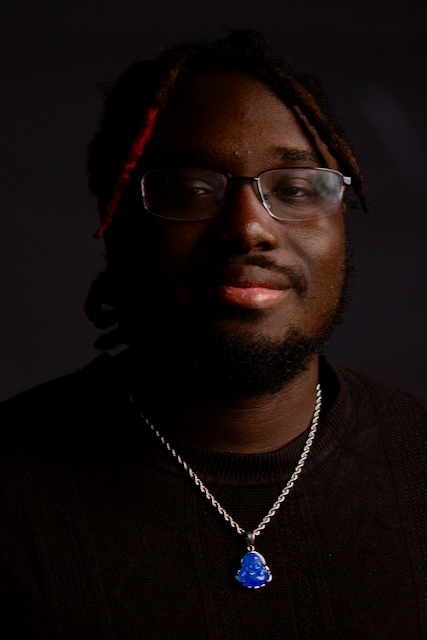
Kwasi Osei-Amankwah is a senior majoring in journalism at the University of Connecticut.