


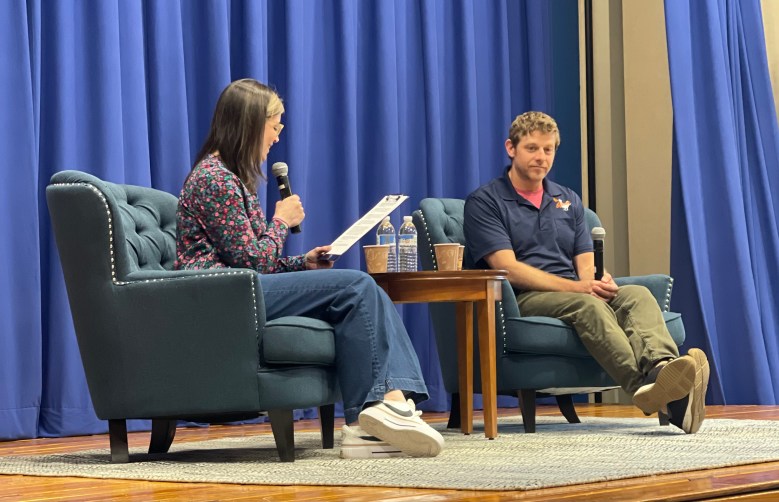
Food and beverage entrepreneur Jason Sobocinski has been feeding New Haven for decades.
As a teenager growing up in the city, Sobocinski started a subscription service of sorts for his neighbors. They would pay him around $20 a week, and he would deliver homemade loaves of bread and quarts of soup to a cooler outside of their houses. Within a month, he had gone from having five or six customers to over 40.
“I had taken over the entire kitchen, and my mom was like, ‘This ends now. Like, we can’t even cook,’” Sobocinski told The Connecticut Mirror’s Erica E. Phillips on Wednesday night. “I had batches of soup going and bread everywhere. I had emptied the entire refrigerator and thrown out all of their food just so I could put bread in there and let it ferment.”
Sobocinski and Phillips discussed his career at the Ferguson Library in Stamford during the third installment of CT Mirror’s “This Could Work” event series, which explores the stories of successful Connecticut entrepreneurs.
Over time, Sobocinski parlayed that love of food and self-starter spirit into a career as a food and beverage entrepreneur, with restaurants and shops based largely in his home city.
He was behind New Haven’s cheese-focused Caseus Fromagerie & Bistro and Olmo bagel shop, as well as Black Hog Brewing in Oxford. His newest venture, Haven Hot Chicken, was recently named by Inc. Magazine as one of the fastest-growing companies in the United States.
In Sobocinski’s case, his origin story revolved around a series of jobs in restaurants and gourmet grocery stores. Among them was Formaggio Kitchen, a gourmet cheese shop in Boston where he worked while pursuing a graduate degree in gastronomy — which he describes as “the anthropological study of food and culture” — from Boston University.
With family roots pulling him back to New Haven, and his work at Formaggio Kitchen fresh in his mind, Sobocinski moved back home and opened Caseus Fromagerie & Bistro, a cheese shop and restaurant in New Haven.
Caseus opened in 2008, and to hear Sobocinski tell it, the timing wasn’t ideal, as people didn’t want to buy cheese that could cost up to $35 per pound in the midst of a deepening recession.
During that time, the Caseus crew stuck it out — “we innovated, we just got scrappy,” Sobocinski said — and the shop remained open until 2018, when Sobocinski decided to close it to make room for a new venture in the same location.
That venture was Olmo, a bagel shop that looks markedly different from the vision he and Craig Hutchinson, his former head chef at Caseus, originally had for it.
In addition to a bagel shop, the initial vision also involved high-end, new-style Italian food — pasta made by hand, a restaurant where chefs cooked in front of people. But after it opened, Sobocinski said, the feedback he and Hutchinson received was negative. People didn’t like Olmo, and they wanted Caseus back.
But when the COVID-19 pandemic struck, everything changed, and Sobocinski and Hutchinson pivoted. They closed the restaurant portion of Olmo and reinvented their bagel formula, and all of a sudden, Sobocinski said, they went from selling around 50 bagels a day to thousands.
“We had to pivot. It’s an opportunity,” Sobocinski said. “You can think of it as the worst thing ever, and it was terrible, or you can make it into an opportunity. Because that’s what failure is. It’s truly an opportunity.”
Sobocinski is now CEO of Haven Hot Chicken, which has brought Nashville-style Hot Chicken to New England and offers five levels of heat that guests can try. Haven has been growing since its founding in 2020, and now boasts nine locations throughout Connecticut, from Norwalk to Newington to Storrs.
He describes Haven as offering a healthier version of fried chicken, one that was raised with no antibiotics and is fried in canola oil rather than the cheaper, but unhealthier, soybean oil that many other restaurants use. He thinks of Haven Hot Chicken as a premium choice.
“I can’t compete with the big guys, nor do I want to, because that will be a race to the bottom,” Sobocinski said. “And so we’re more expensive, and you get something for it. And that’s OK.”
