



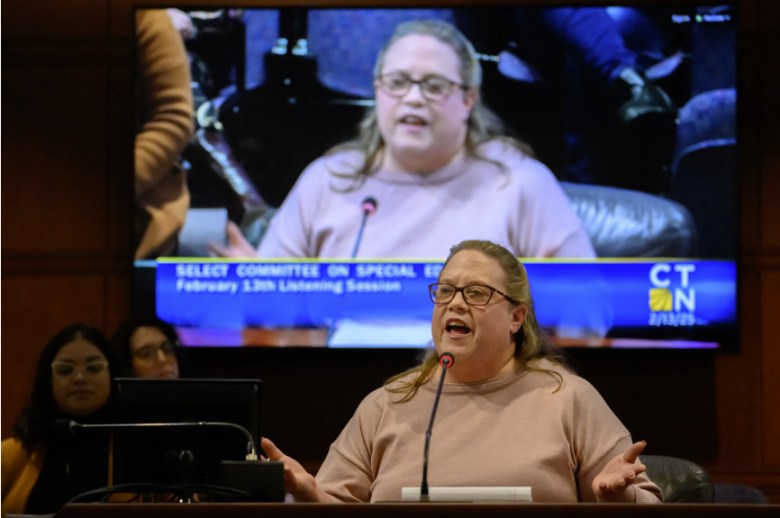
At a public hearing on April 21, members of the Select Committee on Special Education repeatedly asserted that they want to fix the “broken” special education system.
Unfortunately, the special education bills currently speeding their way through Connecticut’s legislature, HB-7277 and the identical SB-1561, would make the system far worse and reduce the ability of families—and even school teams—to meet the needs of children with disabilities. Worse, they would further erode the rights and protections for these children and reduce accountability and transparency in our public schools.

For example, the bills call for removing from children’s Individualized Education Plans (IEPs) a column called “service implementer.” Why should families care? Because if that column is removed, districts will have free rein to use anyone to provide specialized instruction. It could be a special education teacher, a paraprofessional, or the next random person to walk past the principal’s office.
Many short-staffed districts already try to provide special education services with unqualified staff, but students are entitled to have those services made up by the implementer listed in the IEP. Without that column in the IEP, there is no accountability or transparency, and it may be impossible for families to contest the district’s decision-making.
This is just one example; a baffling number of other such “poison pills” lurk in the 63-page bills, despite the supporters’ stated intentions to make special education more accessible.
Most of the April hearing focused on the high cost of private special education placements, and Rep. Maryam Khan, House Chair of the Committee, stated, “As a teacher. . . I’ve been in PPTs (special education Planning and Placement Team meetings) where I’m, like, this child should be elsewhere, but I know I can’t say that as a teacher. That’s just the reality. . .because of what districts are faced with. Districts can’t pay what they are going to be asked to pay if they actually want to provide what the student needs.”
She also stated, “Our goal is to fix the system, not just to save the couple (students) that we can.” Note that Khan is herself a special education teacher in East Hartford. My translation of her alarming remarks: Because of budget concerns, school districts are failing to meet the needs of all but a few students with disabilities. And even if a teacher believes the child needs a private special education school, the teacher cannot speak up for the child but must remain silent, even knowing the child’s needs are not being met.
Khan added, “The education system itself is very broken. . . some students, if they are lucky enough to get access to an advocate or attorney or they have a parent who really knows or understands the system, they may be able to make it, but everybody else is not in a good space. So through some of the measures in this bill we try to address that, so everyone has equal access. . .”
(Khan’s remarks begin at around 8:34:30 of the above video and continue to 8:35:32. The quotes are exact but are out of order.)
But instead of providing more access to special education protections for all children and their families, HB-7277 and SB-1561 move in the direction of eliminating any ability of families to enforce the law. I suppose that could be considered “equal access,” but it is certainly not in the interest of children.
So how do we fix special education?
1) Teach our kids to read!
According to the National Assessment of Educational Progress, only 36% of all Connecticut fourth graders are at or above proficiency in reading. In contrast, research tells us that, if students received structured literacy delivered in a way that is consistent with reading science, 95% of ALL students are capable of reading proficiently.
Unfortunately, most of our universities have not provided our K-3 teachers, special education teachers, or even our reading specialists with adequate preparation to effectively teach reading in a way that is consistent with reading science. Most teachers require two years of training and supervised practicum specifically in structured literacy, which can be done through Orton-Gillingham certification, CALT certification, etc.
Most children, including those with dyslexia, require structured literacy, and all students benefit from it. Providing effective reading instruction —which requires teachers to be certified in structured literacy— will help all students, not just those with disabilities.
2) Districts need to use evidence-based social/emotional/behavioral programming that published, peer-reviewed research has determined to work.
For example, Ross Greene’s Collaborative and Proactive Solutions has an entire body of peer-reviewed publications showing that his model is successful in reducing restraints/seclusions and reducing exclusionary discipline. It is also likely to reduce bullying in our schools. This too requires extensive training and increased staffing in our public schools. But again, this investment helps all students, not just those with disabilities.
We need to keep our eyes on the ball —meeting the needs of all our children, including those with disabilities. The reality is that educating children who need special education does cost more. We can either invest the money to provide children with disabilities a meaningful education now, or we can pay exponentially more throughout their lifetimes.
Ninety-eight percent of students with disabilities are capable of becoming independent adults. Let’s prepare them to be productive taxpayers rather than setting them up to be incarcerated or to need a lifetime of public assistance.
Diane Willcutts is the Director of Education Advocacy LLC in Farmington.