



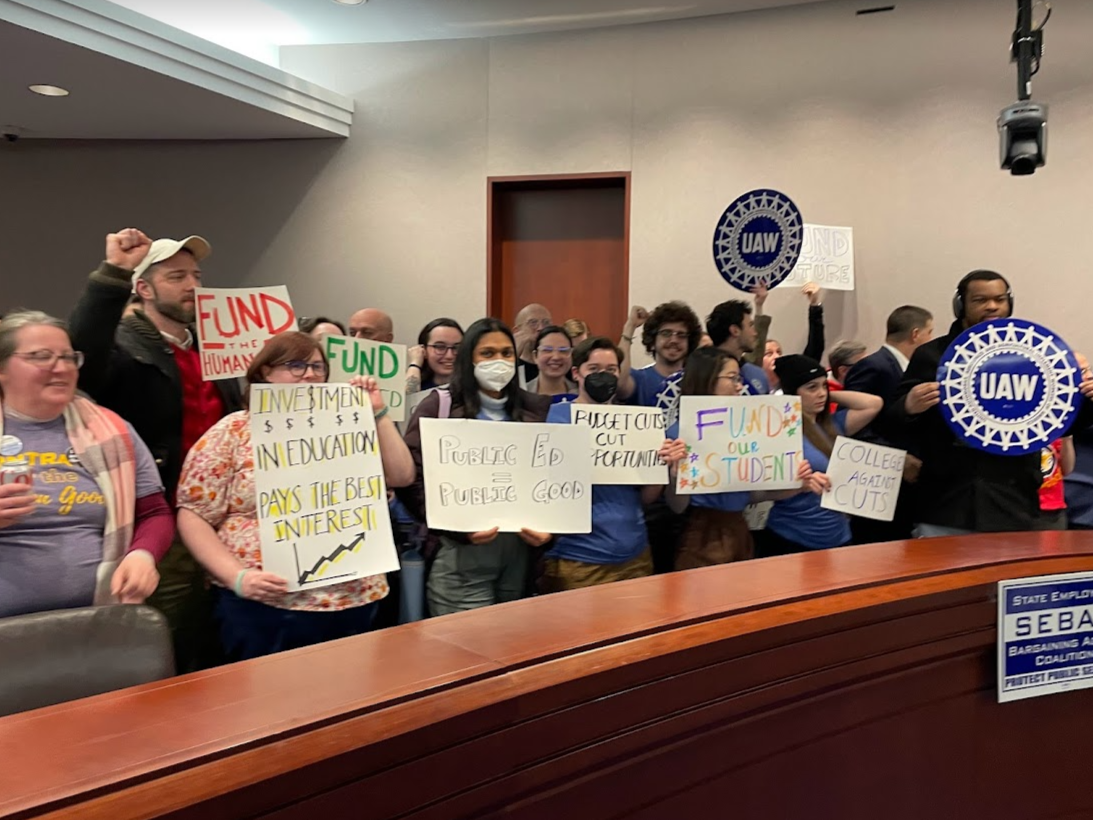
What does Connecticut want to be remembered for? As the state that advances our workforce and well-being of our society by providing affordable higher public education, or carry on as the 4th most expensive in-state tuition out of all states?
In early 2024, the average student loan balance in CT rose by $2,359, bringing it up to a total of $40,596, making it $1,713 above the national average & the 10th highest in the U.S. Along with these disheartening statistics, CSUs continue to face budget cuts and rising tuition hikes. These financial burdens harm not only our students and their ability to obtain higher education, but also the future of our state.
Evidence shows how they affects students’ quality of life and the citizens of Connecticut. I’ve heard countless personal stories of hardship from fellow students regarding this topic, and I happen to be a part of that group.

As a junior at Southern Connecticut State University, when I walk across the stage at graduation next year, I will hold with great pride the honor of being a first-generation college graduate. My parents sacrificed their dreams and abandoned everything they ever knew to come to this country filled with opportunity. My parents have given an arm and a leg to support my dream of obtaining higher education, working countless hours to afford my tuition. I help as much as I can, as I am a full-time student working part-time to be able to afford to come to Southern.
Unfortunately, during the start of the 2024-2025 school year, we were no longer able to afford to pay out of pocket, and financial aid was not able to cover as much as in previous years, with the cost of tuition continuously going up. We decided to take out loans to keep me in school.
Regardless of the financial setback, I was still able to contribute to my institution’s reputation by making the dean’s list with a 3.75 GPA and being a part of my major’s honor society. However, my quality of life, along with my peers, steadily goes down with rising costs, limiting our ability to be the best students we can be.
This cost burden causes me to reminisce about the amazing assistance that PACT offered me when I was in community college. The PACT program covers the remaining amount after federal and state aid is received, making tuition free for eligible students.
As I explored my options for higher education as an upcoming first-generation college student coming out of high school, I realized that due to my limited resources, the chances of obtaining that higher education were looking slim. At the time of my high school graduation, I was working a part-time job while in school, where all my earnings went towards livable expenses and helping my parents, who were already working 50-60 hours a week to make ends meet.
When I fortunately discovered PACT and was provided the opportunity to go to community college, it changed everything. I originally was supposed to get an associate’s degree at the Norwalk campus of CT State College, but because of PACT, I was filled with hope and inspiration to go after my bachelor’s at Southern.
Having the help from PACT allowed me to focus the majority of my attention on my studies while still being able to work and financially help my family. The transition from having the help of PACT to relying primarily on financial aid and grants was heavily felt. Not only was I losing PACT, but I was also transitioning to a university with higher tuition that is continuously rising, with resources within that institution getting cut.
I went from having A’s and B’s, with a position on the Dean’s list in community college, to having B’s and B minuses my first semester at Southern because of how much I was struggling to balance school, work, and financial expenses. It limited my ability to be the best student I could be. Although I was able to turn my grades around by taking out loans, getting help from my parents, and FAFSA, I recognize that there are students with the same, if not more, potential than I who don’t have the same resources.
For example, this year, I met a classmate who couldn’t register for classes yet. She had a hold on her account and was still paying off her tuition despite her great academic standing. Issues like these hold students back from unlocking their greatest potential.
I believe that expanding PACT to our CSUs benefits these institutions, as their ranking would increase as students become more devoted to their studies, with financial obligations being lifted. It also benefits the state workforce, as most of our CSU students plan on staying in the state to work.
Natalia Sanchez is a rising senior at Southern Connecticut State University.