


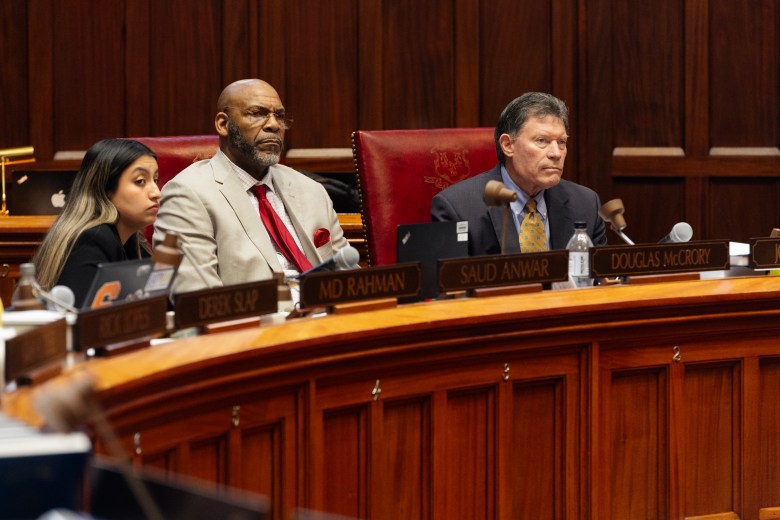
The General Assembly overwhelmingly approved a $9.7 billion bond package Wednesday to finance school construction, transportation upgrades and other capital projects for the next two fiscal years.
The borrowing plan, which passed 35-1 in the Senate and 144-4 in the House, would expand non-education aid for cities and towns, increase affordable housing and combat homelessness, bolster security at places of worship and support construction and renovation of child care facilities.
It recommends new capital investments in higher education — including $5 million to advance the planned renovation of Gampel Pavilion at the University of Connecticut — and a new $60 million program to help K-12 school districts fund small-scale renovation projects.
Lawmakers negotiated the package with Gov. Ned Lamont’s administration, and the governor is expected to sign the measure.
“Today’s package continues to reduce the strains on cities and towns,” said Rep. Patricia Miller, D-Stamford, co-chairwoman of the Finance, Revenue and Bonding Committee’s bonding subcommittee, who called the measure “thoughtful and strategic.”
“These are funds that are so impactful for our communities and make such a positive difference,” said Senate Minority Leader Stephen Harding, R-Brookfield.
Legislators authorized $4.5 billion in borrowing next fiscal year and $5.1 billion in 2026-27. That action doesn’t guarantee financing for any program, and some authorizations won’t progress further than Wednesday’s votes. The State Bond Commission, a 10-member panel that includes Gov. Ned Lamont, other Executive Branch officials and legislators, also must grant approval before the state borrows any funds by selling bonds to Wall Street investors.
Boosting non-education aid for cities and towns
Connecticut traditionally dedicates most of its borrowing to finance municipal school construction, transportation infrastructure work and clean water projects. Almost half of the entire bond package — more than 60%, about $2.8 billion in each of the next two years — would be dedicated to these three areas.
Rather than borrowing, the state pays cash through its budget to fund most operating aid to cities and towns. Aid to schools — the single-largest expense municipalities face — captures the bulk of those funds.
But the two-year bond package seeks to boost non-education aid in several areas.
The Town Aid Road program, which pays for road repaving, other related maintenance and winter snow removal, would grow from $60 million to $80 million per year.
A second generic grant for projects and other expenses would climb from $91 million annually to $150 million.
Other financing for municipal aid included in the package includes:
- $242 million over the next two years for the Community Investment Fund, which supports economic development initiatives and other projects in low-income cities and towns;
- $14 million over the biennium to support economically distressed municipalities;
- $10 million over two years to support school districts in large cities that appear before the state’s Municipal Finance Advisory Commission, which works to assist communities in poor fiscal condition;
- And $15 million in the next fiscal year to support communities impacted by a catastrophic event.
But the head of Connecticut Conference of Municipalities said Wednesday that despite some “bright spots,” overall state aid to communities is disappointing.
“Once again, Connecticut’s cities and towns have been left behind by a state budget that fails to meet the moment,” Executive Director Joe DeLong wrote in a statement, adding that most increases in education and general government grants — whether included in the new state budget or the bond package — dedicate most additional dollars only to the poorest communities.
“That leaves most of Connecticut’s towns and cities scrambling to fill growing budget gaps with fewer resources, all while being handed new responsibilities,” DeLong said, adding that it happened while analysts projected a $2.4 billion budget surplus for this fiscal year and while the state enjoys a record-setting $4.1 billion emergency reserve.
CCM says communities lose more than $400 million annually because Connecticut’s statutory education grants — including general aid, special education and funds for charter and magnet schools — haven’t kept pace with inflation for years.
Education advocates praised a new item in the bond package authorizing $30 million in borrowing in each of the new two fiscal years to help local school districts with small-scale repairs and renovations.
The District Repair and Improvement Project, nicknamed DRIP, “is a practical-yet-transformative solution that will help school districts across the state have access to resources to ensure students and educators can learn and work in safe, healthy and up-to-date environments,” the School and State Finance Project wrote in a statement.
Fran Rabinowitz, executive director of the Connecticut Association of Public School Superintendents, said the new program would make a major difference.
“I can think of so many times you needed a new window or smaller improvements in schools and there was just no place to go for [funding] other than our own capital budget,” said Rabinowitz, a former superintendent in Bridgeport and Hamden.
A strong focus on housing, combating homelessness
Lawmakers recommended slightly more than $1 billion in financing over the coming biennium to build more housing, increase homeownership and get people who are experiencing homelessness into housing.
In recent years, the governor and legislators have called for more investments in housing as rental costs have risen, which Lamont often says hinders Connecticut’s economic growth.
The package authorizes $200 million annually for “flexible housing,” which refers to affordable units typically built in mixed-income developments. It’s often meant to increase housing for the hourly-wage workforce such as those in the service industry or bus drivers.
It also approves $50 million annually for middle housing, which is typically lighter-density multifamily units. It can mean anything from duplexes and triplexes to cottage clusters and townhouses.
Another $60 million over the biennium would be dedicated to the Time to Own program, which offers downpayment and closing cost assistance to first-time homebuyers. The program has opened and closed a handful of times since its creation in June 2022. In October, the state’s bond commission reopened the program with $40 million.
Lamont often touts the program, which helps people of color who were historically and systemically shut out of the home buying market for decades, purchase houses and build wealth. Through the program, first-time homebuyers get an average of about $30,000 toward a down payment.
Lawmakers earmarked $6 million in annual financing for rapid rehousing, which aims to quickly move people experiencing homelessness back into housing. People facing mental health, substance abuse or employment issues often find it easier to address these challenges when housed.
That principle has been the focus of the federal housing policy for years, beginning with former President Barack Obama’s administration.
Connecticut’s investment comes as the state has seen three years of increases in homelessness after years of declines. The latest count showed that there are nearly 6,000 people experiencing homelessness across the state.
State officials have intensified housing construction efforts in recent years, ordering major investments in these areas in 2023.
The General Assembly earlier this week enacted the most expansive housing legislation in recent history. That measure prioritizes municipalities for state infrastructure grants if they change zoning to facilitate multifamily housing construction.
Protecting places of worship and other initiatives
The bond package also includes $10 million in financing in each of the next two years for grants to synagogues, mosques, churches, other places of worship and to other nonprofits to enhance security.
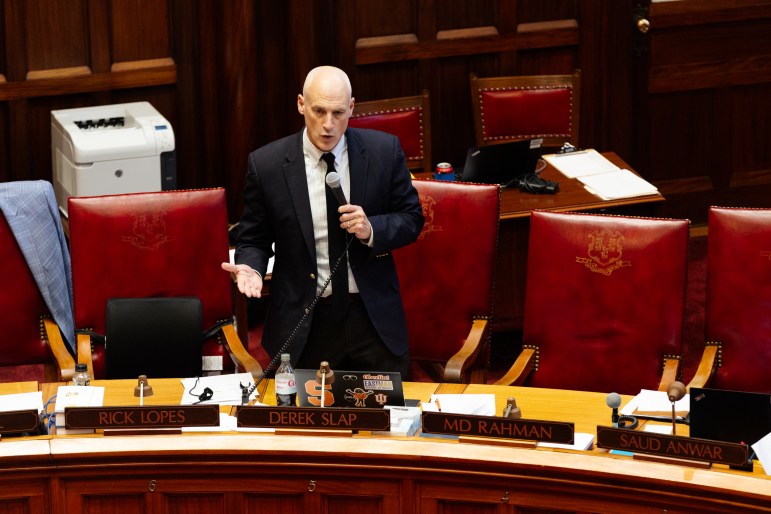
Connecticut launched this assistance program three years ago, and Sen. Derek Slap said, “the need has not been satisfied.”
A West Hartford Democrat, Slap said he recently has driven past several synagogues in his town, and “every single one of them, there is an armed guard outside.”
Slap added that “Nobody should be afraid to pray and nobody should be afraid to worship at a place that is holy and special to them. And that is just a basic tenet of living in a society.”
The bill also includes $50 million in fiscal year 2026 to build a new Whiting Forensic Hospital, the state’s inpatient care setting for people with acute mental health needs who have been involved in crimes. Advocates for years have said conditions in the hospital are poor.
Other items in the biennial budget package include:
- $25 million in each of the next two fiscal years to assist homeowners in eastern Connecticut struggling with crumbling house foundations;
- $11.5 million in each of the next two years to support construction of early childhood education and child care facilities.
- $68 million next fiscal year and $5 million in 2026-27 for capital improvements in the Connecticut State Colleges and Universities system.
- $36 million next fiscal year and $48 million in 2026-27 for capital improvements for the University of Connecticut. The second-year financing includes an additional $5 million in planned renovations to Gampel Pavilion and the field house on the main campus in Storrs.