



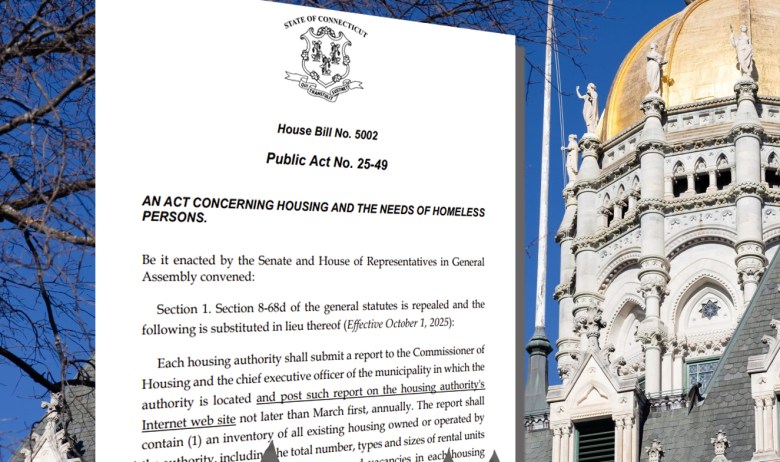
This legislative session, HB 5002, an omnibus housing bill, passed the Connecticut House of Representatives and State Senate. If signed into law, HB 5002 would require towns across the state, but especially in Fairfield County, to increase their housing supply in order to mitigate the cost-of-living crisis that has been pushing residents into poverty or to other states.
The bill would shift many planning prerogatives long held by municipalities to the state government.
The proposed bill has received pushback from members of both parties. Critics argue that local planning decisions should remain in the hands of local officials; they fear the outcomes of developer-friendly incentives without resident input, and Soviet-style directives from callous Hartford lawmakers. I empathize with these concerns, but it must be stated bluntly: the local governments of Fairfield County are the authors of their current misfortune.
HB 5002 was written because planning decisions have remained in the hands of local officials for decades, and these officials have failed to let housing supply grow in order to keep up with demand. Sentimental attachment to lot and unit size minimums, parking mandates, and fastidious micromanagement of developers’ plans has led to endless delays and sprawling development that consumes nearly all remaining green space. Moratoriums on multifamily units have exacerbated demand for missing-middle housing among seniors and young families. The multifamily structures that have been built are often squeezed in on the margins, on former industrial sites behind freeways.
None of this should be taken to mean that I wholly disapprove of the leadership in many of these communities. I have closely followed the work of several planning and zoning commissioners in the region, and I greatly admire their efforts to accommodate two diametrically opposed interest groups: the state government that has pressured them to permit the housing stock that is desperately needed, and the restive, often explosive local opinion that greets development with hostility. Unfortunately, the center can no longer hold.
HB 5002 is a partisan bill, and the Democrats enjoy control of the state senate and the governorship. The bill will likely become state law. Municipal leaders in Fairfield County must accept this political fact and embrace a paradigm shift in community planning. For decades, many of these towns have tried to meet housing obligations while maintaining existing character, often by hiding development from view or slow-walking projects to avoid backlash. This will no longer be sufficient.
Fairfield County residents would do to see that car-centric suburban planning norms are anachronistic; the postwar ideal of a two story ranch on a pesticide-soaked lawn is no longer the universal American Dream. Instead of clinging to this outdated totem of social status, residents should embrace a new kind of lifestyle, one in which the divide between work, home, and recreation is less distinguished.
Change may be scary, but imagine the following scenarios: What if instead of driving an hour to your job in bumper-to-bumper traffic, you could walk downstairs and across the street? What if instead of laboriously coordinating with other parents to pick up and drop off your teenagers at the movie theater, your kid could simply take a bus? What if instead of being shunted off to a dark, understaffed nursing home, your aging relatives could rent an apartment down the road from you, situated above a coffee shop they frequent?
This can be the vision of a new Connecticut, one that embraces change and shapes it to benefit existing residents and newcomers alike. The Nutmeg State can reject endless traffic and embrace multimodal transport, reject sprawl and embrace connectivity, reject reaction and embrace the future. To do so, it must reform zoning laws and rethink what truly makes the Land of Steady Habits such a pleasant place to live. It must allow more mixed-use development, relax parking mandates and height restrictions, and allow builders to build what the market demands and where it demands it.
Monroe State Rep. Tony Scott spoke out against HB 5002, saying the mandated unit goals for his town were “comical.” With some resourcefulness, however, Monroe and towns like it can rise to the challenge of the seemingly absurd development goals. The Maybrook Line, a freight rail corridor running through Danbury, Monroe, and other towns, could be reactivated for passenger service.
Rep. Scott should push for transit-oriented development along this route: new housing clustered around newly constructed train stations rather than sprawling across parks and open land. In this way, towns can reduce traffic, preserve green space, boost tax revenue, and still meet their share of the state’s housing needs.
This hypothetical illustrates how local leaders can accept the provisions of HB 5002 and make them work for their constituents in innovative, forward-thinking ways. If communities can break free from the ideological blinders that shackle them to outmoded planning norms, they can chart the way to solutions that benefit everybody.
The way I see it, the local governments of Fairfield County, and Connecticut at large, have two paths before them. On the one hand, they can accept that some things must change, get creative, and work to ensure that those changes emphasize connection and sustainability. On the other hand, they can thrash vainly against the tide of history, and succeed only in sinking beneath its waves.
Matthew Silber lives in Norwalk.