



It is an unfortunate reality that the number of hate crimes in the nation and in our state have been steadily rising in recent years.
Statistics gathered by the F.B.I indicate that there were 6,121 reported hate crimes in 2016; 8,263 in 2020, and 11,862 in 2023. Some 5,900 of the incidents in the 2023 report were anti-Black, three times higher than the next highest racial or ethnic category. Religion-based incidents in the 2023 report totaled 2,699, more than half driven by anti-Jewish bias; incidents involving anti-Muslim bias also rose.

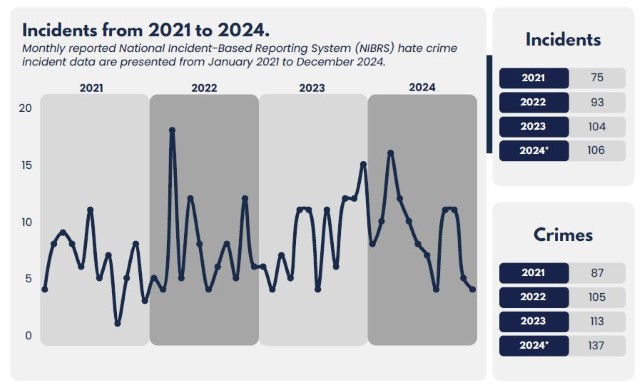
The Anti-Defamation League (ADL) reports that the number of hate incidents reported in Connecticut jumped from 91 in 2020 to 682 in 2024 —an increase of 650 percent. Antisemitic incidents in Connecticut, according to the ADL, spiked from 24 in 2020 to 184, dropping slightly to 159 in 2024. Connecticut hate crime statistics compiled by the state police also show an upward trend. In 2021, there were 75 hate crime incidents; in 2024 there were 103. Hate crimes in Connecticut went from 87 in 2021 to 130 in 2024.
The numbers can numb us to what has been happening. Each crime, and incident, represents a traumatic event that can live with the victim for a lifetime. And when an individual is targeted because of who he or she is, damage is done to that individual’s entire community. As ADL CEO Jonathan Greenblatt put it: “Hate crimes deserve priority because of their special impact. They not only hurt one victim, but they also intimidate and isolate a victim’s whole community and weaken the bonds of our society.”
Concerned about what was happening, the Connecticut legislature passed a law creating the Hate Crimes Advisory Council (HCAC). Pursuant to Connecticut General Statutes Section 51-279f, the council is responsible for encouraging and coordinating programs that increase community awareness and reporting of hate crimes. It also is charged with making recommendations for legislation concerning hate crimes, including recommendations on restitution for victims, and alternative sentencing programs for juveniles and first-time offenders.
The committee members, appointed by the governor, represent a diverse group of people from the private sector, police authorities, and state government. Consistent with its charge, the HCAC has been busily engaged in a wide variety of initiatives. Here are some of the most significant.
Website: A website has been created through the efforts of Amy Lin Meyerson, co-chair of the HCAC. It contains information about the HCAC and its activities, including membership, meeting dates meeting agendas, meeting minutes, hate crimes laws, and other information. Improvements to the website are now being studied.
Regular meetings: Meetings of the HCAC are held every other month. They typically involve discussions of what is being done by the HCAC’s many subcommittees, what initiatives are being undertaken, and invited speakers who are experts in the hate crimes area, or who represent various of the communities affected by hate crimes.
The communities include but are not limited to the Black, Jewish, trans, Asian, handicapped and Sikh communities. Hybrid meetings, held in person at the Office of the Chief States Attorney, 300 Corporate Place, Rocky Hill, are open to the public.
Investigative form: Ensuring that law enforcement is equipped to effectively investigate hate crimes has been a top priority. In collaboration with the Police Officer Standards and Training Council (POSTC), the council developed a model policy guiding officers on how to identify, investigate and rapidly report hate crimes and bias-related incidents. Police departments across the state have adopted and implemented this policy.
Third party reporting portal: It is an article of faith that hate crimes are radically underreported for a number of reasons, including the reluctance of victims to contact police authorities due to distrust or concern about immigration status.
While we encourage individuals to report hate incidents to local law enforcement, we concluded that an alternative public reporting tool would encourage people who prefer not to deal with police authorities to report their victimization. Working with community stakeholders an online portal is being created to permit victims to report hate crimes and hate incidents without contacting police authorities.
Cooperation with state and federal authorities. The HCAC has worked with federal and state law enforcement authorities to coordinate efforts. Police authorities have supported the council’s efforts from the start.
In particular, the HCAC has worked closely with the office of the Commissioner of the Connecticut Department of Emergency Services and Public Protection (DESPP). Ronnell Higgins, who has aggressively supported increased investigation of and prosecution for hate crimes. Specifically, the State Police created a Hate Crimes Investigative Unit in July 2022, which is dedicated to staying on top of trends, sharing information with other police authorities, and organizing awareness events throughout the state at which unit speakers explain hate laws to attendees and discuss hate crimes enforcement in all its aspects.
The Office of the Chief States Attorney, Patrick J. Griffin, has actively worked with the HCAC to study possible improvements in our laws and develop more effective law enforcement strategies for investigating and prosecuting hate crimes. States Attorney Griffin has actively supported the work of the council, assisted in proposing legislation, and made fighting hate crimes a priority of the state’s attorneys around the state.
Outreach: The HCAC has joined state and federal authorities, including the Investigative Unit and F.B.I., in reaching out to mosques, synagogues, churches, and local communities to create working relationships and inform town residents about what state and federal authorities are doing to fight hate crimes. It has sought to urge residents to report hate crimes or hateful activities—such as leafletting by white supremacist or neo-Nazi actors– if they occur. Public meetings, often organized by the state police, are being held all throughout the state to inform citizens about efforts being made to fight hate crimes.
Filing of annual reports: Annual reports, found on the website, are filed to outline what has been accomplished in the previous year.
Public awareness advertisement: A 30-second public awareness spot has been created informing the public what they can do if they have been victimized by a hate crime and informing the public about the existence of the online portal. The spot should be shown on various sites in a matter of weeks. Some final issues need to be evaluated before the advertisement can be released.
Legislative efforts and proposals: The HCAC’s charge includes recommending possible changes in the law relating to hate crimes. The HCAC has spent a great deal of time considering whether to ask the legislature to consider adopting various legislative changes including consolidating and amending the present patchwork of hate crimes laws and permitting members of a victim’s community to make a victim impact statement about the effect of a hate crime on the community of which a victim is a part.
Hate crimes and hateful incidents not only harm individuals but also spread fear through the community of which a victim is a part and corrode our civic sensibilities. They also tear at the social fabric of our multi-ethnic democracy which, for all its challenges, is still a miraculous achievement.
We invite everyone concerned with this issue to attend meetings of the HCAC and go to local events presented by law enforcement.
After all, we are all in this together.
Douglas Lavine, a Judge Trial Referee on the state Appellate Court, is co-chair of the CT Hate Crimes Advisory Council.