


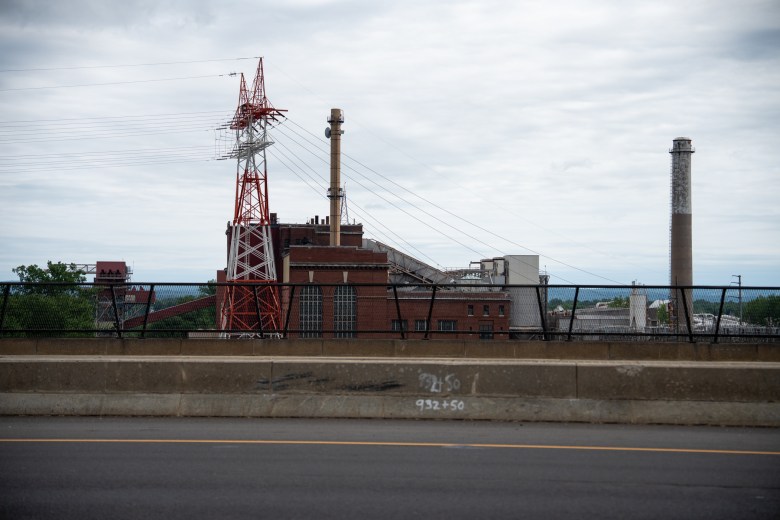
In one of their final acts of this year’s legislative session, Connecticut lawmakers voted to move forward with a long-awaited plan to breathe new life into an abandoned, rusting, trash-burning power plant that has loomed over Hartford’s South Meadows for more than a century.
In the process, however, they also waded into a latent dispute between local leaders in the capital city and the state’s rural northwestern hills, as well as two rival companies competing for rights to haul the trash produced by thousands of Connecticut residents.
The ramifications of that action — described by one lawmaker as a legislative “rat” snuck into the budget — have played out over the past week in a boardroom away from the state Capitol.
In early June, as part of their latest two-year budget package, lawmakers voted to formally transfer ownership of the former Materials Innovation Recycling Authority, or MIRA, plant in Hartford’s South Meadows neighborhood to the Capital Region Development Authority, a quasi-public state agency that has overseen the redevelopment of other downtown projects and the management of two sports facilities, the XL Center and Rentschler Field.
During its final few decades as a waste-to-energy plant, the MIRA facility burned upwards of 700,000 tons of trash a year from residents in the Greater Hartford area and beyond. Before that it burned petroleum — and earlier, coal — to produce power.
As of now, neither the city nor the state have firm plans for the site, which exists on 80 acres along the Connecticut River. Officials, however, say their options include a mix of industrial, commercial or, if enough money is made available, residential uses.
“What is pretty clear is it’s not going to be a power plant,” said Michael Freimuth, the executive director of CRDA. “From there it’s pretty open.”
As part of the transfer, CRDA will inherit up to $47 million in reserves from the plant’s current owner, the MIRA Dissolution Authority, that was established in 2023 to wind down operations at South Meadows and other facilities operated by its predecessor.
Those funds will be held in a separate account controlled by CRDA and used exclusively for the maintenance, cleanup and potential demolition of the power plant site, according to the legislation. Two full-time engineers currently employed at the site will also be hired by CRDA as part of the move.
The MIRA Dissolution Authority itself will cease to exist as of midnight on July 1. As a result, its board has been involved in a flurry of meetings at its office in the South Meadows regarding the remaining funds along with services at its two regional transfer stations.
“This site has for over a century, been a sort of dumping ground for the broader region,” said Hartford Mayor Arunan Arulampalam. “Even in kind of industrial times, in the 19th Century, ships, commercial ships, would dump stuff on that site.”
The result of that history, the mayor said, is a level of environmental contamination that is sure to complicate any efforts to redevelop the property. For generations, children who grew up adjacent to the plant’s fuming smokestacks have reported higher rates of asthma.
“Now that it’s been shut down, we’re going to be left trying to figure out what will happen next,” Arulampalam said.
‘Immaculate Amendment’
Apart from the former waste-to-energy facility in Hartford, the MIRA Dissolution Authority also owns and operates a transfer station in Torrington as well as buildings and equipment at the town of Essex’s transfer station.
Determining the future of those two stations — which collectively serve 23 mostly-smaller towns, and handle roughly 63,000 tons of trash annually — has been part of the authority’s work for the past two years. For Essex, a relatively straightforward plan was approved this week to transfer the remainder of MIRA’s property to the town, which will operate the plant under an existing contract with CWPM Waste Management.
In Torrington, however, dueling proposals to either sell the transfer station or keep it operating as a public facility have split local leaders in Hartford and the state’s Northwest Corner.
Under a so-called “private option,” the transfer station would be leased or sold to an Enfield company, USA Waste and Recycling, for $3.25 million. That money, in turn, would have been added to the reserves available to remediate the site of MIRA’s shuttered waste-to-energy plant in Hartford.
But several towns in that area have expressed concerns about rising tipping fees and USA Waste’s growing presence in the local trash-hauling industry. That’s led some local leaders to propose creating their own regional waste authority to take over the transfer station — the alternative “public option.”
During a meeting in May, several members of the MIRA Dissolution Authority said that while they support the desire for the public option, getting such a regional authority up and running would have required an estimated $4.4 million in subsidies from MIRA’s remaining reserves.
As a result, the board voted to support selling the transfer station, pending a final round of negotiations with USA Waste and Recycling.
Then, a few weeks later amid the frenetic rush to wrap-up this year’s legislative session, an amendment was added to the state’s sprawling budget bill that transferred the Torrington station’s operating permit to the towns’ newly-created Northwest Resource Recovery Authority — throwing a wrench into MIRA Dissolution Authority’s plan to sell the facility.
In addition to the Torrington transfer station, the amendment also added language directing the commissioner of the Department of Energy and Environmental Protection to issue a temporary operating permit to the owner of a transfer station in Wallingford.
Multiple lawmakers — including leaders of all four legislative caucuses — told the Connecticut Mirror this week they were unaware of the exact origins of the permit language, which will go into effect when once Gov. Ned Lamont signs the budget into law as expected.
“I call it the immaculate amendment,” said Bert Hunter, the chair of MIRA Dissolution Authority’s board of directors.
On Friday, however, the provenance of that amendment became clearer when Joseph Mazzarella, a lawyer and partner at McCarter & English, said he wrote letters seeking its inclusion to Courtney Cullinan and Franklin Perry, the chiefs of staff, respectively, for the Senate and House Democratic majorities.
Mazzarella said he was acting on behalf of a client, Richard Antonucci Jr. of waste services operator Country Holdings LLC., who he said has been fighting to establish a presence in the region’s trash disposal and recycling business in competition with USA Waste and its affiliates. Mazzarella acknowleged that the language was intended to block the sale of the Torrington transfer station to his client’s rival, which he said would have resulted in the further consolidation of the trash business.
“How can that be good?” Mazzarella said.
McCarter & English also employs the Senate Democrats former chief of staff, Vincent Mauro, as a government affairs adviser. He referred questions to Mazzarella.
Prior to speaking to Mazzarella, CT Mirror asked Senate Democrats’ chief of staff Cullinan about the language that was inserted into the budget. “I heard about it, but I am not necessarily familiar with it,” she said, and promised to look into the matter.
Later, CT Mirror reached out again to Cullinan again to ask about the letters Mazzarella said he sent her. Cullinan responded in a text offering to share a copy of the letter, but did not say whether she took any action in response to it.
Perry, the House Democrats’ chief of staff, did not respond to a request for comment.
In addition to its interest in the Torrington facility, Mazzarella said Country Holdings purchased a site in Wallingford that once housed a trash incinerator — and later, a transfer station — which had accumulated waste under the control of a previous operator, drawing a notice of violation by DEEP.
The language inserted in the budget restored the Wallingford facility’s operating permit to Country Holdings — further easing the company’s attempts to establish a regional presence in recycling and waste disposal.
Rep. Mary Mushinsky, D-Wallingford, a long-serving lawmaker and environmentalist, said Friday she was uncertain if the end result of the maneuver ultimately would be deemed good public policy. “Too soon to tell. I put a call into DEEP to see what they think as regulators,” Mushinsky said.
But she had no qualms in criticizing the method employed.
“They snuck it in. We only get a couple of hours” to review the final budget document, she said. “Sometimes people sneak things in at the last minute, and that’s what happened here.”
In a statement Friday evening, DEEP spokesman James Fowler said the agency neither negotiated nor reviewed the language prior to its inclusion in the budget. He added that the agency is working with the Department of Administrative Services to “facilitate the continued operation” of the Torrington facility, while reviewing the language involving the Wallingford facility with the offices of the governor and the attorney general.
The move also frustrated officials in Hartford, including Arulampalam, who said it in effect took away the $3.25 million the sale would have generated for cleanup efforts in the city’s South Meadows neighborhood.
Hunter, meanwhile, said the MIRA Dissolution Authority board had examined a number of pathways to move forward with either the public or private option following the legislature’s action. But due to the legal complexities and sudden costs involved, the board on Thursday decided to take no action on either proposal.
As a result, the Torrington transfer station will automatically revert to the state’s Department of Administrative Services on July 1. Its continued operations will be left up to the agency, leaving the door open for Country Holdings to bid for any future contracts.
“We didn’t take a vote. We just had a sense that we just couldn’t, we couldn’t get there,” Hunter said. “There was just not enough support [for either proposal]”
The shift is not expected to impact trash-hauling operations for the time being, Hunter said. A spokesman for DAS said Friday that the state’s “commitment is to ensure secure and efficient continuity of all operations, including the Torrington transfer station, in accordance with all statutes and regulations. We continue to work closely with DEEP and other partners and contractors to meet that commitment.”
The chief executive of USA Waste and Recycling did not respond to a request for comment on Friday. But the company’s attorney, Ed Spinella, ripped into lawmakers’ “rat amendment” during a meeting of the MIRA Dissolution Authority’s board on June 18.
“We were going to buy the [Torrington] facility regardless of whether or not it had a permit,” Spinella said, promising to hold the board to its earlier vote supporting the private option. “It’s an enforceable vote, and I guarantee you I’m going to make in enforceable.”
Neither the leader of the Northwest Hills Council of Governments, Robert Phillips, or Torrington Mayor Elinor Carbone responded to requests for comment on Friday.
Cleaning up
The MIRA plant was originally built in the 1920s to provide power to the growing city of Hartford. Later, in the 1980s, it was reconfigured to offer a solution to another one of the state’s vexing problems: trash piling up in stinking, unsightly landfills. By the late 2010s, however, the age of the facility and competition with cheaper power sources made it uneconomical to run. Operations at the plant finally ceased on July 19, 2022.
Since then, the MIRA Dissolution Authority has worked with DEEP to remediate the property to an industrial or commercial standard, according to Hunter. Contaminants on the site include asbestos, lead paint and chemicals known as polychlorinated biphenyls, or PCBs.
Any future development plans that involve tearing down the hulking former power plant, or digging up contaminated soils to build the foundation for new buildings, are expected to drive up the cost of that remediation, officials say.
Freimuth, the director of CRDA, compared the task to one undertaken by the authority’s predecessor in the mid-2000s to redevelop a section of Hartford now known as Adriaen’s Landing, home to a hotel, convention center and the Connecticut Science Center.
“This area that I’m sitting in right now [was] very similar in characteristics to what the South Meadows looks like: an energy area, tank farms, coal slurry, you know, all kinds of stuff,” Freimuth said. “The logic was: this is very similar to the tasks and the process, so let’s use the agency that did it once before.”
In March, the MIRA Dissolution Authority released a 1,535-page report on the potential for future development at the South Meadows site. That report estimated that demolition and cleanup of the site would cost between $48 million and $334 million, with the highest estimates associated with plans that included multifamily housing.
Due to those likely costs, some local leaders have said plans should instead focus on industrial and commercial uses that have long found a home in the South Meadows.
“It’s probably too expensive to be residential,” said House Speaker Matt Ritter, D-Hartford. “It’s probably going to be a long haul.”
Mayor Arulampalam, however said he wanted planners to look at creative solutions — such as capping the most polluted sections of the property with parking lots, while leaving others open to more expansive development — which could keep costs down.
“Are there open-space uses for parts of the property?” Arulampalam said. “Is there some mixture of commercial and residential that could kind of work in tandem, and based on the physical design features, maybe help mitigate some of the larger costs of remediation?”
Adding to the complexity of redeveloping the site is its location adjacent to the Hartford-Brainard Airport, which mostly serves smaller, civil aircraft. The legislation transferring ownership of the plant to CRDA prohibits the authority from taking any action that would conflict with federal laws or regulations concerning the airport.
“Realistically, you’ve got height restrictions and things of that nature, that you have to accommodate for,” Freimuth said, adding that it would likely be another three to five years before actual development could begin on the property.
While Arulampalam said he was disappointed by lawmakers’ decision to block the sale of the Torrington property, he said he was supportive of the broader decision to endow CRDA with a $47 million to move forward with the long-awaited cleanup of the MIRA plant.
“In many ways, in a small snapshot, you could focus on the $3.25 million that city lost out on, and it feels frustrating to me as mayor to have had that happen,” Arulampalam said.
But, he added, “This story has played out in numerous places like Hartford across the country, and typically there isn’t any effort to remedy the wrongs of the past.
“I think this is a real win for environmental justice. I think it’s a real win for some form of repairing this massive environmental contaminant that the city of Hartford has had to bear the brunt of for the region for far too long. It’s not a full victory, but it is more of a victory than cities like us usually get,” Arulampalam said.