



A quiet stream in northwest Connecticut, hidden beneath a forest canopy and shielded from development, holds more than scenic charm. In these protected waters—part of a watershed that ultimately supplies drinking water to the City of Waterbury—rare freshwater mussels cling to the cobble bottom. Their presence isn’t just a curiosity; it indicates that the water is clean, the ecosystem is functioning, and a community of native species is benefiting in these waters and along the riverbanks.
In recent years, I had the opportunity to conduct mussel surveys at this site alongside staff from the Connecticut Department of Energy and Environmental Protection’s (DEEP) Wildlife Diversity Unit and researchers from the University of Massachusetts. The work was supported by a federal program that most people have never heard of—the State and Tribal Wildlife Grants program. It’s one of the most important, yet underappreciated, funding sources for wildlife conservation in the country.
And it’s currently in jeopardy.
These grants fund science-driven work to conserve Species of Greatest Conservation Need (SGCN), with an emphasis on those that are under-surveyed, declining, or critical to ecosystem health. In Connecticut, these efforts not only help ensure wildlife survival, but also protect public health, drinking water, pollinator services, and sustainable recreation. Yet the Trump administration did not renew funding for the program—a decision that could have ripple effects for decades across our state and region.
These grants supported, for example, the Biodiversity of Bees in Connecticut, authored by Tracy Zarrillo and Dr. Kimberly Stoner at the Connecticut Agricultural Experiment Station. This pioneering project catalogs the extraordinary diversity of bees in our state. Connecticut’s agriculture, native plant communities, and ecosystem stability all rely on pollinators, yet bees face widespread decline due to habitat loss, climate change, and pesticide overuse.
Zarrillo and Stoner’s ‘Biodiversity of bees’ is both a scientific achievement and a tool for recovery. It will help landowners, farmers, educators, and municipalities make informed decisions about planting, land use, and pesticide management. It also serves as a warning. The disappearance of invertebrates—described by scientists as “death by a thousand cuts”—threatens the pollination systems that sustain our crops, gardens, and wild spaces. Without continued monitoring and restoration efforts like those outlined in the Bee Atlas, we risk losing these species before we even know they’re gone.
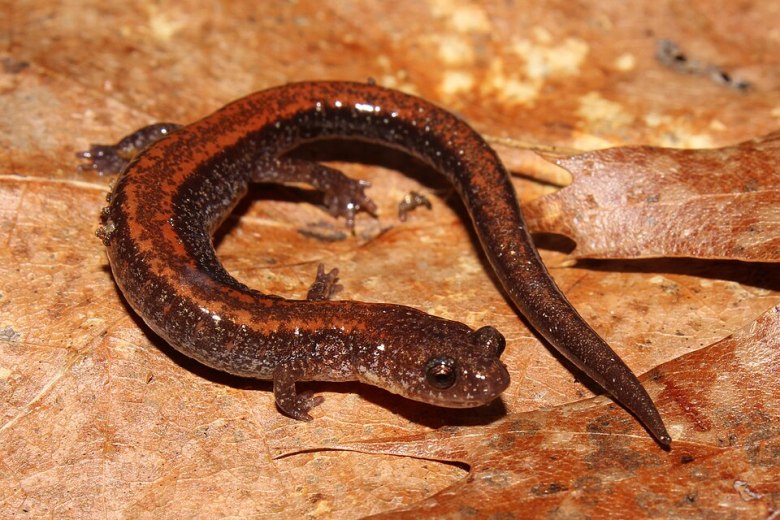
Amphibians and reptiles, too, are benefiting from State and Tribal Wildlife Grant-funded work. Conservationists in Connecticut are collaborating with regional partners to monitor a newly emerging fungal pathogen that poses a dire threat to salamanders. If this disease takes hold, it could devastate populations of red-backed salamanders, one of the most abundant vertebrates in our northeastern forests. In most forests, they outnumber white-footed mice and even white-tailed deer.
These salamanders are small but mighty. They serve as prey for birds and mammals and help regulate invertebrate populations on the forest floor. Their disappearance would trigger cascading effects throughout the ecosystem. We’ve seen what happens when a deadly fungus goes unchecked: the white-nose syndrome that decimated bat populations across the Northeast is a cautionary tale. The damage it inflicted will take generations to undo.
What ties all of these stories together—mussels, bees, salamanders—is that they are not charismatic megafauna. They don’t appear on bumper stickers or spark multi-million dollar fundraising campaigns. But they are essential. They are ecological cogs and wheels, quietly keeping systems in balance and signaling the health of the environments we all share.
As Aldo Leopold, the father of wildlife ecology, wrote: “To keep every cog and wheel is the first precaution of intelligent tinkering.” These grants allow us to do just that—study, monitor, and safeguard the less visible but deeply consequential components of our natural world.
The work supported by State and Tribal Wildlife Grants also fosters collaboration across jurisdictions. Scientists, wildlife agencies, nonprofit organizations, and academic institutions are able to coordinate efforts, share data, and respond to emerging threats more effectively. In a small state like Connecticut, where watersheds cross town lines and migratory species traverse hundreds of miles, this kind of cooperation is indispensable.
Importantly, the public also has a role to play. Connecticut’s State Wildlife Action Plan (SWAP)—the foundational document that guides how these grant funds are used—is currently under revision and will soon be available for public comment. This is the moment for Connecticut residents to engage.
The SWAP identifies at-risk species, outlines conservation goals, and informs local planning efforts. It’s a practical tool that connects wildlife conservation to broader concerns—clean air and water, healthy soils, sustainable land use, and resilience to climate change. A well-informed and engaged citizenry can ensure that the plan reflects both scientific priorities and community values. When residents speak up, decision-makers listen.
Yet all of this depends on reliable funding. Without the renewal of State and Tribal Wildlife Grants, these vital projects will stall or vanish. Agencies and researchers will be left scrambling to piece together alternative sources. The long-term consequences won’t be immediate or dramatic, but they will be real. We’ll see more species quietly disappear. More ecosystem functions will falter. More opportunities to act early will be lost. Connecticut’s congressional delegates are on board with maintaining support. I urge you to contact all your friends and family in other states to reach out to their representatives, as this issue affects every state and all wildlife populations throughout the country.
And it doesn’t have to be this way.
We have the knowledge. We have the tools. What we need now is the political will and public awareness to protect the programs that protect our wildlife—and, by extension, our water, air, food systems, and future.
From mussels in forested headwaters to bees in backyard gardens and salamanders under rotting logs, these species tell us when the world is working—and when it’s not. Their survival is our survival, too.
Let’s not lose the forest for the trees. Let’s not wait until it’s too late.
Let’s keep every cog and wheel.
James Fischer is a conservation biologist and ecologist based in Litchfield County for the past 20 years. He has worked with the CT DEEP Wildlife Division and other conservation partners on a wide range of wildlife conservation and research initiatives.