



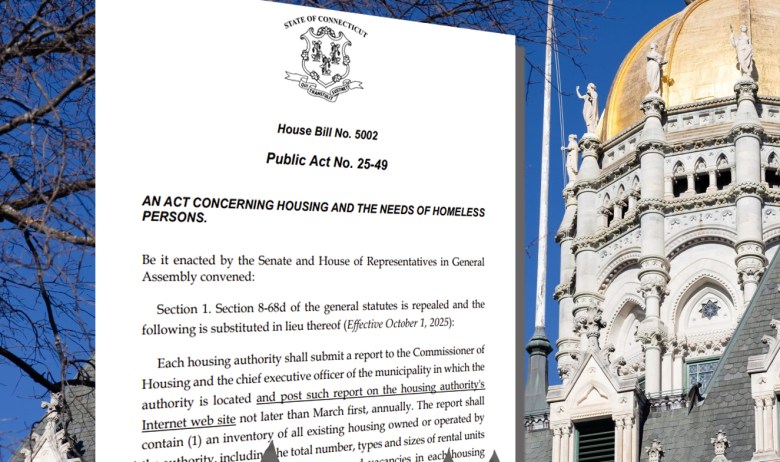
On June 4, H.B. 5002, the “Act Concerning Housing and the Needs of Homeless Persons,” having passed the Connecticut House and Senate, was headed to the governor’s desk. Advocates celebrated the anticipated adoption of multi-faceted affordable housing legislation.
By June 10, the bill had a Public Act number –but no governor signature. Lobbying commenced. Emails and articles-many replete with misinformation-began flying.
On June 24, as we know, Gov. Ned Lamont vetoed the bill, vowing to call the legislature into special session, probably in September, to fix several sections. But the governor’s office was and continues to be tight-lipped about what sections should be fixed and how, perhaps as it seeks consensus.

With sympathies to those who expected to take the summer off from housing debates, this article, based on my experience with land use law and affordable housing, takes a stab at articulating a consensus.
This is presented in two parts. Part One provides observations about where we are after the veto, a summary of the vetoed bill, and my list of which sections should be adopted as is or revised or deleted. Part Two tomorrow focuses on what I call the Big Five, the concerns that most likely led to the veto.
Observations
First, the bill is, at most, incremental progress. It represents what the Democratic majorities in the House and Senate were able to accomplish in the face of staunch opposition, primarily from representatives of affluent towns and suburbs of cities in the southwest part of our state, and in light of Gov. Lamont’s opposition to state mandates and preference for measures that enable or incentivize municipalities to do more to promote and approve lower-cost housing.
The bill does not tinker with, much less overhaul, the core dysfunction of our land use system: 169 towns, each exercising the broad discretionary powers of General Statutes § 8-2, the Zoning Enabling Act, and our planning, wetlands, and sewer statutes.
In September 2024, I wrote in this publication about how our system preserves the parochial status quo of exclusionary regulation and economic segregation. I stated that the legislature’s goal should be “to identify with more precision and comprehensiveness how towns are using their land use power to prevent lower-cost housing production; devise a specific list of powers and procedures to be purged, pruned, or clarified; create a revised list of shalls and shall nots; and then summon the political will to revise the state-local balance” of delegated authority. Measured against this goal, H.B. 5002 is modest changes at the periphery of this system. The bill contains no forced marches; no town will be required to build units.
Nonetheless, the bill does recognize that our affordable housing crisis has many facets and requires multiple approaches. H.B. 5002 includes sections on zoning reform, middle housing, parking, rent subsidies, home buyer tax deductions, protection of the homeless, eviction process improvements, modifications of § 8-30g, tax credits, regional planning coordination, civil rights enforcement, sewer system management, transit-oriented development, and more.
Third, continuing a trend that began years ago, the bill secures a central role of General Statutes § 8-30g in Connecticut’s affordable housing program, not only by (again) leaving it essentially unchanged but also by adopting several new measures in non-§ 8-30g statutes that utilize standards taken directly from § 8-30g, such as specifying new situations where commissions must demonstrate a “public health or safety” basis for denying permits, in place of the broader, traditional, discretionary standard “health, safety, and general welfare.” Put another way, H.B. 5002 recognizes that § 8-30g is now embedded in dozens of state and local housing programs and is here to stay.
The bill’s 42 sections and 92 pages present a steep learning curve. For example, the bill proposes several types of transit-oriented entities. Town and city planners and attorneys will be in the hot seat to educate their commissions and constituents, respond to the Act’s mandates and enabling provisions, and work through the numerous legal and planning issues that the bill, like any “omnibus” measure governing a largely technical field of law and policy, will present.
H.B. 5002 kicks several cans down the road in the form of studies, and its efficacy rests on provisions and promises not yet spelled out. A recurring theme is eligibility for “discretionary infrastructure funding.” Obviously, whether this money works as an incentive to promote affordable housing will depend not only on the programs becoming operational, but also on the state appropriating enough money –substantial by any calculation– to make the incentives meaningful statewide. Older folks like me will recall that the 2007 Incentive Housing Program, still part of the General Statutes, was touted as a “towns take the lead” alternative to § 8-30g, backed by financial incentives, but then in the recession of 2008-2012 the promised funding dried up and the program was reduced to planning grants to help with drafting incentive zones. We must hope that H.B. 5002, if adopted, does not meet a similar fate.
H.B. 5002 requires state agencies, especially the Office of Policy and Management and the Department of Housing, to step up and draft guidance about eligibility, staff their programs sufficiently, and dispense the discretionary funding equitably and transparently.
Finally, those working now to fix the vetoed bill will again need to be ready to counter the misinformation –some merely misinformed, but some from those who know better– that plagued the first three weeks of June. We need to tune out groups who claim that our affordable housing programs and statutes are unfair and who seek exemptions, waivers, loopholes, and revised definitions, not to create more housing but to reduce municipal housing obligations.
To those who continue to advocate “local control” as the solution, we need to reply that local control is the problem, as the first Blue Ribbon Commission on Housing recognized in 1988. We should also strive to correct the deeply-rooted misconception that state law establishes a goal or quota for all municipalities that ten percent of their units should be affordable and once that level is achieved, a town has nothing more to do. In fact, ten percent is what lawyers call a “bright line standard,” the level at which a municipality becomes exempt from § 8-30g; but it is not (and never has been) a measure of housing need. In general terms, those earning 80 percent or less of the median income need affordable housing; that’s about 40 percent of the population.
Summary of 5002’s provisions
I will here attempt to accurately summarize in plain English what H.B. 5002 says, both to fend off misinformation and provide a basis for focused discussion of revisions. H.B. 5002’s 42 sections can be put into six groups: (1) the “Big Five” major changes; (2) modest improvements to existing programs; (3) tweaks to § 8-30g; (4) financial programs; (5) land use procedural reform; and (6) further study programs.
The Big Five
Middle housing. Allow development of “middle housing,” defined in the bill as two-to-nine-unit structures such as townhouses, “as of right” (meaning no special permit or discretionary permit, no public hearing required, only site plan approval needed) on “any lot… zoned for commercial use,” except that local regulations may require that the site plan “[conforms] with applicable zoning regulations” and that “public health and safety will not be substantially impacted” (Section 2). This zoning reform will be supported financially by direction to the Department of Housing to implement a middle housing development grant program in towns of less than 50,000 population (Section 9).
Parking. Eliminate the maximum parking space ratio rules adopted in Public Act 21-29, along with the municipal opt-out provision; in favor of a new rule prohibiting “a minimum number of parking spaces for any development except as specified in § 3,” which section states that no zoning or planning commission or combined commission or enforcement officer shall reject a development application “solely on the basis that it fails to meet any requirement for off-street parking” unless it “finds” that such parking will have “a specific adverse impact on public health or safety.”
This applies to any application for development of more than 24 residential units. For such developments, the applicant must submit a site-specific “parking needs assessment,” which must consider available public and private parking, public transportation, and current and future parking needs of the development. Upon submission of this study, the commission may not require more than 110 percent of the number calculated by the assessment (Sections 2, 3, 42).
Transit-oriented development. Implement a robust transit-oriented development program, with minimum zoning requirements and financial incentives (Sections 19, 20, 21, 23, 25);
Fair share. Implement a detailed, prescriptive program requiring towns, in their every-five-years municipal affordable housing plans, to plan for, by adopting land use regulation amendments, the “Fair Share” housing unit allocation devised by the State Office of Policy Management as directed by 2024 legislation (Sections 6, 7); and
Priority housing zones. Establish a “Priority Housing Development Zone” program, proposed by the Governor’s office, creating a zone or zones encompassing at least 10 percent of a municipality’s “developable land” and specifying minimum residential development densities within that zone (Sections 37, 38, 39).
Improvements to existing housing programs
- For the homeless population, a two-year pilot program of mobile vans with showers and health care service (Section 4); and a permanent ban on “hostile architecture,” meaning physical obstacles that prevent the homeless from sitting or resting (Section 8);
- A variety of improvements to rental assistance and voucher programs, including allowing non-profit entities to administer such programs and expanding the geographic areas where households receiving assistance can use their vouchers or certificates (Sections 10, 11);
- Protecting renters and tenants by extending time limits in the eviction process (Sections 30, 31, 32);
- A requirement that cities and towns with a population exceeding 15,000 (decreased from 25,000) establish a fair rent commission (Section 28);
- An extension of existing protection of mobile manufactured homes from regulations that treat them differently from single-family, multi-family, and cluster housing, to homes narrower than 22 feet wide (which is the existing standard), provided that the home is built in compliance with federal safety standards (Section 2);
- A ban on the use of certain formulas and algorithms to calculate or set rents (Section 18); and
- Authorization to the Attorney General’s office to enforce the state’s fair housing and anti-discrimination laws in the same manner as the Commission on Human Rights and Opportunities (CHRO) (Section 16).
Tweaks to § 8-30g:
- Allow judges in § 8-30g court appeals to require the defendant land use agency to reimburse a successful applicant for its attorneys’ fees if the court finds that the agency acted in bad faith or intentionally delayed the process (Section 17);
- Create for a small group of towns a lower point total for obtaining a four-year § 8-30g moratorium if the town has adopted a priority housing development zone under §§ 38-39 and a specified number of units have been built and occupied in that zone; or the town has adopted a municipal affordable plan as required by the Fair Share provision of the bill (Section 34) ; and
- Provide an additional one-quarter § 8-30g moratorium point for units “constructed by or in conjunction with a housing authority of a neighboring municipality” (Section 34).
Financial programs
- A modest income tax credit (based on household income limits, and limited to $2,500) for first-time home buyers (Sections 13, 14, 15);
- Expansion of CHFA’s Smart Rate Pilot Interest Rate Reduction Program, to provide additional help to mortgage borrowers (Section 29);
- Additional funds for regional planning agencies to help them provide technical help with planning, development, stormwater control, and flood management (Section 12);
- Direction to the Department of Housing to establish an Affordable Housing Real Estate Investment Trust pilot program, to provide grants to municipalities with a population of 130,000 to 140,000 (Section 36);
- Authorization to OPM to provide grants to regional councils of government to support public transit, bicycle, and pedestrian infrastructure (Section 22); and
- Direction to the Department of Housing to establish a program by which union pension funds may “coinvest” in affordable housing development and thereby “create employment opportunities in the construction industry” (Section 27).
Land use procedural reform
- Eliminate the two-thirds “supermajority vote” (two-thirds) provision that kicks in if adjacent property owners file a so-called “protest petition” to oppose a zone change application, in favor of a simple majority vote (as is otherwise now required of all zone change applications), and increase the minimum required proof of ownership by the petitioners of land abutting the zone change from 20 to 50 percent (Section 5);
- Require additional reporting by municipal housing authorities, such as rental price levels by income groups (Section 1); and
- Clarify which municipal body can vote to opt out of the 2021 standards for accessory apartments (Section 24).
Further study
- An interagency task force to study the state’s wastewater and sewer programs and the powers of municipal sewer commissions (Section 26);
- A committee to study changing the points qualification for a four-year exemption to § 8-30g to a single number rather than the current alternatives of a percentage or flat number (Section 35); and
- An “interagency housing council” to assist the State’s Responsible Growth Coordinator with transit-oriented development programs (Section 21).
Comments on sections other than the Big Five;
What should and should not stay in the bill
Hooray for the proposed amendment to the “protest petition” statute that allows owners of 20 percent or more of land adjacent to land proposed for rezoning to file a petition and force a super-majority vote to approve the zone change, which sometimes kills the proposal. The petitioners don’t need to give a reason. Protest petitions are an exclusionary zoning tactic, a relic of the original 1920’s Zoning Enabling Act. Good riddance.
Section 17 proposes to allow a judge in a § 8-30g appeal to award “reasonable attorneys’ fees” to the person appealing a denial or an approval with conditions if the court, after a hearing, finds that the denial or conditions were “made in bad faith or to cause undue delay.” The remedy is only available if “the number of units ordered by the court to be built is at least 90 percent of the units proposed in the original application.”
I have argued for many years that § 8-30g should be strengthened by applying it to wetlands and sewer commissions and streamlined by specifying truly expedited procedures. But this year I argued against § 17, for several reasons.
First, who knows what “bad faith” and “undue delay” mean in this context? I don’t think property owners and developers want or need to spend thousands of dollars litigating these terms. Second, proving “reasonable attorneys’ fees” in any context is a complex procedure; I don’t foresee applicants wanting to get bogged down in such quicksand.
Third, in my experience, judges are often hesitant to award attorneys’ fees against municipal volunteers, especially in potentially substantial amounts that will be unknown until the end of the case. (In other contexts, municipal officials have immunity from damages and attorneys’ fees.) A related problem is that we don’t want horse-trading about the 90 percent density standard (referred to above) simply to maintain or avoid an attorneys’ fees claim.
There is a better alternative to attorneys’ fees: modest civil penalties, such as what the Freedom of Information Act Commission imposes for intentional violations. Such penalties would be a “black mark” against an agency or even individual members for their conduct. A modest penalty imposed for illegally or unreasonably obstructing affordable housing would be a far better deterrent than an award of attorneys’ fees. My recommendation is to remove § 17 from the bill.
The proposed “wastewater” study – sewers and alternative treatment systems – is a hugely important step because cities and towns can and do use sewers and wastewater regulations to fend off affordable housing. Let us hope this committee faces the problems head on.
The subsidy and voucher provisions are essential because the Trump administration has taken aim at the Section 8 and Low Income Housing Tax Credit programs.
Tomorrow in Part Two, a closer look at the Big Five.
Tim Hollister is a land use attorney with the Hartford office of Hinckley Allen. His affordable housing experience includes arguing the landmark exclusionary zoning case Builders Service Corp. v. East Hampton Planning and Zoning Commission, 267 Conn. 208 (1988); serving as an assistant to the Co-Chair of the Governor’s Blue Ribbon Commission on Housing, 1988-1989, which drafted and recommended General Statutes § 8-30g; since 1990, handling more than 200 affordable housing applications; in 2002, drafting § 8-30g’s regulations under contract to the Department of Housing; and in 2022-23, co-chairing of the Affordable Housing Plans Working Group, part of the Commission on Connecticut’s Future and Growth.