


This story has been updated.
The six Connecticut municipalities briefly labeled as sanctuary cities by the Trump administration’s Department of Homeland Security in May are absent from a revised list posted without explanation Tuesday by the Department of Justice.
But Connecticut, whose Trust Act limits cooperation with federal authorities in identifying and detaining undocumented immigrants, was one of 12 states deemed to have “policies, laws, or regulations that impede enforcement of federal immigration laws.”
The mayors of New Haven and Hartford, the two largest Connecticut cities on the previous list, said the administration offered no notice or rationale for the inclusion in May, nor did it explain why they were stricken Tuesday.
“Who the heck knows? Trying to figure out any sort of method to the Trump administration’s madness is a fool’s errand,” said Mayor Justin Elicker of New Haven. “They seem to change their minds every few hours.”
Hartford Mayor Arunan Arulampalam was equally adrift.
“Your guess is as good as mine,” said Arulampalam, who emigrated to the U.S. as a child. “We got the list, and that’s about it. The best I can tell is a bunch of 20-something tech bros are doing policy.”
East Haven, Hamden, New London and Windham were the other four places deemed to be sanctuary cities on a list that appeared on the Homeland Security web site on a Friday in May and was gone by the following Monday.
There was no mention of the old list in the statement posted Tuesday by Attorney General Pamela Bondi.
“Sanctuary policies impede law enforcement and put American citizens at risk by design,” Bondi said. “The Department of Justice will continue bringing litigation against sanctuary jurisdictions and work closely with the Department of Homeland Security to eradicate these harmful policies around the country.”
Natalie Baldassarre, the senior media affairs manager for DOJ, offered no specific reason for why the six Connecticut cities were on the first list and not the second but pointed to a general statement about the process:
“These designations were made after a thorough review of documented laws, ordinances, and executive directives by the listed jurisdictions. This initial list of designated Sanctuary Jurisdictions will be reviewed regularly, to include additional jurisdictions and remove jurisdictions that have remediated their policies, practices, and laws. Each state, county, and city will have an opportunity to respond to its placement on the list.”
An updated version of the DOJ announcement added nine criteria for sanctuary jurisdictions absent from the original post Tuesday. Among them were restrictions on information sharing with ICE and refusing to honor detainer requests made by ICE without a judicial warrant.
Connecticut’s Trust Act, which was passed in 2013 and revised in 2019 and this year, limits the circumstances in which police and others can alert federal agents to the location of an undocumented immigrant or detain them for deportation, with exceptions for individuals facing serious criminal charges.
The original Trust Act was passed unanimously during the administration of Barack Obama, but the two revisions during Trump’s first and second terms came on largely party-line votes in a General Assembly dominated by Democrats.
State officials say the law is consistent with the anti-commandeering clause of the Constitution, which bars the federal government from forcing local and state authorities to act as agents of the federal government.
Democrats say the intent of all three laws was to ensure undocumented immigrants will feel safe reporting a crime or seeking aid from police without fear of being turned over to ICE. Republicans say they are too restrictive.
In February, New Haven joined San Francisco and other cities and counties to file a lawsuit enjoining the Trump administration from withholding federal funds over their immigration policies.
“They have not attempted to cut funding to us,” Elicker said.
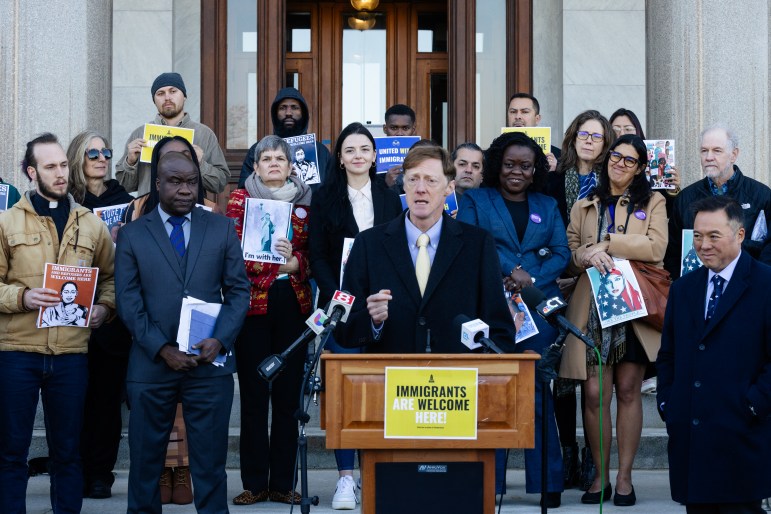
New York, Rhode Island and Vermont were among the northeastern states deemed sanctuary states. Massachusetts and New Jersey were not, though Bondi listed Boston and four New Jersey cities: Hoboken, Jersey City, Newark and Paterson.
The other states labeled as impeding immigration enforcement are California, Colorado, Delaware, Illinois, Minnesota, Nevada, Oregon and Washington, as well as the District of Columbia.
Protest in New Britain
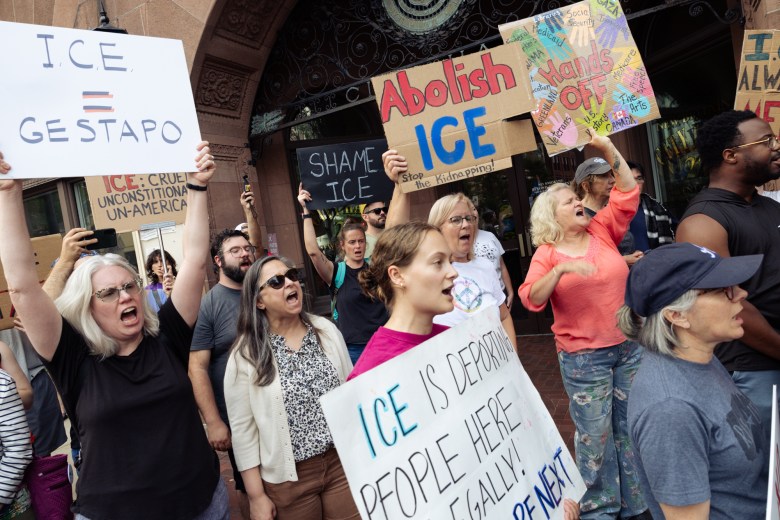
Meanwhile, protesters gathered in front of city hall on Tuesday in downtown New Britain to protest Immigrations and Customs Enforcement. They said that five people at a local car wash were picked up by ICE the day before.
Chanting “Say it loud, say it clear: immigrants are welcome here,” protesters held signs like ICE OUT OF CT and DEPORT ICE.

Ebaa Mohamed, the executive director of the Muslim Center for Justice led the protest, criticizing New Britain’s mayor Erin Stewart as silent in the face of ICE activity in the city.
“She has put out zero statements,” Mohamed said. Stewart has been exploring a run for governor.
Omer Abdelgader, a Sudan native, also spoke at the protest. He said that ICE is coming to New Britain because of its large immigrant population from countries like Yemen and Mexico, people who are “working hard. And they’re just wanting to scare us,” he said. “Have you ever seen a criminal at a car wash?”
The protesters closely linked the issues of immigration enforcement and the U.S. role in Gaza. Many wore keffiyeh scarves to show solidarity with Palestinians in Gaza, where the United Nations says there is evidence of famine.
“They want everyone to look away from what’s happening in Gaza,” said Abdelgader. “I don’t want to make this about Gaza, but to be honest with you, that’s what they’re trying to do with us. They’re trying to tell us, ICE is coming for you. You better hide.”
Deicin García tearfully spoke to the crowd through an interpreter about the people in New Britain who had been picked up by ICE the day before.
“To those who try to divide us by kidnapping immigrants, if you detain one of us, you don’t just take one person. You tear apart a family, you leave children crying for their parents, you create fear in classrooms, silence in playgrounds and trauma in hearts that may never fully heal. This is not justice, this is cruelty.”
García said their movement would never stop fighting for dignity.