



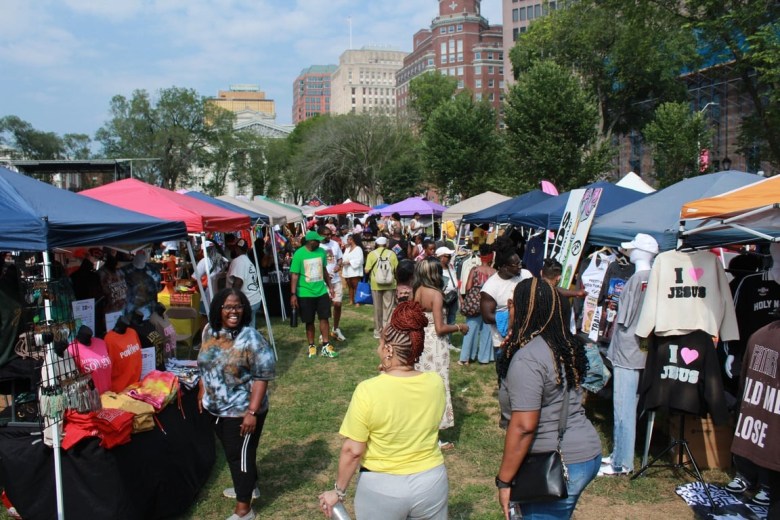
Walking the New Haven Green during Saturday’s fourth annual Black Wall Street festival, there was a sense of a need being met.
The stage at the north end of the Green featured a variety of live bands, DJs, and MCs that kept a small dance floor’s worth of people moving in front of them, while others lounged in lawn chairs nearby.
The aisles among the dozens upon dozens of vendors, meanwhile, buzzed with conversation, as potential patrons checked out streetwear, African imports, beauty products, small business services, resume help, event planners, and even the chance to have an ultrasound party.
One vendor sold posters with portraits of the businesspeople of Black Wall Street in Greenwood, in Tulsa, before it was burned to the ground in a race massacre in 1921. “Black Wall Street: We Did It Before, and We Can Do It Again,” his t‑shirt read.
That was the scene Saturday at an event that has become a staple of late summer in New Haven.
The Green was a maze-like bazaar of vendors, offering everything from clothing and jewelry to mental health and legal services. Throngs of people walked the aisles, perusing what the vendors had. It was also a chance for friends to run into one another, and a chance for families to hang out on the Green, listen to live music, and get a meal from a row of food trucks that lined the curb along Temple Street. It was a celebration of Black entrepreneurship and community, and with the event seeing its biggest year yet, it showed how the two easily went hand in hand.
“Honestly, it feels amazing,” said David Burgess of The Breed, which organized the event with the city’s Economic Development Administration as a partner. Citing Breed founders Aaron Rogers and Rashad Johnson, among others, Burgess said “it was just a team coming together,” but “bringing people together like this is really a blessing.”
“The Breed has been a great partner over all four years,” said Michael Piscitelli, the city’s economic development administrator. “The logistics have worked really well again this year, to stage this many vendors on the Green.” He noted that Black Wall Street had under 30 vendors in its first year, about 100 in its second year, about 200 last year, and more than 200 this year. “People are out here spending money, enjoying the time, the music, and celebrating a really cool event here in the city.”
Burgess cited the trust The Breed has worked to build in the community as one ingredient in Black Wall Street’s growth. “We try to bring people together, and we try to support as many Black businesses as we can that we see in the city because there’s a need for it,” he said.
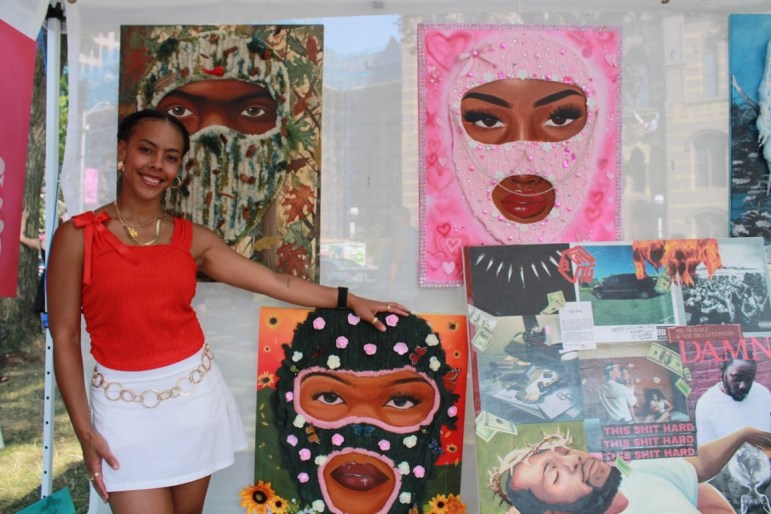
Among the vendors was painter Kayla Staples, whose business went by the name Black N Artsy. Staples got into art as a child in Stockton, Calif., “as a way to create, get my hands on things, then make my own little reality, and I’ve been hooked ever since,” she said. She made her way to New Haven, she said, for love (and school) by way of Texas and upstate New York. The diversity of her experiences is reflected in her art, which runs the gamut from still lifes and landscapes to more surreal and collage-like pieces.
“I really like the 3‑D side of things,” she said of a series of portraits depicting people in ski masks. Usually, she said, it’s taboo to touch art; “I wanted something you could literally feel,” she said, and “I wanted to show the unity behind the masks.” People may be very different from one another, but “we’re still people, whether Black, brown, a hunter, or from the street.” A portrait of a melting face, she said, is “an embodiment of how I was feeling at the time,” suffering a sadness.
Staples got interested in Black Wall Street because “I am a Black artist, and I figured it would be the right audience for me. I get a lot of inspiration from my culture.” She motioned toward a series of portraits she did of people’s mouths, each decorated with elaborate grills. Additionally, a few friends encouraged her to try vending. She participated in her first Black Wall Street last year and it went “amazing,” she said. It was her first time being a vendor anywhere, “so I was a little nervous, but it went so well. That’s what brought me back again this year,” which was going “equally well.” She looks forward to keeping on developing as both an entrepreneur and an artist.
“AI can’t do this,” she said.
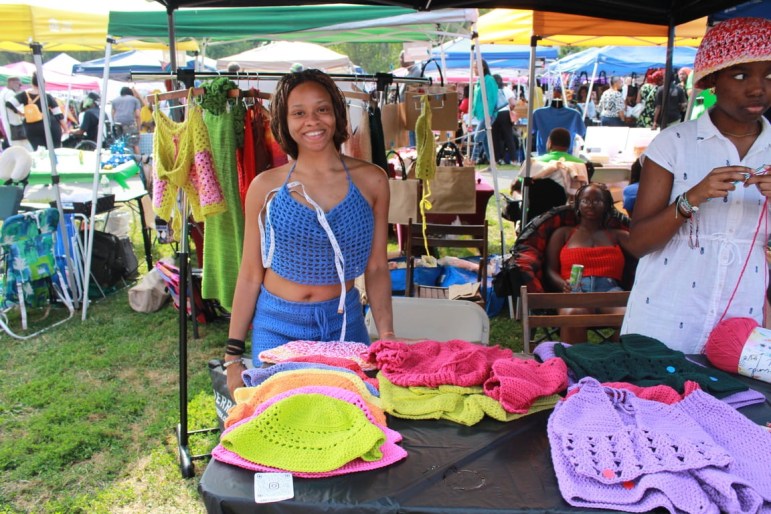
Nearby was a booth for Melanin Skein, where Alexa Monrose was on hand selling crocheted hats, tops, dresses, and other items. Monrose started crocheting as a hobby in 2022 as a “Christmas gift to myself,” she said. She bought supplies from JoAnn Fabric. She took a trip to Jamaica with her family and decided to make her own clothes for that. She started making things for other people “kind of randomly,” she said. This April, a cousin’s hairdresser asked her to make a piece for her daughter after striking up a conversation and seeing pictures of what she’d made. The daughter came to pick up the piece and loved it, and “that’s when she told me about Black Wall Street.”
She spent the summer making an array of pieces to sell, following her own tastes of leaning toward bright colors while also keeping an eye on what current fashion trends were. She figured she might have made it a business in time, but “Black Wall Street probably got my face out there for people to know.”
“I’m a proud, first-generation Haitian girl trying to make it,” she said. “I’m trying to take my crochets, my talents, into the fashion world,” and “I’m trying to make a deal with myself.”
As afternoon moved into evening, Black Wall Street showed no sign of slowing down. The Breed hopes to make the event even bigger next year. “I’m always a go bigger and better man,” Burgess said. “We love our city and we love the people. Keep God first and we’ll continue to keep striving and keep growing.”
This story was first published Aug. 18, 2025 by New Haven Independent.