


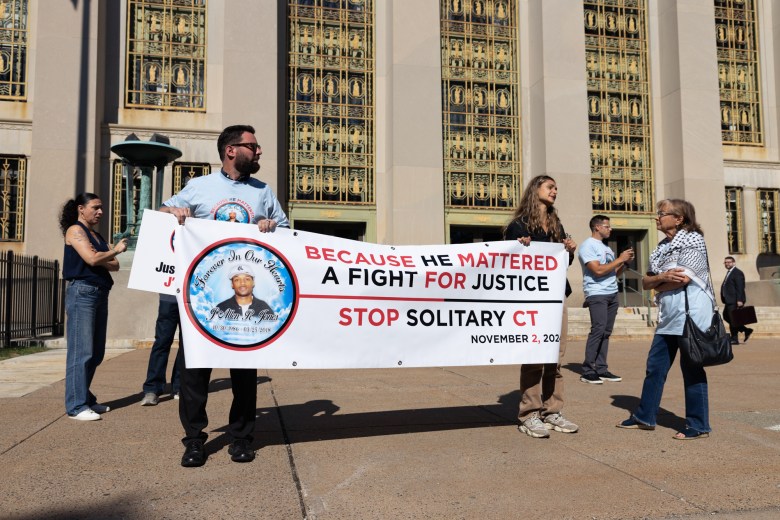
An official from the Department of Correction testified in Hartford Superior Court on Friday that he would be willing to make public a portion of a video showing the death of J’Allen Jones at Garner Correctional Institution in 2018, as long as certain conditions were followed about how the video could be viewed.
But Attorney Ron Murphy, who represented Jones’ family, argued that removing any part of the video would not do justice to Jones’ memory and would leave out critical information about Jones’ conduct the day he died.
Jones died after being pepper sprayed, restrained, struck and forcibly moved by as many as 10 corrections workers. In August 2018, Jones’ mother and girlfriend filed a lawsuit against the Department of Correction. The family has been petitioning the courts for the release of the video, along with the ACLU and the Connecticut Examiner.
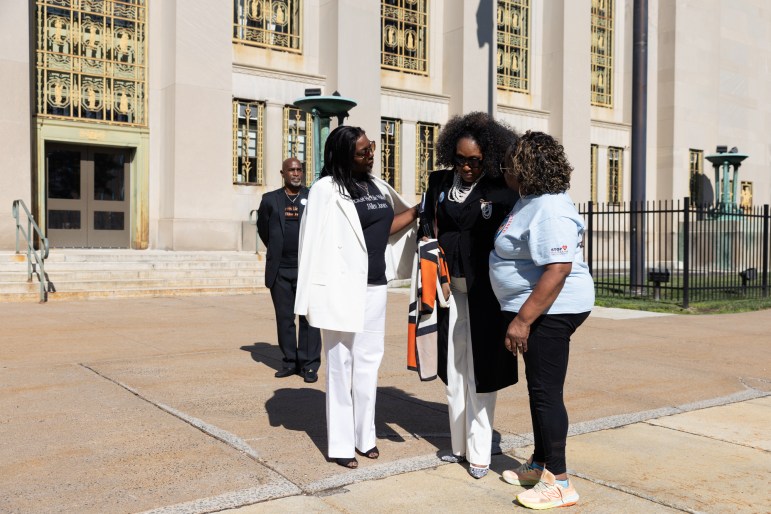
At the Friday hearing, Jessica Jones, J’Allen Jones’ mother, pleaded with the judge to release the video.
“I want the world to see what happened to my child. He did not deserve this,” she said.
She said she needed to see how he died.
“I am a grieving mother. My heart aches every day.”
Superior Court Judge Claudia Baio did not rule on the motion Friday and said attorneys should file briefs on their arguments by October.
In 2019, both the state and Jones’ family members agreed to have the video sealed under a protective order. In 2020, the family members asked to overturn the protective order and allow the video to be viewed by the public. In their argument, they said that the state had required them to agree to a protective order if they wanted the video released. They said the state had cited “safety and security” concerns.
“After viewing the video, and similar videos widely available on the internet, Plaintiffs are convinced that no such security issues exist,” the motion reads.
The state’s assistant attorney generals argued in response that releasing the video “would severely impair the safety and security of DOC correctional facilities” and that the only reason the family wanted the video released was in order to “make extrajudicial, public statements about this pending case, which will certainly poison the jury pool and effect the Defendants’ right to a fair trial.”
Both the ACLU and the Connecticut Examiner have motioned to intervene in the lawsuit to release the video. A trial judge denied the ACLU’s motion, which they are appealing. The Examiner filed its motion earlier this month.
Last year, CT Insider reviewed a 350-page report by an investigator at the Department of Correction, which included still photos from the video, and described the events it showed.
Excerpts from the January 2019 report reviewed by CT Mirror indicate that the 31-year-old Jones was being transferred within Garner, in Newtown, for monitoring when correction officers told Jones that he needed to submit to a strip search. He resisted, “chanting, yelling and shouting incoherently.” Staff physically forced him onto a bed and removed his clothes. One of the officers gave him several knee strikes to the thigh, according to the report.
A lieutenant sprayed Jones twice with pepper spray, and the officers put him into restraints. They covered his head with a “universal precaution safety veil” to prevent him from spitting on the correction officers. They also administered a combination of benadryl, the anti-anxiety drug Ativan and Haldol, an antipsychotic, the report states.
At that point, Jones became “less resistive,” and the staff moved him to a cell. A nurse found him unresponsive, and he was transferred by ambulance to Danbury Hospital, where he was pronounced dead.
The investigator concluded that the staff’s use of force was not “excessive.” He noted that Lt. Gary Gray had tried to limit the use of force by other correction officers, stopping officers from holding Jones by the neck or putting their knees on his back, and explaining to Jones that the officers were “trying to control your actions so that you don’t hurt yourself.”
Gray told investigators that he’d called for Jones’ head to be covered with the safety veil as a “precautionary measure” to protect staff from being spit on and that he’d had “no idea” that Jones was asthmatic when the chemical spray was used.
But the investigator did say the officers had violated the department’s policy on use of force by failing to recognize when Jones stopped resisting and could not stand on his own. According to the report, it took 7 minutes and 16 seconds before the staff realized that something was wrong and began trying to revive Jones with CPR.
In a motion for public access to the video filed in October 2024, the video is described as showing four correction officers, all weighing over 225 pounds, holding Jones down while Jones was “hog-tied and wearing the safety veil soaked in pepper spray.” The motion claims that the sound of Jones’ coughing from the pepper spray, and the change in his breathing — which turns “from labored to wheezing to agonal” — is audible in the video. And it notes the delay in the officer’s starting CPR.
“During those 7 minutes, the video shows J’Allen’s unconscious limp body flopping around while the COs moved him from the cell contaminated by the pepper spray to an uncontaminated cell,” the motion read. Attorneys for the state argued that the plaintiffs had not given any good reason why the order should be vacated.
Court arguments
On Friday, William Mulligan, the deputy commissioner of operations and rehabilitative services for the Department of Corrections, divided the video into three separate phases: transferring Jones from his cell to the inpatient medical area, his time within the inpatient medical area, and transporting him from the inpatient medical area out to emergency medical services and an ambulance.
Mulligan said the parts of the video where Jones was being transported throughout the facility showed door numbers and the locations of cameras and metal detectors. He said audio transmissions made by staff could also be heard. Knowing the locations of these things, Mulligan said, could make it possible for an inmate to figure out a way to escape from the facility.
“Our overarching responsibility is public safety, and escape is our No. 1 concern,” Mulligan said.
He said he was also concerned that incarcerated individuals could discover the identities of the staff involved in the incident, which could create negative encounters between those staff members and the incarcerated.
Mulligan said he felt a “reasonable solution” would be to make the “second phase” of the video — the events in the inpatient medical area, the place where Jones was strip-searched, pinned down, pepper sprayed, struck and forcibly moved by corrections officers — available for members of the public to view but not distributed widely on the internet. Having the video readily available, he said, would make it possible for people to view the video repeatedly, note the location of things like cameras and metal detectors and get the information to incarcerated people.
But Murphy pushed back, calling Mulligan’s fears “imagined.” While Mulligan said he was concerned someone outside the facility could view the video and give information to incarcerated people about the locations of cameras or metal detectors, Murphy questioned how, with the precautions required by the Department of Correction — opening and inspecting mail and monitoring phone calls and emails — the information could get in without being caught. He said it was unlikely that even with that information an inmate would be able to escape, given the security in the facility.
Mulligan said they were only able to inspect a small percentage of the communications that incarcerated people received and that contraband does arrive into the facilities.
Murphy said that removing the “first phase” of the video from the public would prevent people from seeing that Jones was “100% calm” as he walked from his housing unit to the inpatient medical area, countering the narrative from the Department of Correction that Jones had been “resisting.”
He also said that leaving out the “third phase” of the video, which showed Jones being transported, unconscious, to emergency medical services and an ambulance, would prevent the public from seeing “the consequences of how J’Allen [Jones] was treated” when he was in the inpatient medical area.
Murphy also questioned whether it would be possible for things like room numbers to be redacted from the video.
Other members of the public who testified said they saw the release of the video as key for bringing accountability to the Department of Correction and the potential catalyst for policy changes within the prisons.
Attorney Alex Taubes, who is representing the Connecticut Examiner, said the video was being used to protect the Department of Correction from having to face accountability for what happened. He argued that other videos have been released in the past and that releasing this video would not cause harm to anyone involved.
Attorney Dan Barrett of the ACLU questioned how the video would reveal anything more than what had already been demonstrated in 800 pages of information and photographs that the department had already produced. He said the department would have a hard time proving that the need to conceal the video overrode the public interest.
Several people referred to the release, in December 2024, of a video in the Marcy Correctional Facility in New York that showed corrections officers physically assaulting inmate Robert Brooks, who died the following day. Correction Ombuds DeVaughn Ward argued that there was an especially strong public interest in viewing the video of Jones’ death because at least one of the officers involved is still employed by the Department of Correction.
Kevnesha Boyd, a mental health therapist who worked for six years in the Department of Correction, said the case reminded her of that of Carl “Robbie” Talbot, who died after being restrained, piled on by officers and pepper sprayed in New Haven Correctional Center in 2019. In February, the state of Connecticut settled the case for $3.75 million.
“This is how we’re treating men with mental health issues. This is how we’re treating our most vulnerable, over and over again,” she said.
