



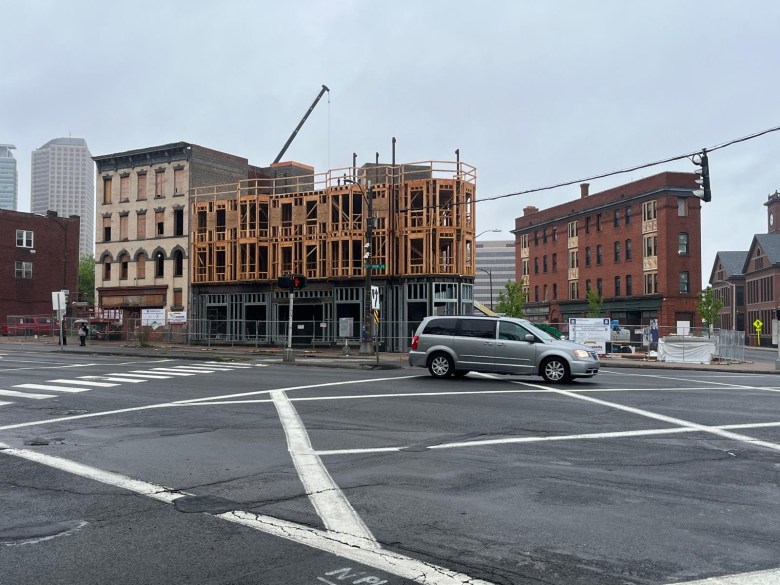
This two-part series is all about the promise parking reform holds for the state of Connecticut. Part I today will look at how parking reform is leading to an infill development boom in Hartford, while Part II will examine how parking reform is sweeping across the nation—and make the argument that Connecticut shouldn’t be left behind.
Parking policy may sound like a wonky issue, but as Donald Shoup says at the beginning of The High Cost of Free Parking “the cost of parking is hidden in higher prices for everything else,” including housing, businesses, and our built environment.
Hartford wisely realized this and made history when it became the first American city to fully eliminate parking mandates city-wide in 2016. While Hartford’s parking reforms took time to kick in, they’re helping lead to an infill building boom in the city.
Parking mandates —government requirements that force homes and businesses to provide a set amount of parking— profoundly impact Connecticut’s built environment. These requirements are arbitrary and based on pseudo-science, and they make infill development especially challenging.
Prior to these reforms, Hartford had a confusing array of inflexible regulations that mandated a parking space and a half per home in a city where over 70% of households have one or fewer vehicles. It went further, mandating one space per 600 square feet for retail stores and two spaces per 500 square feet for offices, often meaning that you’d often have more parking than building. Years of these parking mandates being on the books hollowed out downtown Hartford and led to 33% of its land area being surface parking (and that doesn’t account for garage spaces). The spatial costs of parking are immense, and with each space taking 325 square feet, excessive amounts of parking are incompatible with the walkable commercial centers that make Connecticut so great.
In 2014, Hartford realized that their parking mandates were holding the city back and losing them $1,200 in annual tax revenue for every unnecessary parking space. Eliminating parking mandates helped Hartford approve a 35-year high 468 homes in 2024 and welcome new businesses all across the city. Let us highlight a few exciting examples:
Forge City Works, a Hartford based non-profit, opened Grocery on Broad in 2024 to provide fresh affordable groceries to the Frog Hollow neighborhood and continue its mission of providing job training. This store adaptively reused vacant space, provided net-zero new parking, instead sharing existing parking that was lightly used during grocery store hours, flexibility that wasn’t possible a few short years ago.
Two dilapidated buildings across from a school in Hartford’s Clay Arsenal neighborhood are coming back as housing. To put it simply, these investments would not be happening without parking reform
- 94 Edwards – Abandoned and boarded up for over 10 years. Fully renovated and brought back to livability in 2021 thanks to the flexibility of Hartford’s new code. Provided parking without any city mandate but at a level less than the pre-2016 mandate required.
- 98 Edwards – Fire damaged in 2016, demolished in 2020 and now proposed for a new 20 home apartment building at a range of income levels and home sizes. Providing one parking space per unit without any city parking mandate.
Parking reform’s key benefit is that it recognizes that the world is complicated and that arbitrary, inflexible numbers passed down from planners may not get it right much of the time. Yet these pseudo-science regulations exist in nearly every town in Connecticut.
For example, in Naugatuck’s business district —right next to its train station, which is getting a long overdue multi-million dollar upgrade —you need to build three parking spaces per studio apartment – three times more parking than living space! Meanwhile, Trumbull mandates you build four parking spaces before you’re allowed to build an in-law suite for an aging parent, who may not even be capable of driving.
It isn’t just Hartford that’s recognized how pointless these policies are: Thompson, in Connecticut’s Northeast corner, eliminated parking mandates in 2020, and in the four years of 2021-2024 permitted twice as many homes per year (25) as it averaged in the 16 years from 2004-2020 (12.25). This is not just a Connecticut phenomenon, either; a 2024 research study found that absent any other reforms, eliminating costly parking mandates can boost home building by an astonishing 40 to 70 percent.
Dropping parking mandates is a clear way to get housing built, support small businesses, and strengthen our walkable town centers. The Connecticut legislature was right to include it this session in HB 5002 to bring the benefits statewide, and any future housing bill must include similar reforms.
In Part II, we look at the nationwide, bi-partisan movement to pass parking reform.
Thomas Broderick and Casey Moran are Co-Founders of Connecticut Parking Reform.