



Part I of this two part series focused on how parking reform is helping Hartford build new homes and gain new infill investment. This part talks about how these trends are sweeping across the country in a bipartisan fashion.
When Gov. Ned Lamont vetoed Connecticut’s housing bill in June, he said the parking reform provision raised some eyebrows. It’s time to lower those eyebrows: 2025 has been the year of parking reform across the United States, and Connecticut would be placing itself firmly in the bipartisan mainstream by reforming its onerous, government-required parking mandates.
Part I of this series addressed how parking mandates make little sense and drive up the spatial and financial cost of infill housing and businesses to the point that they often become impossible to build. As we pointed out in Part I of this series, Connecticut municipalities as distinct as Hartford and Thompson are benefitting from parking reform.
Indeed, the arguments against parking mandates are so compelling and common sense that municipalities across the country are doing away with them. In 2023, Austin, Texas (which has the same population as Fairfield County) became the largest city in the country to eliminate its mandates, and Burlington, Vermont joined them that same year. And in 2025 Dallas and Denver have joined the movement and eliminated their parking mandates, joined by small towns like Shoreline (population: 63,740) and Bothell (population 51,770) in Washington state.
The Shoreline and Bothell stories are instructive: it’s not just large cities that benefit from parking reform: twice as many small towns have eliminated parking mandates as large cities. Evidence shows that reforming parking in small jurisdictions is even more transformative in strengthening small business heavy main street districts, allowing missing middle housing to be built, and protecting forests and farms from sprawl development.
Parking reform case studies are so powerful —and the benefits so overwhelming— that it has now swept through statehouses across the country. States as diverse as Washington, New Hampshire, Texas, and Montana each passed laws to reform their onerous local parking mandates this year, and North Carolina is on the cusp after their House of Representatives voted 107-0 to fully eliminate all mandates statewide. While the details differ, the story is the same: Democratic and Republican, rural and suburban states are reforming their outdated parking regulations.
These legislatures and governors understood that parking mandates are bad for business, bad for infill housing, and bad for runoff pollution, and they refused to give into fear-mongering. Eliminating parking mandates does not eliminate parking, as entrepreneurs and towns can still —and almost always will— build parking for their needs, just in more reasonable quantities. These states also understood that no one has to give up their car in a world without parking mandates, it just builds in a touch more flexibility.
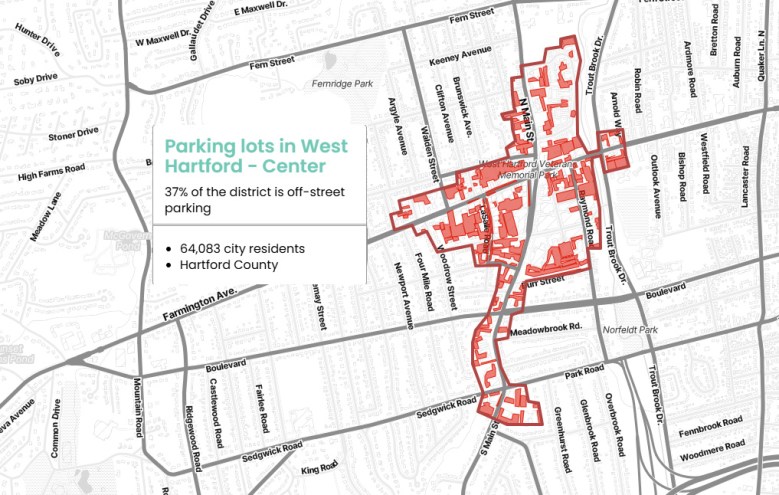
Not only will most developers continue to build parking in Connecticut after we modernize our parking policies, but we have a significant amount of parking already. Our research at Connecticut Parking Reform showed that parking lots make up an average of 29% of Connecticut’s downtowns and transit hubs, equating to 4,327 acres of parking —or over 630,000 parking spaces— on only 1.5% of our land! Want to see how much parking your local town center already has? Check out our work at ctparkingreform.org and scroll down to the “Paved Paradise: Mapped.”
New ideas can take a moment to digest, and some legislators and governors can be nervous to enact changes like parking reform. But they shouldn’t be: this is a common-sense, evidence-based, bipartisan policy passing in small towns, cities and states across the country. When Governor Lamont convenes a special session to reconsider HB 5002, he should feel more than comfortable moving forward with the parking reform provisions as already written.
Thomas Broderick and Casey Moran are Co-Founders of Connecticut Parking Reform.