



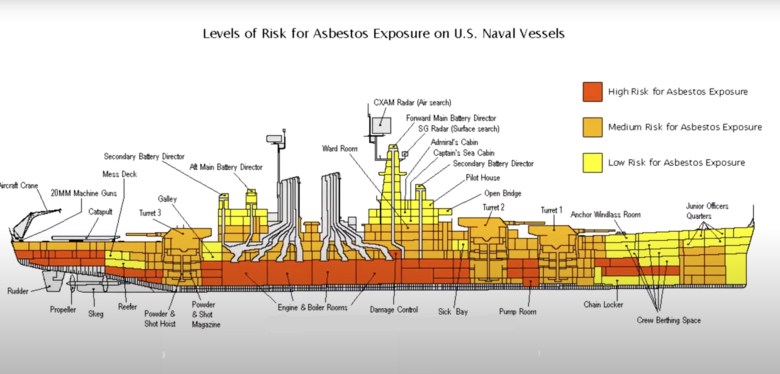
Asbestos is not just a relic of America’s industrial past —it is a continuing threat that has etched a deep and disconcerting mark on thousands of veterans across Connecticut and the country.
Previously celebrated for its versatility, this natural mineral was widely incorporated into almost all military infrastructure during much of the 20th century. Likewise, ships constructed before 2002 were also packed with asbestos in their engine and boiler rooms and other areas that needed heat and chemical protection. This extensive use resulted in the asbestos exposure of shipyard workers involved in the construction and maintenance of these vessels. Similarly, Navy veterans’ asbestos exposure also occurred as they both lived and worked in an environment surrounded by asbestos products.
It took a long time for science to discover that this mineral’s tiny fibers could cause lethal diseases, such as mesothelioma, asbestosis, and lung cancer.
Recognizing these dangers, federal regulators began moving toward restrictions as early as 1989, when the country’s Environmental Protection Agency (EPA) attempted to phase out most asbestos-containing goods. The last mining operation of this mineral also stopped eventually in 2002. Yet such efforts were only partially successful as chrysotile —the most commonly used form— remains legal, allowing various industries to import and use it in their products. That gap remained a glaring weakness in public health protection until 2024, when the EPA finally prohibited the use of this asbestos, closing one of the last cracks that allowed the material into the country.
But just as a significant stride was achieved, the agency shockingly announced in June 2025 that it would reconsider the chrysotile ban after several chemical manufacturers filed a petition questioning the rule. Rather than standing firm on this hard-won policy, authorities opted to reassess it —a process that could drag on for as long as 30 months. In a troubling twist, the agency also asked the court to pause ongoing litigation related to the matter.
For veterans and their families already enduring the devastating health repercussions of asbestos exposure, these choices represent far more than a bureaucratic delay. Furthermore, the ban rollback also poses an alarming risk to public health and safety, potentially reintroducing this toxic mineral back into federal and military supply chains.
How asbestos exposure impacted veterans in Connecticut
Asbestos exposure has long been a troubling issue affecting all 50 states nationwide, including Connecticut. An updated interactive map showed that between 1999 and 2017, the Constitution State saw at least 3,865 related deaths, which emphasizes a devastating impact on a coastal state that hosts over 131,600 veterans. Of these, 2,860 were attributed to lung cancer, while asbestosis and mesothelioma, respectively, accounted for 314 and 715 cases. Among the hardest hit regions was Hartford County—which reported about 804 fatalities —followed closely by New Haven County with an alarming 802 deaths.
A large share of these victims were former service members who spent an extended period in contaminated bases like Naval Submarine Base New London in Groton. Nationally, veterans make up about a third of the 3,000 mesothelioma diagnoses logged annually, despite representing only 6.1% of the entire adult population. This disproportionate burden makes one truth impossible to ignore: unless asbestos exposure is eliminated once and for all, the human cost—especially among veterans—will only escalate.
Protecting the veterans means upholding the asbestos ban
The federal government has made meaningful progress in acknowledging toxic exposure in military service. One result is the ratification of the Honoring Our PACT Act of 2022, which expanded healthcare and disability benefits for veterans suffering from service-connected conditions, including those caused by asbestos. Yet the logic of such reforms sadly becomes meaningless if, at the same time, policymakers allow the hazardous mineral to creep back into supply chains.
The 2024 chrysotile asbestos ban was the product of decades of science and public pressure converging on a single conclusion —that this natural mineral is dangerous. As such, reconsidering that decision not only undermines trust in public health protections but also places veterans and their families back in harm’s way. And for those already fighting asbestos-related illnesses, the mere possibility of weakening the rule already feels like a profound betrayal.
Moreover, future service members deserve the assurance that they will be shielded from what’s supposed to be a preventable danger. With this, maintaining the asbestos ban is even more essential to ensuring that the invaluable contributions of those who sacrifice so much for our country are not only remembered, but actively honored.
Cristina Johnson is a Navy veteran advocate for Asbestos Ships Organization, a nonprofit whose primary mission is to raise awareness and educate veterans about the dangers of asbestos exposure on Navy ships and assist them in navigating the VA claims process.