


The “endangerment finding” is a seemingly nondescript term for what is arguably the most critical regulation in the U.S.’s climate change-fighting arsenal.
It allows the federal government, under the authority of the Clean Air Act, to regulate the greenhouse gas emissions that are warming the planet and in turn causing climate change.
The U.S. Supreme Court affirmed it almost 20 years ago.
President Donald Trump wants to get rid of it.
And that has unleashed a flood of outrage, along with increasingly coordinated pushback, from groups of scientists, climate experts, legal entities, governments, environmental advocates and individuals.
Connecticut is in the thick of it, with its emissions levels and air quality hanging in the balance.
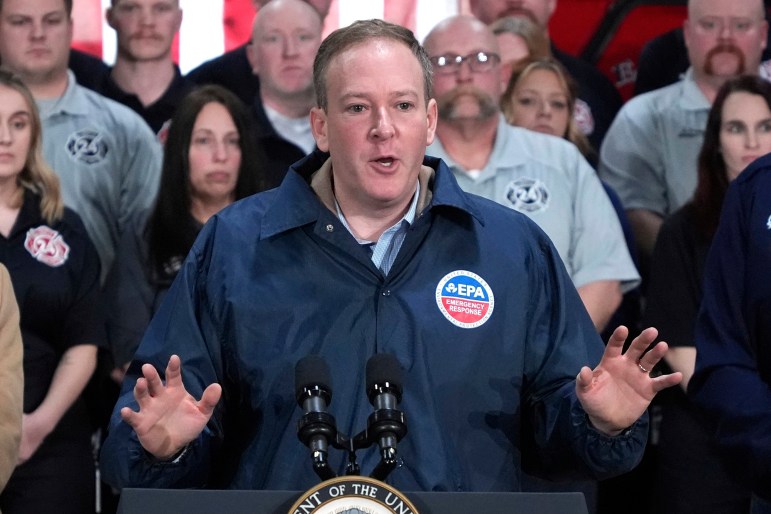
The endangerment finding was specifically targeted for reconsideration in the conservative government playbook Project 2025. In March, Environmental Protection Agency Administrator Lee Zeldin announced it was under review, denigrating endangerment as “the Holy Grail of the climate change religion.” And on July 29, EPA announced it wanted endangerment gone.
Repealing the finding “will be the largest deregulatory action in the history of America,” Zeldin said.
“We will not let Trump and Zeldin do this without a fight,” said Connecticut Attorney General William Tong at the time. His office is now one of four on a leadership team, with California, New York and Massachusetts heading up a multistate pushback.
While the proposed repeal is viewed as catastrophic, what really incensed opponents and galvanized large group efforts to fight the administration was a draft climate report by the Department of Energy, conducted in secret, released simultaneously with the EPA announcement and used as justification for the repeal.
The DOE report was compiled by a working group of five known climate skeptics, if not outright deniers, handpicked by Energy Secretary Chris Wright. He has since disbanded the group in a letter that disputes the existence of climate change as “settled science.”
The report was not peer-reviewed, as is the norm with such material. It pulled information from existing research. But many scientists whose work was cited said the report cherry-picked information, then misinterpreted and lied about their findings.
Fury ensued.
Jennifer Marlon, executive director of the Yale Center for Geospatial Solutions and senior research scientist at the School of the Environment, who specializes in wildfires and climate change, is one of those whose work was cited. She said she found out through a network of friends and colleagues.
“’Hey, did you see that your paper is cited in this report that kind of says, oh, wildfires are not a problem?’” Marlon recalls hearing.
“DOE directly misinterpreted my study. They cited me and twisted my findings.”
The DOE report, she said, missed the importance of active suppression of wildfires and what it does to fuel sources. And it minimized, if not ignored, the importance of warming temperatures and changing precipitation rates. It used data known to be inaccurate.
“They omit and minimize the importance of climate change in driving uncontrollable wildfires today,” Moran said.

“I spent multiple years working to compile the data behind the article that they reference. And when you invest so much time and effort in careful scientific research, where you think about every sentence that you’re saying and you provide evidence for every claim that you make, and then you see somebody who knows nothing about wildfires whip out some sentences and make these graphs that misrepresent your data,” she said, “it made me angry and upset and motivated me to put down all my other work and say, ‘OK, I’m gonna respond to this.’”
Marlon joined a group of 85 scientists who provided what has become a massive refutation to the DOE report.
The pushback has come from the grassroots of science, but it’s also been increasingly coordinated because of the sheer volume of outrage.
“It is very unique,” Marlon said. ”It kind of comes out of the blue. It rises very quickly. It demands your full attention right now to respond quickly while you can. The Trump administration moves very, very quickly, and they always are starting fires in multiple places so that people are kind of scattered and trying to figure out, ‘how do we address the chaos that’s unfolding?’”
Science group efforts
It fell to Andrew Dessler, a climate scientist and director of the Texas Center for Extreme Weather at Texas A&M, to figure that out. He asked on social media if people like him and Marlon should have a coordinated response and, if so, who was organizing it.
“People took that to mean I was doing it. And so, ultimately, I agreed to do it,” he said.
The plan became to file a group response for both the DOE report and again with EPA on the proposed endangerment rollback. Coming in at some 460 pages — three times the length of the report — the first filing was made in time for the DOE report comment deadline on Sept. 2, which also drew a total of 59,563 written comments. The comment period for the proposed EPA rule rollback goes until Sept. 22.
“By coordinating it, we probably got more people to respond, because everyone sees everyone else doing it and a lot of people working together on sections,” said Dessler, who also said he was shocked at how many emails he got from people wanting to participate. “Also, I think it made the response better.”
He acknowledged the uniqueness of his effort.
“Yeah, it’s unique. What the government’s doing is unique. This is basically a show trial for climate science,” he said. “They picked the jury — all people that say CO2 is innocent — and then they wrote a report.”
In the end, he said, the administration will declare victory, and everybody knows that’s what’s going to happen.
“People are offended. People are doing it because they’re mad that these people are making a mockery of science,” he said. “I’ve spent my entire career doing science. I respect science. Science works.”
The comments the group submitted include experts responding to every section of the DOE report.
Among those participating was Robert Kopp, a noted climate scientist at Rutgers University whose research focuses on sea level rise, climate and their economic impacts. He also holds multiple titles on other climate endeavors and has helped author both national and international top climate reports. He co-edited the submission, co-authored the section on sea level changes, and his previous research was cited throughout.
“My first reaction to opening the DOE report was, ‘wow, that was like a time capsule from 25 years ago,’” Kopp said. “It’s the same people making essentially the same arguments for 25 years even as the evidence of climate change becomes clearer and the evidence of the damages climate change is causing become clearer.
“I feel like, as a scientist, I need to address the cherry picking and misrepresentation that DOE is putting out and that EPA is using.”
Kopp points specifically to subject matter he knows best — the claim in the EPA proposed rule that sea level rise has been minimal. It cites the DOE report, though Kopp says the DOE doesn’t even say that. It offers some contradictory minimal analysis in a couple of citings.
“I think they’ve tried to write the proposed rule such that they could give up on the science argument and still convince the Supreme Court of the validity,” he said.
“Their primary proposal is to undercut the legal authority to regulate greenhouse gases under the Clean Air Act. They’re also proposing to attack the science, but they’re not relying on that. They don’t need to win on the science to undercut the legal authority,” Jenks said.
The goal, she said, seems to be to tie the hands of future administrations to prevent the regulation of greenhouse gases under the current Clean Air Act.
In an emailed statement, an EPA spokesperson appeared to confirm Jenks’ view.
“EPA’s proposal is legal in nature,” it read. “The Endangerment Finding is the legal prerequisite used by the Obama and Biden Administrations to regulate emissions from new motor vehicles and new motor vehicle engines. Absent this finding, EPA would lack statutory authority under Section 202(a) of the Clean Air Act (CAA) to prescribe standards for greenhouse gas emissions. EPA is bound by the laws established by Congress, including under the Clean Air Act. Congress never explicitly gave EPA authority to impose greenhouse gas regulations for cars and trucks.”
In an unusual move, the National Academies of Sciences, Engineering and Medicine have undertaken what they call a fast-track review of the latest evidence for whether greenhouse gas emissions endanger public health and welfare. At the time of the announcement in early August, Marcia McNutt, president of the National Academy of Sciences, said the review was in direct response to EPA’s proposal to rescind endangerment. The report is slated to be released Wednesday.
“Decades of climate research and data have yielded expanded understanding of how greenhouse gases affect the climate,” McNutt said in a statement at the time. “We are undertaking this fresh examination of the latest climate science in order to provide the most up-to-date assessment to policymakers and the public.”
Economists weigh in
Environmental and climate economists have also joined forces to respond to endangerment and the DOE report. So far there’s at least one group of a dozen. It includes Yale’s Ken Gillingham, senior associate dean of academic affairs. He has environmental and energy economics appointments in the environment and management schools and the economics department. He also served on the White House Council of Economic Advisers in the Obama administration.
The group has filed objections to the DOE report, focusing on three chapters with economic assertions. Among its findings are that the economics literature used “is woefully out of date;” that it “employs an array of fallacies” in saying climate damages are small compared with other trends; it accuses the report of using “strawman scenarios and fallacious reasoning” in its cost benefit analysis; and it says the report misrepresents the effect of climate change on agriculture and on secondary issues such has death from heat stress.

Gillingham is mainly focusing on the economic reasoning in the endangerment rollback, along with numbers in the regulatory impact analysis and the proposed rule itself. The group will be filing a new document in time for the Sept. 22 deadline, and Gillingham is also working with a second group of economists that will be filing comment as well.
Gillingham is questioning the EPA’s assertions that the cost of cars will increase, the choices for cars will decrease and old polluting cars will stay on the road longer.
“It’s disingenuous to be worried about increasing car prices when implementing a massive tariff policy that’s raising car prices,” he said. “They’re clearly not worried so much about car prices. They’re just trying to destroy environmental regulations.”
What Gillingham sees at work is influential parties who stand to lose money from a decarbonized economy.
“It’s inconvenient to have climate policy — to a set of people whose fortunes depend on fossil fuels,” he said. “They are very keen to see a rollback of the endangerment finding and anything that can be done to make it very difficult to regulate greenhouse gases. That’s fundamentally what’s going on.”
Legal pushback
While scientists and economists are coalescing to push back against the double-barreled endangerment rollback, a group of more than two dozen state attorneys general and chief legal officers in several cities are also coming together, as they have frequently in Trump’s second term.
The attorneys general, including Connecticut’s William Tong, have already filed an amicus brief in support of a lawsuit filed by the Environmental Defense Fund and the Union of Concerned Scientists that alleges the U.S. Department of Energy did not follow proper procedures in establishing the group that compiled the DOE report.

The group also filed 85 pages of comments against the report itself — enumerating the volumes of peer-reviewed research the report ignored and a 122-page appendix of state-by-state climate change impacts. Connecticut’s section notes the observed temperature increases, rise in sea levels that exceeds the global average and the region’s increase in climate extremes including storm intensity, rates of precipitation, flooding, heat and drought and the impacts from all of them.
A representative of Tong’s office has already testified during a live comment period on the legality of the Trump administration’s plan to dump endangerment. In the allotted two-and-a-half minutes, the testimony focused on how the proposed repeal denies the scientific reality that climate change is happening; that endangerment can only be changed by Congress, not the EPA; and that the proposal ignores health and other benefits of climate protection.
There were more than 600 live comments over four days of testimony (extended from the originally scheduled two days), that, according to observers, ran about 97% against and 3% in favor.
As of midnight Sept. 15, nearly 103,000 written comments were submitted on the endangerment repeal. The AG group filing on that will be a much-expanded version of its DOE comments.
“We’re pushing back on the junk science, but we’re also going to push back legally, procedurally and substantively legally that this is an illegal approach to rescinding the endangerment finding,” said Matthew Levine, deputy associate Connecticut attorney general and chief of the environment section. “I’ve been working on this stuff for decades, and the science is only continuing to improve and get better with specificity. We feel really confident on the facts and the support for it, and we also feel really confident on the legal issues as well.”
Endangerment in brief
Endangerment goes back to a 2007 U.S. Supreme Court ruling — Massachusetts v. EPA — that paved the way for EPA to regulate greenhouse gas emissions in motor vehicles in addition to the standard pollutants it had been regulating under the iconic Clean Air Act since it came into its modern existence in 1970.
The Act’s language says said that the EPA is required to regulate any air pollutant the administrator finds if the administrator finds they “cause, or contribute to, air pollution which may reasonably be anticipated to endanger public health or welfare.”
Two years later, the administrator did just that, and greenhouse gases — six of them — have been regulated as pollutants since.
It’s widely assumed the EPA will go ahead with rolling back endangerment. So it’s also widely assumed this matter will wind up back before the U.S. Supreme Court. Three of the four justices who voted against it originally remain on the court: Chief Justice John Roberts, Clarence Thomas and Samuel Alito. None of the five justices who voted for it remain.
The use of the finding has been stretched since the original ruling to justify requiring emissions reductions from power plants and industrial facilities. In a related matter, the EPA proposed a rule on Sept. 12 to discontinue the Greenhouse Gas Reporting Program signed into law in 2007 by President George W. Bush. The rule, which began operating a decade ago, required annual reporting of emissions by refineries, factories and other large industrial operations to make the public aware of emissions as a first step towards limiting them.
But the focus of endangerment in the current instance is for motor vehicles. And while the overall issue is wonky to the average person, it has a major impact on their lives, especially here in Connecticut.
Connecticut’s emissions
Connecticut set itself greenhouse gas emissions reduction goals to meet between now and 2050, when overall emissions are supposed to be 80% below 2001 levels. The annual GHG Inventory released by the state Department of Energy and Environmental Protection earlier this month shows the state continues to be off-track to meet its goals.
The transportation sector, which constitutes the largest source of those emissions, provided a small bright spot. Its emissions were down 2% in 2023 (the most recent data available) over 2022. Prior to the pandemic, during which emissions dipped dramatically, it had been trending up slightly. But to reach its sector goals, the rate of decrease will need to increase 3.6-fold to meet its next benchmark in 2030.

It is likely the 2023 decrease was driven by greater adoption of electric and more fuel-efficient vehicles, as well as power sector emissions reductions mandated during the Biden administration that would have helped clean up power plants upwind of Connecticut. But the potential rollback of endangerment, along with the Trump administration’s elimination of electric vehicle tax credits and other motor vehicle efficiency measures, including the more restrictive emissions levels some states follow, may send them back up.
“We are concerned that recent actions by the EPA to roll back power plant regulations, vehicle fuel economy standards, and even the Endangerment Finding will remove critical federal tools that contributed to this progress,” said DEEP Commissioner Katie Dykes in a statement that accompanied the report’s release.
DEEP would not make anyone available to discuss the endangerment repeal effort or the DOE report specifically, though Deputy Commissioner for Environmental Quality Emma Cimino did speak during the EPA live testimony on endangerment.
“Greenhouse gas emissions significantly impact human health by contributing to climate change, which in turn leads to various health problems including respiratory illnesses, heat-related illnesses, infectious disease outbreaks, food and water insecurity, and mental health issues,” Connecticut Public Health Commissioner Manisha Juthani said in a statement at the time. “Amid the EPA pulling back on these efforts, Connecticut will hold our values to protect and improve the health and safety of our residents.”
“If you want to address the contributions of climate change from Connecticut, there’s no way to do it without making rapid and large reductions in gasoline use,” said David Reichmuth, a senior scientist in the clean transportation program at the Union of Concerned Scientists. The EPA’s changes, he said, mean car buyers will have options that are less efficient and with higher emissions. “That‘s going to take us in the wrong direction. In a time where we need to be going as quickly as possible to reduce emissions, we’re going to be actually increasing emissions.”
The Trump administration argues in the endangerment rollback that the higher cost of EVs — now exacerbated by the loss of the EV tax credit coupled with tariffs, which Reichmuth calls disingenuous on the administration’s part — will cause people to hang onto existing dirtier cars for longer. It also claims lower emissions rules by class of vehicle means that any changes in each class will be negligible.
“The idea that the emissions from vehicles don’t matter — it flies in the face of all the of the data we have,” Reichmuth said, calling such arguments “absurd.”
He points out that even if the next administration were to reimpose tough GHG auto emission standards, the cars purchased under more permissive Trump standards could stay on the road for well over a decade. “You’re locking in decades of emissions from those new vehicles,” he said.
Advocates band together
Scientists like Harvard’s Carrie Jenks believe that public input will also be critical to the their cause in this effort.
“I think it’s important for stakeholders to give EPA as much information as they can,” she said. “I think it’s going to be important for EPA to really dig into that, and it’s going to be interesting to see how they do that.”
The Union of Concerned Scientists, like other advocacy groups, is no stranger to group efforts. It has sent out multiple emails requesting individuals file comments on endangerment and contact lawmakers. But Rachel Cleetus, the group’s senior policy director with the climate and energy program, said this one isn’t taking take much effort.
“This report is so egregious that it hasn’t even required a big coordinated effort,” she said. “Within 24 hours, there were scientists on the media, on social media, writing, from the perspective of their expertise, that this was just wrong. So many errors in this report, blatant, complete obfuscation of scientific facts.”
Cleetus was also among the hundreds who gave live testimony on the endangerment repeal effort. She said, as she waited her turn, that what struck her was the ordinary citizens who stepped up, like a woman from Texas on the panel before hers.
“She spoke so movingly about the impacts of Hurricane Harvey and then the recent floods in Texas and what it has meant for people in her community,” Cleetus said. “It’s heartbreaking, it’s enraging, actually. … This is not just political football. This really affects people’s lives.”
Among other organizing efforts, the Sabin Center for Climate Change Law at Columbia University immediately provided a full explanation of the issue along with templates for comment letters for both individuals and governments.
The Climate Action Campaign, CAC, which is a coalition of major national environmental, environmental justice and public health groups representing about 15 million members across the country, has stepped up.
Executive Director Margie Alt said their tactical approach is both group and individual efforts, but a couple of things are different this time. First, the Trump administration seems more organized than it was in the first administration, and the fossil fuel interests operating within it are exerting more pressure.
“I’d say the other thing that’s different, though, is that people across the country are experiencing climate change every single day,” she said. “We’re just seeing incredible, incredible public response, especially as people are affected by extreme weather, which they understand to be supercharged by the climate crisis.”
She, and many others, accused the Trump administration of making climate denial the official policy of the U.S.
“I don’t think the public is going to stand for it,” Alt said.
At the Natural Resources Defense Council, Madeline Hankins, the group’s federal climate legal director, said the organization is pulling out all the stops.
Hankins said they knew what rollbacks were coming but not how quickly and widespread.
“We have required some level of sort of coordination and capacity and trying to figure out, ‘OK, it’s all hands on deck, but who’s going to handle what, and how are we going to address this?’” Hankins said.
Most inspiring, Hankins said, were the tens of thousands of members who have filed comments and that, even at the height of summer, “we’re seeing scientists band together to really rebut this report, and they’re coming out of the woodwork to talk about how their research is being misquoted.”
That may have been what motivated Yale’s Marlon to begin with. But she also sees the contrast with the previous federal climate policies she said were designed to improve people’s health, provide cleaner air, cleaner water, lower the temperatures globally, and to even make money doing it.
“All of these tools and policies were like a road map to a safer, cleaner future,” she said. “Basically what these new efforts are doing are taking that map, tossing it out the window, turning off the headlights in the car, and stepping on the accelerator towards a cliff. It’s really endangering the lives of millions of people.”