



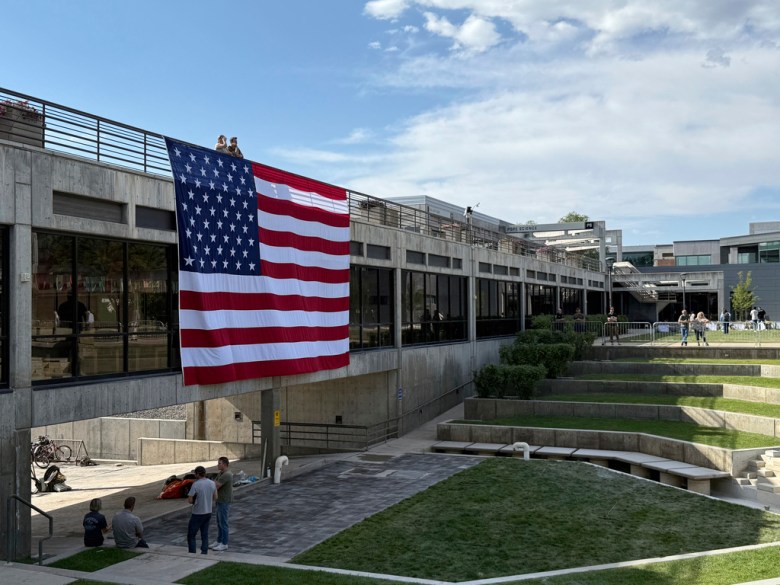
The picture remains blurred on the personal conflicts and motivations driving a 22-year-old video gamer, with developing thoughts on politics, to allegedly assassinate conservative political activist Charlie Kirk.
However, it’s clear we live in times again of deep social and political unrest, including inflammatory social, political, and cultural comments daily, similar to 1968, when the assassination of Rev. Dr. Martin Luther King Jr. also occurred in a charged environment.
Emotion often outruns reason, then tragedy strikes.
The Kirk shooting is only one of many horrendous, violent physical, verbal, and strategic attacks occurring as often as sipping water or targeting video game characters to die and resurrect with infinite resets of life. It’s also a time when we feel bodacious and entitled to be heard and forcefully thrust our beliefs on others.
In such a climate, we must be careful of the slippery slope of blaming fiery words as the cause of these actions and attitudes. The easy grab, history shows, is authority-driven retaliation, shrinking freedoms, and dissenters branded as enemies of law, order, reason, and the public good.
The paradox here is that fiery words come from all sides.
As an adjunct professor at Manchester Community College, I found this week a teaching moment —unlike most others— to discuss free speech, hate speech, and inciting speech with my students. The class at first was rooted in strong opinions without discernment between the expression of opinion and avoiding a blanket legal prohibition of those they find offensive.
What is acceptable one day could be unacceptable another, so how should we decide? I asked them.
The answers were all feeling-based, as I expected from 20-somethings. They haven’t the backgrounds, beliefs, or experiences to remember the 1960s; many can’t even express a clear understanding of the civil rights movement. They haven’t lived enough of life in many respects.
For them, as much as for the general public, it was an opportunity for educational understanding about the true value of their freedoms.
People make the polarized climate, I started explaining. Behavior about national issues stretches into your neighborhood, too. That same reflex plays out in local communities’ social media posts and public meeting comments, veering from unsettling to unhinged, some pushing the boundaries of what comes next.
So we must ask: What do we do about speech we strongly dislike —even hate— when the stakes are high, opinions differ, and emotions run strong, whether about national issues or local zoning, school, town, or city policy matters?
We, first, must hold two truths:
- Yes, people’s words can harm —and the law must act when people cross clear lines.
- But yes, a free society requires the freedom for people to speak, even when their speech offends. It is freedom for the thoughts we hate that matter most.
The legal standard is clear. Under Brandenburg v. Ohio (1969), speech can only be punished if it is (1) intended to incite unlawful action, (2) imminent, and (3) likely to produce that unlawful act.
A second, more recent rule comes from Counterman v. Colorado (2023): true threats—particularly online— are only criminal if the speaker acted with at least recklessness. That means they knew their words could be seen as a threat and spoke anyway.
These standards draw a bright line. Ugly, outrageous, or offensive speech may still be legal. But direct incitement and true threats, made knowingly or recklessly, can and should be prosecuted.
What about social media? The law still applies.
Dean Erwin Chemerinsky, of the University of California’s Berkeley Law School, notes that Counterman helps courts distinguish real threats from hyperbole. University of California, Los Angeles’s Eugene Volokh adds that punishment should be limited to speech narrowly tied to imminent crime —not just because it’s inflammatory.
Nadine Strossen, former American Civil Liberties Union president, advocates “counter speech, not censorship” unless legal standards are met. Law scholar Danielle Citron argues that laws on threats, stalking, and “intimate privacy” already cover most online abuse. Other legal scholars, like Jack Balkin and Kate Klonick, remind us those platforms —not government— enforce most digital speech rules.
Where’s balance?
At a rally following the Kirk shooting, law professor Stephen E. Sachs urged the crowd to think differently about how we argue. It’s about how people handle their thoughts and feelings, separate considerations.
He drew on the writing of psychiatrist and essayist Scott Alexander (a pen name), who once noted that a short-term focus may be part of the problem.
As Sachs put it, “Everyone … knows that they are right. The only remaining problem is how to convince others. Go on Facebook and you will find a million people with a million different opinions, each confident in her own judgment, each zealously devoted to informing everyone else.”
Sachs acknowledged that debate can feel frustrating, slow, and rarely decisive. Yet he defended its worth, saying, “Logical debate has one advantage over narrative, rhetoric, and violence: it’s an asymmetric weapon. That is, it’s a weapon that is stronger in the hands of the good guys than in the hands of the bad guys.”
The professor contrasted the enduring strength of reason with the fleeting impact of coercion or force.
“You didn’t develop your opinions after a five-minute shouting match. You developed them after years of education and acculturation and engaging with hundreds of books and hundreds of people. Why should they (opponents) be any different?” Sachs said, urging patience and persistence.
He closed by reminding listeners that lasting change comes from teaching people “ways to distinguish truth from falsehood,” even when that learning must withstand blustery counterforce or competition in the marketplace of ideas for acceptance.
The path forward
Our laws regarding speech and incitement are meant in part to also help foster cooler heads. They also are directed at sending a message about prosecution to those who want to ignore the need in a democratic society for reason.
Reasoning —discernment— helps to define what is a harsh expression of opinion from a direct provocation that mobilizes or causes people to bring imminent harm to others or the country.
We have had much debate, especially with the Jan. 6 riots at the end of the last Trump administration, over that precise meaning.
As more facts emerge about the Utah shooting, let us mourn— but not lose our heads. Let’s also cool the often-inflammatory rhetoric on social media. Whether discussing national politics or town political or policy issues, let’s pause, observe, and ask: What is my intent? What’s the likely result? Can I disagree using discernment?
Let’s teach and model for our kids about that precise and detailed thinking, even if schools aren’t doing an adequate job with it. Parents and guardians need to be the controlling force.
We do this not because we’re hard on hate, but because we’re strong on liberty.
Student comments during and afterward were interesting, and the teaching moment broad and penetrating.
“Charlie did what a lot of people fear doing, which is ‘speaking out’ and ‘public speaking,’” one student said. “He took his freedom of speech and started a following with people who have the same beliefs and grew a platform, but he did more than that.”
“He also invited the people who didn’t have the same values/views as him, showing that freedom of speech isn’t just about expressing ideas but making room for difficult and uncomfortable conversations,” she added.
Yet, for most of these students and as mirrored by a CNN commentator this week, determining the line between “actionable” speech and vicious commentary is hard to distinguish.
Another student offered, “One crosses that line once the words they are saying start to entice violence against other groups, or just downright accepting violence, like when Charlie Kirk stated, ‘I think it’s worth it to have a cost of, unfortunately, some gun deaths every single year so that we can have the Second Amendment to protect our other God-given rights’…or when he said, ‘Happening all the time in urban America, prowling Blacks go around for fun to go target white people, that’s a fact. It’s happening more and more.'”
“These statements accept violence and can be interpreted to entice violence against certain groups of people, and if left unchecked, this can turn into a 1930s Germany situation where people are calling for the extermination of certain ethnic/social/political groups (Jews, homosexuals, and Communists),” he added.
These and other kinds of comments required clarification, debate, discernment, and questioning —complex, difficult, and delayed in gratification for expressing a feeling or emotion,but needing to reconcile it with their thinking-level skills.
It is something many found startling in the face of discernment, but understandable as I, a nearly 70-year-old professor teaching nearly 40 years, looked at the youthful faces. They had much more of life to wrestle with yet.
The answer to hateful speech is not to ban all tough talk —but to uphold the law and protect the space for debate that includes thoughtful —perhaps sharp, even belligerent— commentary, but that avoids imminent provocation. It’s a thin line, almost impossible to define. It’s also one that preserves real free speech.
Let’s keep the Republic sane, I concluded. On that, they all agreed.
Bill Seymour, a freelance writer and resident of Glastonbury, teaches writing, historical and cultural analysis, and other courses in colleges and universities in Connecticut. Parts of this essay also have appeared in his “About South County” column he writes for Southern Rhode Island Newspapers.