



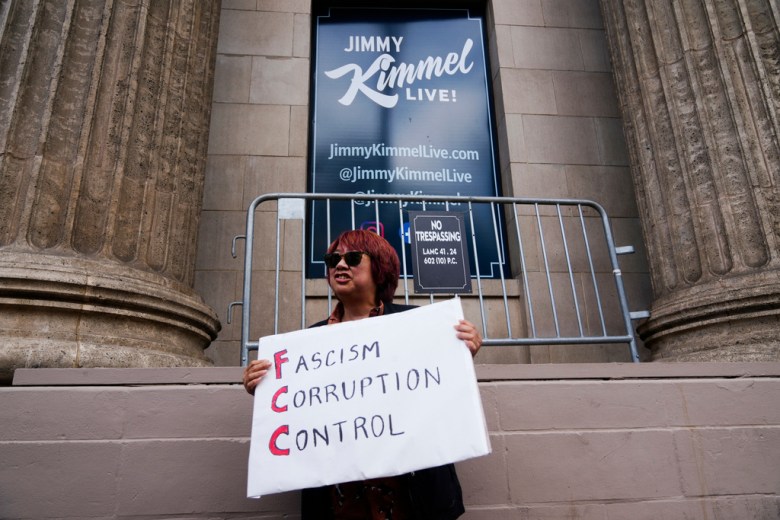
ABC’s decision to indefinitely suspend Jimmy Kimmel’s late-night show due to comments he made about the assassination of Charlie Kirk is the latest example of a major media company bowing to pressures from the Trump administration.
On his show last week, Kimmel said that Trump’s supporters were “desperately trying” to paint Tyler Robinson (the alleged assassin) “as anything other than one of them.”
Anyone who follows the news and monitors social media will conclude that Kimmel’s statement was largely accurate. Indeed, many in the Trump administration including the vice president went out of their way to suggest that a radical network of left-wing extremists was behind the assassination of conservative activist Charlie Kirk even as this claim stood in contrast to the evidence presented by law enforcement.
ABC’s suspension of the Jimmy Kimmel show came right after Brendan Carr, the Trump-appointed Federal Communications Commission chairman, threatened in an interview that he would consider punishing the local stations that carried Kimmel’s show. Carr’s comments were swiftly followed by announcements from several stations with ABC affiliates that they would move to cancel Kimmel’s show.
In the wake of the Charlie Kirk murder, U.S. Attorney General Pam Bondi suggested that the Justice Department would target groups and individuals that were employing hate speech. When reporters pointed out to Bondi that hate speech is generally protected by the First Amendment of the Constitution, she seemed to walk back some of her initial comments. Nonetheless, by then the Trump Administration’s threatening message was resonating.
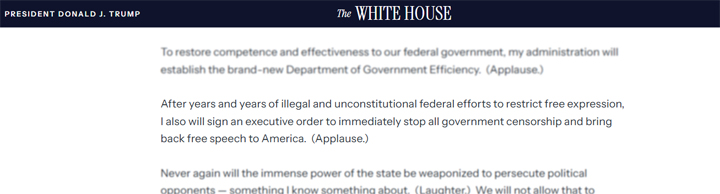
The canceling of the Jimmy Kimmel show is nothing less than a cynical attack on one of the most sacred liberties in a democracy—the freedom of speech and expression. Trump applauded this canceling in a tweet, ironically negating his own remarks from the second inaugural address in January 2025 when he vowed to “immediately stop all government censorship and bring back free speech to America.”
Yet even more troubling than the attack on free speech by the Trump administration is the culture of fear and intimidation that they have created since coming into office nine months ago. Earlier this week, President Trump filed a $15 billion defamation lawsuit against the New York Times and book publisher Penguin Random House. The lawsuit focuses on a book about Trump by two New York Times reporters and three “false, malicious, defamatory, and disparaging” articles that he says were aimed at sabotaging his chances in the 2024 presidential election.
The suit was dismissed last Friday by a federal court judge, but a report by PBS observes that “Trump has filed lawsuits against outlets whose coverage he dislikes, threatened to revoke TV broadcast licenses and sought to bend news organizations and social media companies to his will.” Such tactics are akin to those used by Hungarian Prime Minister Viktor Orbán and are aimed at chipping away at political freedoms and independent media while consolidating power.
An independent media is not the only institution that has been targeted by the second Trump administration. Upon assuming office in January, one of the first actions of this administration was to withhold research funding and exert tremendous political pressures on major universities like Columbia and Harvard.
Columbia, the first to capitulate to the demands of the Trump Administration, agreed in March to overhaul its protest policies, security practices and Middle Eastern studies department. In the case of Harvard, the government insisted that it change hiring and admissions in departments that “lack viewpoint diversity” and “immediately shutter” any programs related to diversity, equity and inclusion. Even if one agrees with some of the demands of the Trump Administration, the tactics they are using to secure compliance are not consistent with dialogue and negotiation, which is how healthy democratic societies pursue change.
We should also remember the executive order signed by Trump, which targeted prestigious law firms like Paul Weiss for conducting work or hiring lawyers that the White House disfavors. Weiss ultimately reached a deal with the administration that enabled the firm to get out from the penalties imposed by the order. According to an article in Politico, “eight firms followed that precedent in order to avoid becoming targeted themselves, ultimately committing a combined total of nearly $1 billion in pro bono legal services to largely unspecified initiatives supported by the Trump administration.”
Taken together, the actions of the Trump Administration amount to much more than bullying a network to cancel a late-night talk show or censoring the negative coverage that the President is receiving. What is at stake here is a concerted effort to establish a culture of fear and intimidation, one in which media organizations, non-profits, and ordinary citizens must think twice about critiquing and challenging the government.
As we approach the 250th anniversary of the American experiment in democracy, we should remember that our founders called on us to vigorously resist any efforts to curtail our fundamental rights and liberties.
Mordechai Gordon is a Professor of Education School of Education at Quinnipiac University.