


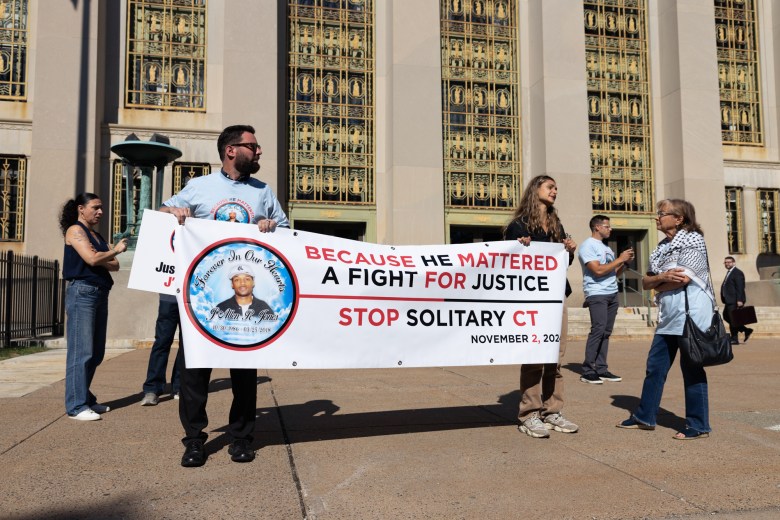
A Superior Court judge on Thursday ordered the Department of Correction to release the video showing the death of J’Allen Jones at Garner Correctional Institution in 2018.
In her 11-page decision, Superior Court Judge Claudia Baio said that the Department of Correction had not sufficiently proved that the safety concerns that officials raised during a hearing in August were enough to override the public interest in the video’s release.
Jones died in March 2018 after being pepper sprayed, restrained, struck and forcibly moved by as many as 10 corrections workers. In August 2018, Jones’ mother and girlfriend filed a lawsuit against the Department of Correction. The family has been petitioning the courts for the release of the video, along with the ACLU and the Connecticut Examiner.
In August, the court heard arguments in favor of and against the release of the video. William Mulligan, the deputy commissioner of operations and rehabilitative services for the Department of Correction, said he was concerned that the release of certain portions of the video would create a security risk, allowing incarcerated individuals to map the facility and possibly plan an escape.
He said he was also concerned that incarcerated individuals could discover the identities of the staff involved in the incident, which could create negative encounters among those staff members and the incarcerated.
Mulligan proposed that the department allow the portion of the video in which Jones had been strip-searched, pinned down, pepper sprayed, struck and forcibly moved by corrections officers to be available for members of the public to view, but not distributed widely on the internet. The modified version of the video would not include segments in which Jones was transported from his cell into the inpatient medical area, or when he was transported from the medical area out to an ambulance.
But Attorney Ron Murphy, who represented Jones’ family, argued that removing any part of the video would not do justice to Jones’ memory and would leave out critical information about Jones’ conduct the day he died.
In her decision, Baio acknowledged the security concerns that Mulligan raised but maintained that the majority of the video could not be sealed, since it provided direct evidence of the central issue of the case — the actions of both Jones and the correction officers on the day of Jones’ death.
“The defendants chose to submit the entire video in connection with their motion for summary judgement, rather than only a portion. Therefore, it is not reasonable for the defendants now to advocate that only a certain portion be publicly available,” the decision read.
Baio ordered that the Department of Correction provide the video to the court within two weeks. The department will be allowed to blur out doors and door numbers, metal detectors and staff members who are not involved in the lawsuit. They are also permitted to erase radio transmissions between corrections officers “if they feel the conversation therein raises legitimate security concerns.”
Baio noted that the number of people who attended the August hearing — including attorneys, criminal justice reform advocates and Jones’ mother — proved that the issue “had generated substantial public interest.” She also noted that the video was the primary evidence that the Department of Correction had presented in asking the court to dismiss the lawsuit without a trial, and that the public had a right to see that evidence “so that they can evaluate the court’s decision on that motion.”
Advocates celebrated the video’s release but were mixed on whether the department should be allowed to redact even portions of the video.
Barbara Fair, executive director of Stop Solitary, CT, said she was “ecstatic” that the department had released the video, and that “J’Allen did not die in vain.” But she said she was concerned that the Department of Correction could use the pretense of security concerns to blur out some of the most brutal actions that happened.
She said she hoped the video would lead to changes in how the Department of Correction is held accountable.
Attorney Alex Taubes, who is representing the Connecticut Examiner in a petition to intervene for the release of the video, called the judge’s ruling a “major victory for public accountability and transparency.” He said he disagrees with the need to redact parts of the video but “understands and respects” the judge’s decision.
Correction ombuds DeVaughn Ward said the judge’s ruling proved that the state’s argument for concealing the video was “indefensible,” particularly since they themselves had presented it as part of their argument against the case going to trial. He said he plans to ask to see an unredacted version of the video and use that to make a recommendation to the Department of Correction on whether they should discipline the officers involved.
Ward said he understood the need to redact parts of the video for security reasons and said the judge’s ruling struck the right balance.
Dan Barrett, attorney for the ACLU, which filed a petition in October 2024 for the video’s immediate release and was denied, said he felt the judge was “absolutely correct” in her ruling.
“The court affirmed that documents filed by the government need to be seen by the public so we can evaluate our government institutions,” Barrett said.
Asked about the redactions, Barrett said he felt the court had “struck the right balance,” since the redactions were intended to be very limited.
Barrett pointed out that the prison system belongs to the public and said what happens inside “is done in our names.”
Barrett said the real question now is whether Attorney General William Tong will release the video or attempt to file an appeal.
“[Tong] really should stop fighting. The public needs to have access to this,” he said.
Corrie Betts, the criminal justice chair for the Connecticut chapter of the NAACP, who praised the court ruling, said in a statement that representatives from the CT NAACP state conference had recently met with Tong, who reportedly told them that there was “nothing he could do” about releasing the video.
“The court’s ruling now makes it clear that such a position is inconsistent with the positions of justice and accountability,” Betts said.
Elizabeth Benton, the spokesperson for the Attorney General’s office, said their office was “reviewing the decision and evaluating next steps.”
Andrius Banevicius, spokesperson for the Department of Correction, said the department was reviewing Baio’s decision “in order to determine the appropriate course of action.”