


More than half of the affordable housing units Connecticut funded over the past six years were rehabilitated properties, as opposed to new construction, a report from the state’s Office of Legislative Research found.
The report, obtained by The Connecticut Mirror, examined the number of state-sponsored affordable housing units built during Gov. Ned Lamont’s administration. The report showed that just over 13,700 units of affordable housing have received state funding since 2019, and about 8,000 of those were rehabilitated homes rather than new construction.
It wasn’t clear from the report how much the rehabilitated properties actually expanded the state’s overall housing stock.
That has raised questions about Gov. Ned Lamont’s claims that under his leadership, the state is building more housing than in past years.
At a Department of Housing conference last week, the governor said, “We built more new housing … over the last three years than we have during any three-year period 10, 20 years ago. We’ve built probably 70% more housing than during that time.”
“We have built more housing in the last three years, in the last six years than we have in the decade before,” he said at a Stamford event earlier this month.
Housing experts say it’s not clear what data Lamont is referring to when he makes claims like these, although he clarified after the housing conference that he was referring to state-sponsored housing.
“I think a lot of the conversation makes it sound like we’re talking about new homes only, and those numbers are generally quite a bit lower than the numbers for preservation,” said Sean Ghio, policy director at the Partnership for Strong Communities. “It’s not a very nuanced conversation, just to take the total number.”
“When I hear, ‘We’re building more housing than we have,’ that’s kind of a general statement. I need to understand better what’s underneath that,” Ghio said.
Housing costs in Connecticut have been rising for the past several years, and multiple estimates show the state lacks upwards of 100,000 units of housing that are affordable and available to its lowest-income renters. During the last legislative session, lawmakers passed a bill that aimed to reform zoning and increase housing stock, but Lamont vetoed the measure saying he wanted to get towns on board.
There are myriad ways of measuring Connecticut’s housing progress, like tracking the number of affordable units built or market-rate units built. Each year, the state also tracks the number of units demolished.
Rehabilitating housing to ensure it stays on the market is also important, experts say, because the state’s housing needs include retrofitting units so they work for families, people with disabilities, people with the lowest incomes and seniors.
Still, the legislative research report showed that the last three years have actually seen a slight decline in the number of affordable housing units built or rehabilitated compared to the three years prior. Ghio noted that much of the building completed in the early years of the Lamont administration likely came from funding allocated under Gov. Dannel Malloy’s administration.
From 2019 to 2021, there were 6,677 state-sponsored units completed. From 2022 to 2024, there were 5,277 — not including the units from the Department of Housing’s Build4CT program. The OLR report didn’t analyze that program but noted that there were 484 units of housing built in 2024 and 2025 through Build4CT.
Since Lamont took office in 2019, his administration has invested $713 million in state funding through the Department of Housing, the governor’s spokesman Rob Blanchard said in a statement. That has generated nearly $3 billion in “private-public investment,” including resources from the Connecticut Housing Finance Authority.
“Despite this progress, the ripple effect of the pandemic — which is now being felt — along with high interest rates, tariffs, supply chain disruptions and material costs or access, have hampered construction,” Blanchard said.
He added that there are another 7,000 units under construction, paid for with another $400 million in state funds. He didn’t say whether the units were new construction or rehabilitated homes.
New affordable housing is concentrated in a handful of towns
The governor has also commended towns for making progress. But in his speech at the Department of Housing last week, he acknowledged that much of the affordable housing is concentrated in a just a handful of the state’s larger cities.
The 10 municipalities with the most completed units from 2019 to 2025 accounted for more than 60% of the affordable housing built statewide. The five largest cities — Bridgeport, Stamford, New Haven, Hartford and Waterbury accounted for about 43% of all completed units. Ninety-eight towns had completed no affordable housing units.
“It’s true that probably 75% of that housing is in our 20 biggest towns and cities. And I want that widely distributed, no question about it, but I do like the fact that our towns and cities are coming back to life,” Lamont said at the housing conference last week.
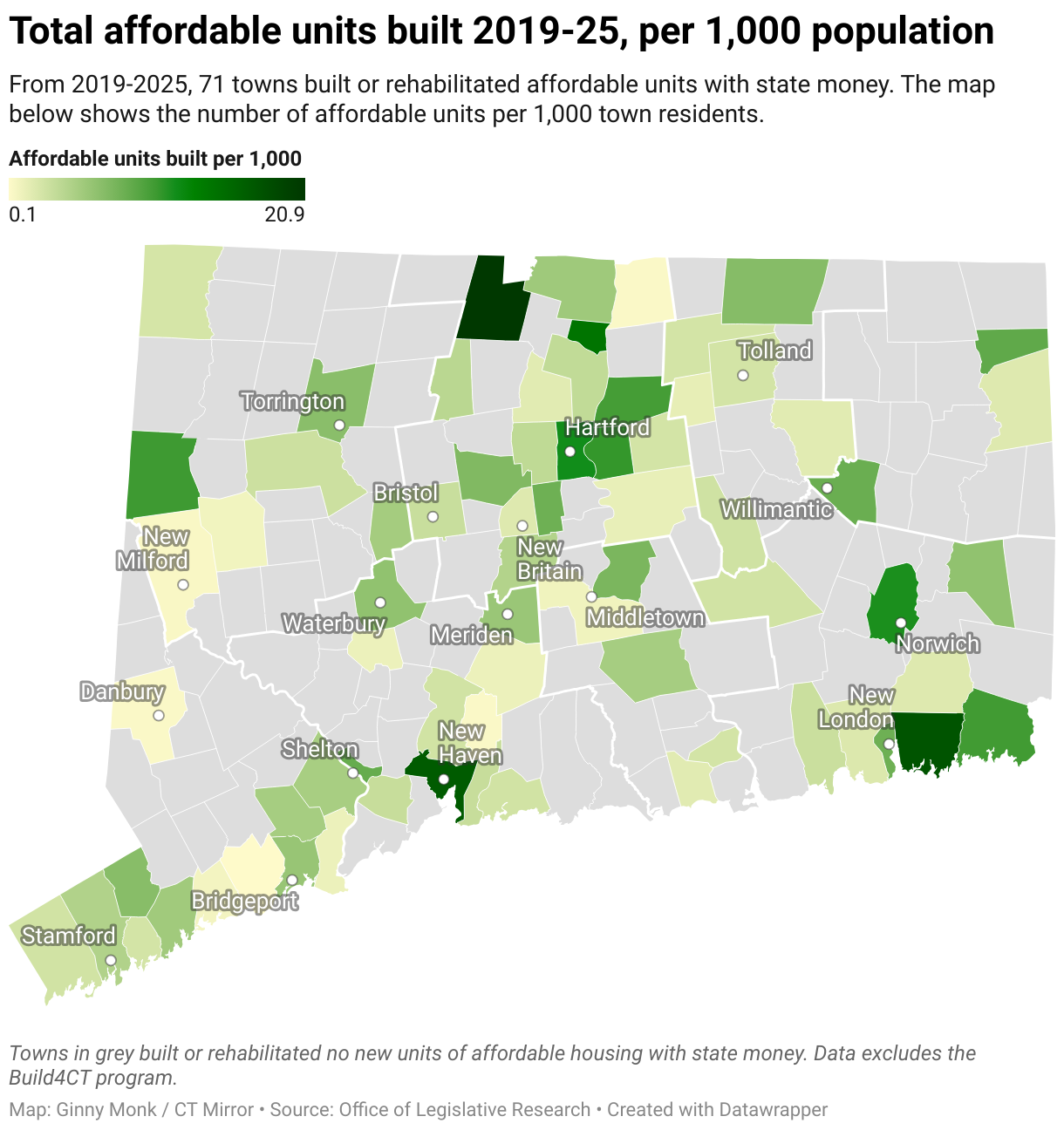
Experts say that the data calls into question whether towns are really making progress without state intervention.
“What would be interesting [would be] an analysis of which towns have rezoned for how many units,” said Melissa Kaplan-Macey, chief initiative officer at the Housing Collective. “There’s a lot of conversation about intent, but I think really getting to action is where the rubber meets the road.”
Kaplan-Macey said for many towns, restrictive zoning makes it hard to build apartments. Experts have long pointed to zoning as a key reason for the lack of housing in Connecticut, but many town officials maintain that local control is important for zoning.
Connecticut and New England have also seen “slower and more uneven” growth in housing than the nation over the past decade. Connecticut has seen a decrease in overall housing starts in six of the last eight fiscal years, the OLR report found.
Housing starts increased by about 54% in fiscal year 2023, but then shrunk by 28% in fiscal year 2024, according to the report.
“While housing starts have rebounded in recent years, growth in New England and Connecticut has been slower and more uneven than the nation overall over the last 10 fiscal years,” the report said.