



Monique Rainford has built a decades-long career as an obstetrician. But, for the last ten years, she’s been grappling with how the traditional health system she’s been a part of has failed to adequately serve Black mothers and babies.
Now she is redesigning maternal care delivery with the lofty goal of eliminating racial disparities. In June, Rainford and her business partner, Andrea Lee, opened Enrich Health, located in Hamden, where the model of care uses clinical strategies that are proven to improve outcomes for expectant mothers who are most at risk.
The United States has the highest rate of maternal deaths of any high-income nation, according to research published by the Commonwealth Fund, a private foundation that studies health policy. Black and Indigenous women bear the brunt of this underperformance.
Last year, Black people in the U.S. were more than three times as likely as their white counterparts to die from pregnancy-related causes, according to nonprofit research organization KFF. Their babies were also more likely to be born prematurely or with low birthweight. The gaps persist even when controlling for factors like income and education, “pointing to the roles racism and discrimination play in driving disparities,” researchers wrote.
“The traditional system was not designed for hundreds of thousands of women in America,” Rainford said. “That is part of why disparities are not going away.”
A 2019 study of nearly 7,000 pregnancy-related deaths from the U.S. Centers for Disease Control and Prevention found that a Black woman with a college degree was more likely to experience a fatal pregnancy than a white woman without a high school diploma. A working paper from the National Bureau of Economic Research found that the wealthiest Black mothers die of pregnancy-related causes at more than twice the rate of the poorest white mothers.
A group-based approach
For Rainford, addressing the problem requires completely reimagining the current system from the ground up.
Her clinic’s model of care incorporates methods proven to drive improvement in the areas where Black women experience worse outcomes. The physicians will monitor specific metrics for their patients, including birth weight, NICU admissions and c-section rates, and then compare them to state averages.
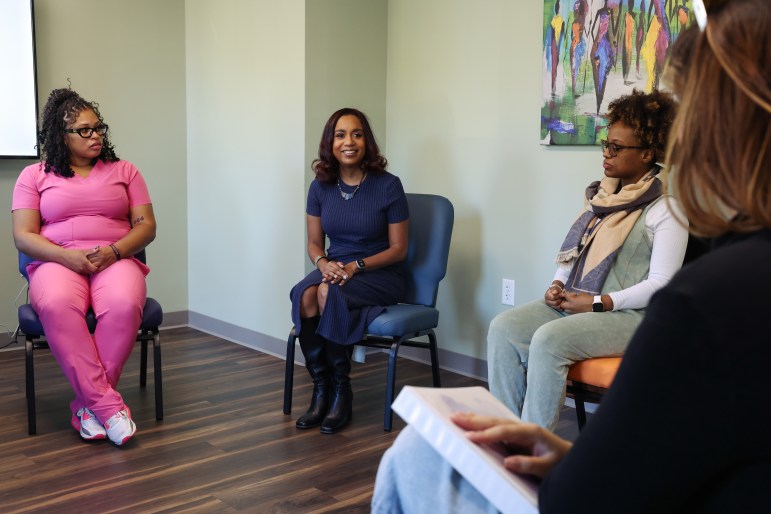
Instead of typical prenatal appointments where patients and providers meet one-on-one for a few minutes, patients at Enrich attend group appointments, which Rainford refers to as “motherhood circles.”
A 2022 study of 2,400 pregnant women published by the Yale School of Public Health found that group prenatal care dramatically decreased the risks of preterm birth, low birth weight and NICU admissions.
The motherhood circles last roughly an hour and a half, and Rainford meets with all the expectant mothers at once. Doulas and other clinicians also participate, and some appointments include visits from community partners or specialists who offer expertise on topics like fitness, nutrition and lactation. During the session, Rainford conducts quick private check-ins, where she performs a routine obstetric exam and listens to any individual concerns, but otherwise, the entire appointment occurs with the full group.
“They’re able to sit with a clinician, doulas, and each other — to have time for extensive interaction, community support, engagement, and facilitation. You just can’t do that in 15 or 20 minutes,” Rainford said.
The clinic also accepts patients who want care under the traditional model of one-on-one appointments.
Each patient at Enrich also gets paired with a doula. Research shows that doulas improve outcomes for both the mother and child — reducing rates of C-sections, premature births, and long labors, as well as lowering anxiety and stress.
[RELATED: Hartford doula training targets gaps in care for Spanish speakers]
While Enrich Health is designed to address challenges faced by Black women, patients of any race who feel underserved by the current system are welcome, Rainford said.
“We’re here because traditional care has not worked, and we don’t believe it will ever work to correct the problem,” Rainford said. “The whole goal of this is to use the best evidence from the literature to achieve the outcomes we want.”
How state policy helped open the door
Like many states around the country, Connecticut has tried to address racial equity in maternal care through policy.
This year, the state Department of Social Services launched a value-based payment model for Medicaid enrollees seeking maternity care. The initiative, known as the “maternity bundle,” contributed to Rainford’s decision to start Enrich Health in Connecticut.
“We decided to develop this innovative way of paying providers for value to address those racial and ethnic disparities in maternal and birth outcomes,” Fatmata Williams, deputy Medicaid director at DSS and one of the program’s designers, said. It’s also designed to improve outcomes for other groups, as well, like people with substance use disorders, Williams added.
Instead of compensating physicians solely based on the number of services they provide, the maternity bundle compensates them at a flat rate per patient, but also offers them the opportunity to get rewarded for reporting and improving outcomes across ten quality measures.
Providers get paid for reporting measures like doula utilization, breastfeeding and preterm births. They also receive compensation for performance on metrics including maternal adverse events and low birth weight.
The model does not penalize providers who don’t meet the marks, Williams said. “This is all upside only,” she said. “If [providers] do well in the quality measures, they get some money for that.”
The state’s approach appealed to Rainford because her clinic’s model was designed to improve many of the outcomes tracked for the maternity bundle.
“That is directly aligned with our revenue model,” Rainford said. “What the state was doing is part of why we even started in Connecticut.”
Enrich Health is still in its early days, but Rainford and Lee, her co-founder, have ambitious plans for the clinic’s expansion and they believe the concept could reshape maternal care nationally. They imagine a future where Enrich Health offers motherhood circles around the country.
“That is our vision,” Rainford said. “To transform health care delivery, first by eliminating health disparities and then giving moms a new option of care.”